The Japanese Yen gets its ambush, and the Bank of Japan gets overnight to justify it
- USD/JPY trades just above 159.50 after a 2.31% collapse, the sharpest single-session Dollar decline against the Yen since 2022.
- Tokyo has confirmed nothing, which is the design: no jawboning, no rate checks, just size arriving without warning at 13:30 GMT.
- Tokyo inflation accelerated to 1.9% on the measure the Bank watches most closely, hours after the operation and hours before the decision that has to justify it.

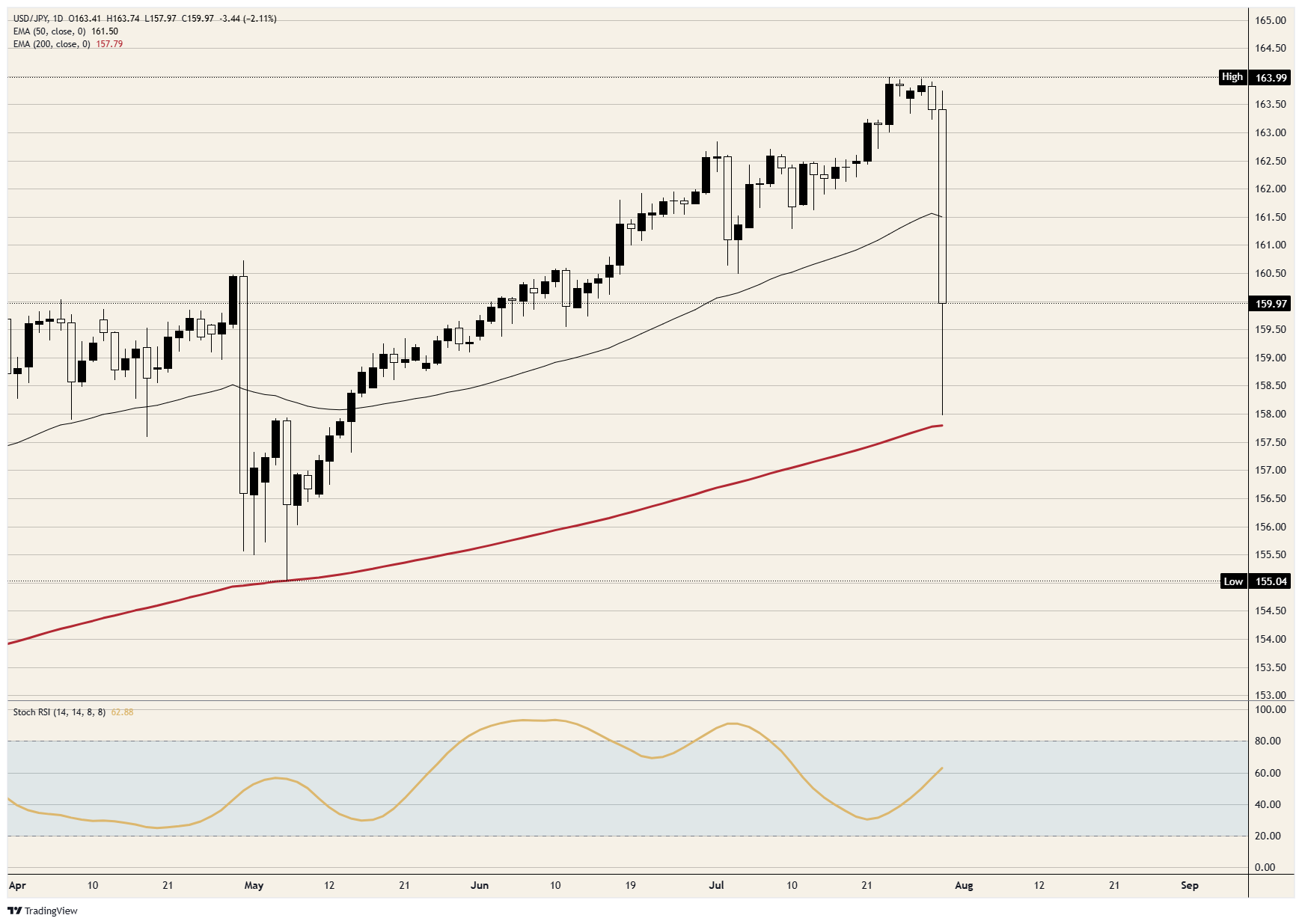
USD/JPY trades just above 159.50, down 2.31% and more than five Yen below a high set just short of 164.00. The move arrived in minutes rather than hours, went through the 50-day Exponential Moving Average (EMA) near 161.50 without pausing, and stopped within 20 pips of the 200-day EMA just below 158.00. Nothing on the calendar accounts for a move of that size.
Ten minutes, five Yen
The collapse began at 13:30 GMT and was substantially over before most desks had read the tape. One trading desk recorded roughly 8.1 billion Dollars of selling in the pair across core venues in the ten minutes that followed, with volumes across the complex running far above normal. The Ministry of Finance division that directs intervention was unreachable for comment, and the government has said nothing since.
American data at 12:30 GMT had already softened the Dollar, with advance second-quarter Gross Domestic Product (GDP) growth of 1.5% against a 2.1% consensus and core Personal Consumption Expenditures (PCE) inflation at 0.1% MoM. Soft data moves this pair in tens of pips, not hundreds. The Yen took more than 2% out of the Euro and the Pound and close to 2% out of the Australian Dollar in the same window, which is the signature of one buyer rather than a repricing.
The playbook changed before the operation did
Earlier Japanese operations were preceded by weeks of escalating verbal warnings, rate checks and calibrated hints, all of which gave speculative positions time to trim. This one carried none of that. The approach now is to say nothing and then arrive at size, with the stated aim of wiping out speculative Yen shorts rather than politely discouraging them, and Thursday is the first full demonstration of what that looks like.
The timing was not accidental either. The operation landed the day after a divided Federal Reserve, into a weak American growth print, with month-end flows already running and the Yen at four-decade lows. Tokyo bought the cheapest Dollars it was going to get, at the moment the largest number of leveraged positions sat on the wrong side of the trade.
Now the central bank has to agree
The Bank of Japan announces Friday and is expected to hold at 1.00% after June's increase. The Outlook Report is the substance, with the fiscal 2026 growth forecast expected to be revised up toward 0.8% from 0.5%, and a large majority of surveyed economists still looking for 1.25% by year end, with October the favoured timing for it.
The inflation data has now done part of that job for the committee. Tokyo prices for July, released hours after the operation, came in above expectations on every measure the Bank tracks, which makes it considerably harder to describe the currency's weakness as a passing energy effect. The argument for bringing the next increase forward is stronger on Friday morning than it was on Thursday afternoon.
Tokyo committed roughly 70 billion Dollars to supporting the currency across April and May, and the Yen still reached four-decade lows two months later, which is a fair measure of what an operation buys without a rate move behind it. Intervention without a policy follow-through gets absorbed, and the arithmetic explains why. The gap between the American target range and the Japanese policy rate is roughly 260 basis points, which is the yield the carry trade rebuilds on within days of any operation. A press conference that treats the currency as central to the inflation outlook keeps Thursday's work intact. One that frames the energy shock as temporary and declines to bring the next increase forward hands the positions Tokyo just liquidated back at better levels.
What lands next
The July Tokyo inflation report landed at 23:30 GMT and ran hot across the board. The reading excluding fresh food rose to 1.9% YoY against a 1.7% consensus and 1.6% previously, headline reached 2.0% from 1.7%, and the measure excluding food and energy also printed 2.0%. The June unemployment rate held at 2.5%. The decision follows overnight with the press conference at 06:30 GMT, and Chinese official surveys at 01:30 GMT carry a consensus of exactly 50.0 on both readings.
Next week brings labour cash earnings on Tuesday against a 3.2% previous, the wage measure policymakers have repeatedly named as their test, and the June meeting minutes the same day. The American calendar delivers its manufacturing survey Monday, private payrolls Wednesday, and Nonfarm Payrolls Friday against a 57K previous, with a September Federal Reserve hike priced at 63%. Every one of those is an opportunity to widen the gap Tokyo has just spent reserves narrowing.
Levels and bias
Resistance: First at 160.00, the handle the operation was defending. Above it, the 50-day EMA near 161.50 decides whether Thursday was a correction or a turn, with 163.50 the reference beyond that.
Support: 158.00 covers both the session low and the 200-day EMA, which halted the first wave almost exactly. A daily close below there opens 156.50 and puts the operation firmly in profit.
Bias: Bearish while 161.50 caps. Fading an active operation into a central bank meeting is a poor trade whatever the carry arithmetic says, Tokyo has historically worked in multi-day bursts rather than single strikes, and Thursday night's inflation figures make a validating press conference more likely than it looked when the operation began. A Friday that declines to validate the currency anyway is the trigger that hands the pair back to the funding trade.
USD/JPY daily chart
Inflation FAQs
Inflation measures the rise in the price of a representative basket of goods and services. Headline inflation is usually expressed as a percentage change on a month-on-month (MoM) and year-on-year (YoY) basis. Core inflation excludes more volatile elements such as food and fuel which can fluctuate because of geopolitical and seasonal factors. Core inflation is the figure economists focus on and is the level targeted by central banks, which are mandated to keep inflation at a manageable level, usually around 2%.
The Consumer Price Index (CPI) measures the change in prices of a basket of goods and services over a period of time. It is usually expressed as a percentage change on a month-on-month (MoM) and year-on-year (YoY) basis. Core CPI is the figure targeted by central banks as it excludes volatile food and fuel inputs. When Core CPI rises above 2% it usually results in higher interest rates and vice versa when it falls below 2%. Since higher interest rates are positive for a currency, higher inflation usually results in a stronger currency. The opposite is true when inflation falls.
Although it may seem counter-intuitive, high inflation in a country pushes up the value of its currency and vice versa for lower inflation. This is because the central bank will normally raise interest rates to combat the higher inflation, which attract more global capital inflows from investors looking for a lucrative place to park their money.
Formerly, Gold was the asset investors turned to in times of high inflation because it preserved its value, and whilst investors will often still buy Gold for its safe-haven properties in times of extreme market turmoil, this is not the case most of the time. This is because when inflation is high, central banks will put up interest rates to combat it. Higher interest rates are negative for Gold because they increase the opportunity-cost of holding Gold vis-a-vis an interest-bearing asset or placing the money in a cash deposit account. On the flipside, lower inflation tends to be positive for Gold as it brings interest rates down, making the bright metal a more viable investment alternative.
Author

Joshua Gibson
FXStreet
Joshua joins the FXStreet team as an Economics and Finance double major from Vancouver Island University with twelve years' experience as an independent trader focusing on technical analysis.

















