The French economy under pressure: What impact on the Euro?

For several months now, France's economy has been at the center of attention in Europe. As the Eurozone attempts to regain a stable trajectory after the successive shocks of the pandemic and the war in Ukraine, the fragility of French public finances and political instability threaten to weigh heavily on confidence in the Euro (EUR).
A weakened economy and a worrying debt burden
At the end of the first quarter of 2025, according to government figures, France had a public debt close to 114% of Gross Domestic Product, a level that places it among the most indebted countries in the European Union, just behind Greece and Italy.
The cost of this French debt has become overwhelming. By 2025, the State will be spending over 66 billion Euros on debt servicing alone, more than on education or defense.
This dynamic has alarmed the financial markets, widening the gap between ten-year French Bond yields and those of the German Bund, the Eurozone benchmark.
For investors, France is now perceived as an intermediate risk, less secure than Germany, but with a vulnerability profile comparable to that of traditionally more fragile countries.
This mistrust is helping to accentuate the volatility of the Euro, whose value depends to a large extent on the fiscal solidity of its main members.
The role of François Bayrou and political uncertainties
This economic fragility is further exacerbated by recurring political crises. French Prime Minister François Bayrou, who has been in office for less than a year, chose to put his government to a vote of confidence, deeming the budget situation a national emergency.
His plan calls for 44 billion euros in savings by 2026, including highly unpopular measures such as the abolition of public holidays.
But the government's relative majority, parliamentary deadlock and the resolute opposition of other political parties make this an extremely risky gamble.
Financial markets, already nervous, fear another government fall and a further weakening of France's credibility.
Political uncertainty is immediately reflected in the Bond market and, in turn, in the Euro.
The impact on the Euro and financial markets
The health of France's economy directly influences the future of the single currency. France is the Eurozone's second-largest economy, and an indispensable pillar of its stability.
Any sign of weakness, whether fiscal deterioration, political crisis, or weakening banks, is immediately reflected in the Euro exchange rate.
In recent weeks, the single currency has shown signs of fragility, particularly against the US Dollar (USD) and the Swiss Franc (CHF), as the yield differential between French Bonds and German sovereign Bonds has widened.
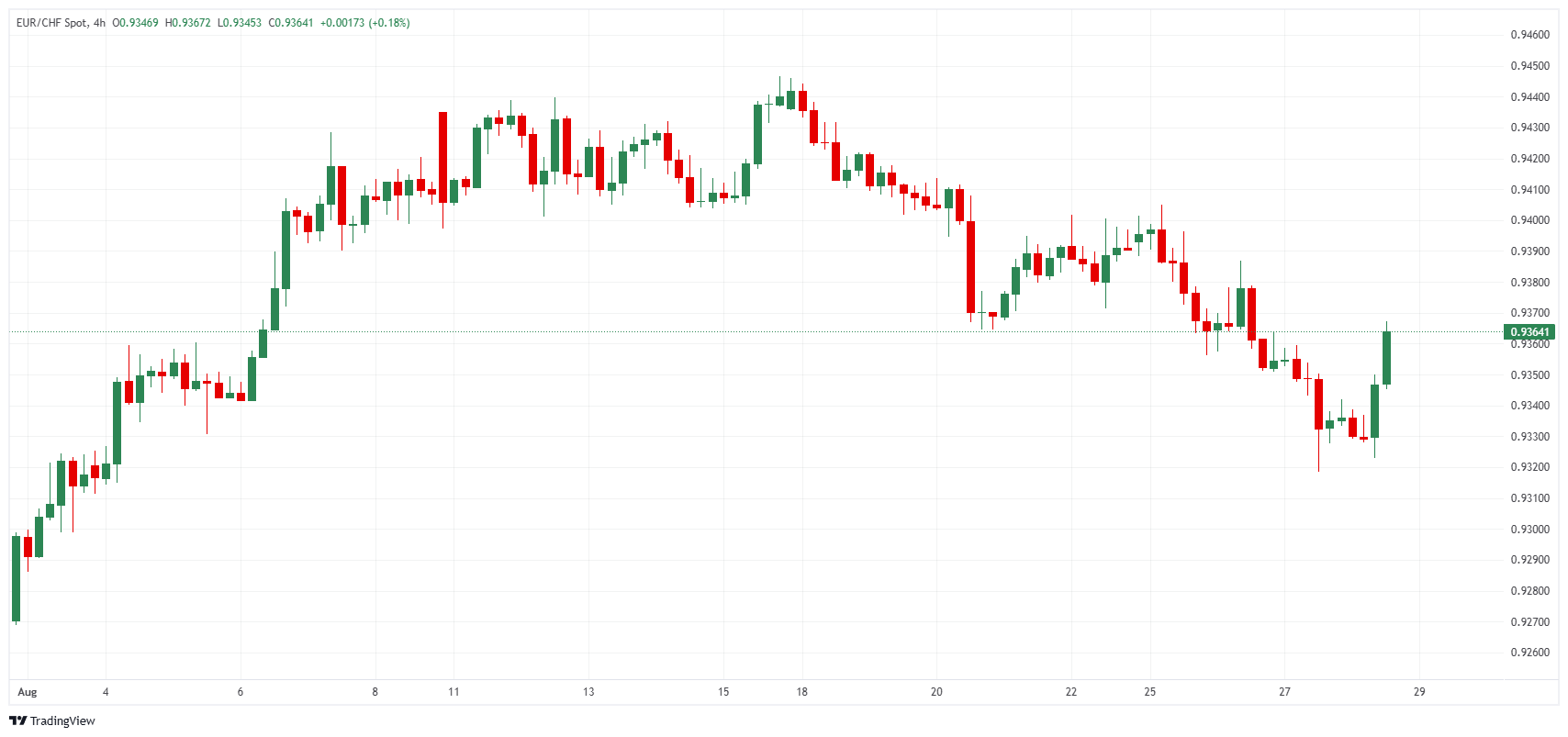
EURCHF 4-hour chart. Source: FXStreet
Investors fear a scenario in which Europe is forced to compensate for France's fragility, limiting the European Central Bank's (ECB) room for manoeuvre.
A European risk
The current crisis illustrates a fundamental truth. The Euro's stability depends not only on Germany, but also on France.
If France's economy tumbles into a spiral of political and budgetary instability, the credibility of the EUR is at stake.
Prime Minister François Bayrou's gamble, backed by French President Emmanuel Macron, is to convince the markets that France is still capable of fiscal discipline.
But with no political consensus and public opinion hostile to reform, confidence remains fragile.
For investors, the trajectory of French Bonds and French debt will, in the coming months, be the essential barometer not only of France but of the single currency itself.
Author

Ghiles Guezout
FXStreet
Ghiles Guezout is a Market Analyst with a strong background in stock market investments, trading, and cryptocurrencies. He combines fundamental and technical analysis skills to identify market opportunities.