The Australian Dollar stalls exactly where everybody said it would
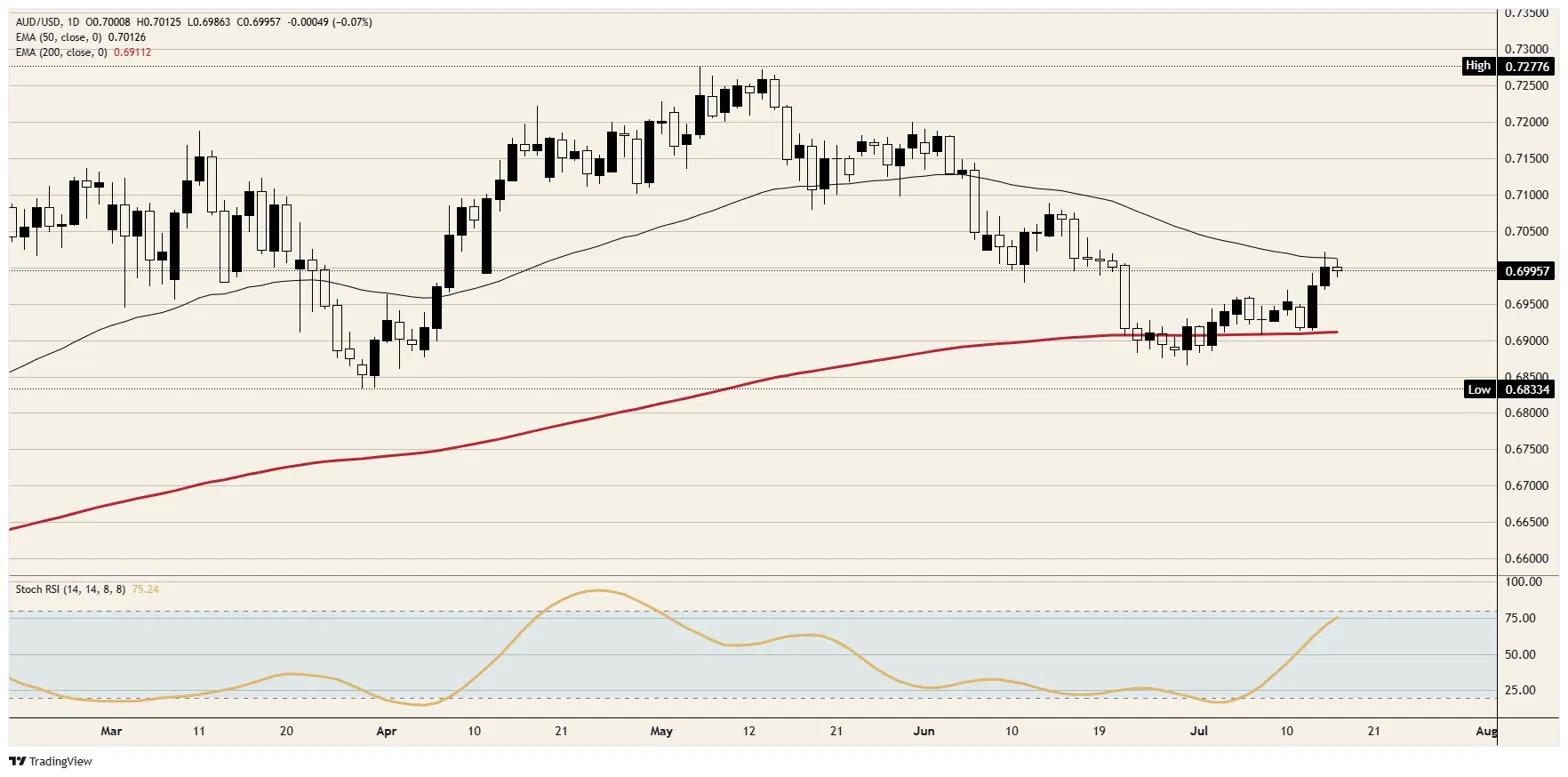
- AUD/USD idles at the 0.7000 handle, capped by the 50-day Exponential Moving Average hovering fractionally above the figure.
- Consumer inflation expectations cooled sharply to 4.7% from 5.5%, sanding down the case for an August Reserve Bank of Australia hike.
- Monday's People's Bank of China decision and the July 23 jobs report will decide whether the round number breaks or holds.
The Australian Dollar is going nowhere with great precision, with AUD/USD flat on the session and pinned to the 0.7000 handle for a fourth consecutive day. The recovery off the 0.6900 area earlier this month has run directly into the 50-day Exponential Moving Average (EMA), which hovers just above the figure and has repelled every probe, while the daily Stochastic Relative Strength Index climbs through the mid-70s without price confirming any of the effort. Momentum, in other words, is being spent rather than banked.
The hike premium is evaporating
Thursday's only domestic input argued for patience. The monthly consumer inflation expectations survey dropped to 4.7% in July from 5.5% in June, a steep single-month cooling and precisely the kind of print that lets the Reserve Bank of Australia (RBA) sit on its hands. The central bank held the cash rate at 4.35% in June after three hikes this year, while keeping language alive about tightening further if the inflation picture demanded it.
The demand for another hike is getting harder to demonstrate. Headline inflation eased to 4.0% in May even as the trimmed mean accelerated to 3.6% on Middle East cost pass-through, leaving the June-quarter Consumer Price Index (CPI) report, due in late July, as the release that decides the August 11 meeting. Futures still lean toward the cash rate ending the year nearer 4.50%, but the major domestic forecasters have split into a hold camp and a one-more-hike camp, and Thursday's survey feeds the former.
The June minutes showed a board still worried that underlying pressures would build through the June quarter, with labour cost strains broad-based and sentiment weak even as activity cooled. That is a committee holding a hawkish pose over a softening economy, and every downside data surprise between now and August 11 widens the gap between the pose and the pricing.
Waiting on Beijing and the Dollar
External engines matter more than usual with the domestic story parked. The People's Bank of China (PBoC) sets policy Monday at 01:15 GMT with the benchmark rate at 3%, and any easing signal from Beijing travels straight into the Aussie as the market's preferred China proxy. The stimulus pulse and iron ore demand have done more for AUD/USD this year than anything said out of Martin Place, and a hold paired with dovish guidance Monday would help the Aussie more than another quiet week at home.
The Gulf war cuts in both directions for a commodity currency. Australia ships liquefied natural gas and coal into an energy market that reprices on every supply scare, a terms-of-trade tailwind that has quietly cushioned the Aussie through the escalation. The same conflict fattens the global growth discount and hands the US Dollar a safety bid on every ugly headline, and so far the second effect keeps winning on the chart.
The American side sharpened that problem on Thursday. US jobless claims fell to 208K while the Philadelphia Federal Reserve survey printed a scorching 41.4 against 13 expected, keeping rate futures alive to a hike as soon as the July 28-29 meeting. An RBA that pauses while the Federal Reserve tightens flattens the rate-differential story that carried this pair off 0.6900 in the first place.
July 23 decides the range
Thursday July 23 at 01:30 GMT delivers the June labour force report, the one domestic release with the weight to move August pricing. The prior month added 40.3K jobs with unemployment at 4.4%, but the composition skewed heavily part-time, 35.2K against 5.2K full-time, which is not the stuff of wage pressure. A hot, full-time-led print revives the hike trade and forces a genuine test of the 50-day EMA, while a soft one sends the pair back into the 0.6900s with momentum already exhausted.
The same evening brings preliminary July Purchasing Managers Index (PMI) surveys at 23:00 GMT, with manufacturing at 51.5 and services at 50.5 a month ago, both barely above water. Add Friday's Michigan sentiment print at 14:00 GMT and the US PMI round on July 24, and the Aussie faces a week in which every meaningful catalyst belongs to somebody else's economy.
Levels and bias
Resistance: The 0.7000 handle and the 50-day EMA just above it form the immediate cap, ahead of 0.7050 and the June congestion shelf near 0.7100.
Support: Initial demand sits near 0.6950, ahead of the 0.6900 handle where the 200-day EMA guards the July launch point, with the yearly low just below 0.6850 beyond.
Bias: Lower. Momentum has been spent pressing a cap that refuses to give, the jobs report carries asymmetric downside after last month's part-time-heavy composition, and only a daily close above 0.7050 turns this grind into a trend.
AUD/USD daily chart
Australian Dollar FAQs
One of the most significant factors for the Australian Dollar (AUD) is the level of interest rates set by the Reserve Bank of Australia (RBA). Because Australia is a resource-rich country another key driver is the price of its biggest export, Iron Ore. The health of the Chinese economy, its largest trading partner, is a factor, as well as inflation in Australia, its growth rate and Trade Balance. Market sentiment – whether investors are taking on more risky assets (risk-on) or seeking safe-havens (risk-off) – is also a factor, with risk-on positive for AUD.
The Reserve Bank of Australia (RBA) influences the Australian Dollar (AUD) by setting the level of interest rates that Australian banks can lend to each other. This influences the level of interest rates in the economy as a whole. The main goal of the RBA is to maintain a stable inflation rate of 2-3% by adjusting interest rates up or down. Relatively high interest rates compared to other major central banks support the AUD, and the opposite for relatively low. The RBA can also use quantitative easing and tightening to influence credit conditions, with the former AUD-negative and the latter AUD-positive.
China is Australia’s largest trading partner so the health of the Chinese economy is a major influence on the value of the Australian Dollar (AUD). When the Chinese economy is doing well it purchases more raw materials, goods and services from Australia, lifting demand for the AUD, and pushing up its value. The opposite is the case when the Chinese economy is not growing as fast as expected. Positive or negative surprises in Chinese growth data, therefore, often have a direct impact on the Australian Dollar and its pairs.
Iron Ore is Australia’s largest export, accounting for $118 billion a year according to data from 2021, with China as its primary destination. The price of Iron Ore, therefore, can be a driver of the Australian Dollar. Generally, if the price of Iron Ore rises, AUD also goes up, as aggregate demand for the currency increases. The opposite is the case if the price of Iron Ore falls. Higher Iron Ore prices also tend to result in a greater likelihood of a positive Trade Balance for Australia, which is also positive of the AUD.
The Trade Balance, which is the difference between what a country earns from its exports versus what it pays for its imports, is another factor that can influence the value of the Australian Dollar. If Australia produces highly sought after exports, then its currency will gain in value purely from the surplus demand created from foreign buyers seeking to purchase its exports versus what it spends to purchase imports. Therefore, a positive net Trade Balance strengthens the AUD, with the opposite effect if the Trade Balance is negative.
Author

Joshua Gibson
FXStreet
Joshua joins the FXStreet team as an Economics and Finance double major from Vancouver Island University with twelve years' experience as an independent trader focusing on technical analysis.