SpaceX IPO (SPCX): Why this could be the biggest trading story of 2026
When Alibaba went public in 2014, it rewrote the record books and dominated trading desks for months. When Saudi Aramco listed in 2019, it redefined what ‘big’ meant in equity markets. Both felt historic at the time. On June 12, 2026, SpaceX will make them both look like warm-up acts. This is not hype. This is not big. This is MEGA. And the numbers are no longer debatable.
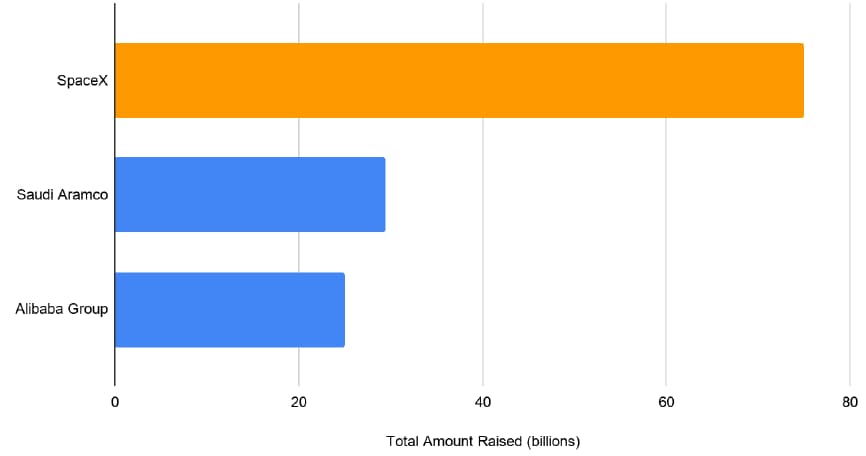
Size creates attention. SpaceX is targeting a raise of approximately $75 billion at a fixed IPO price of $135 per share, implying a valuation of up to $1.75 trillion. The previous record was Saudi Aramco's $29.4 billion raise in 2019; SpaceX is raising more than twice that in a single offering. But here is where it gets truly staggering: the IPO has reportedly attracted over $150 billion in investor demand, doubling the $75 billion it is actually seeking to raise. That level of oversubscription doesn't just signal enthusiasm. It signals a feeding frenzy.
That alone would make the SpaceX IPO a historic capital markets event. But for traders, the story is bigger than size. SpaceX combines a rare mix of record-breaking fundraising, intense retail participation, limited tradable float, index-inclusion potential, governance debate and a business model that cuts across space, broadband, defence and artificial intelligence.
This is not simply another large IPO. It is a deal large enough to reach institutional investors, retail brokers, passive funds, index committees and momentum traders at the same time.
One ticker – Three radically different businesses
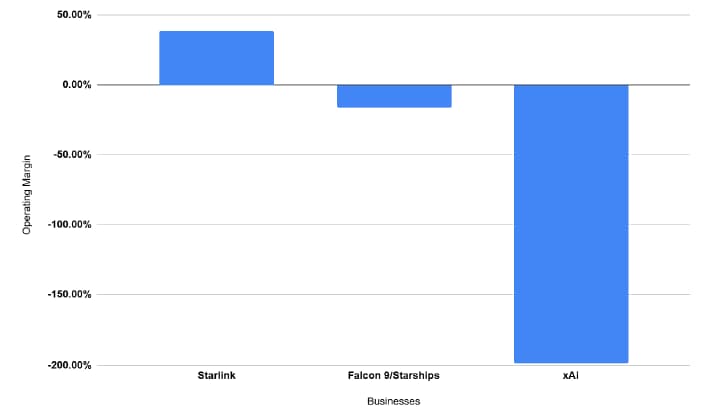
Most IPOs are a single business in a box. SpaceX is three fundamentally different companies wearing the same jersey, and that complexity is where the trading opportunity lives. Three segments. Three completely different valuation frameworks. Three completely different risk profiles. That structural complexity alone guarantees months, possibly years of analyst disagreement, and disagreement is what creates volume.
Starlink – The satellite internet arm generated over $11 billion in revenue in 2025 with over 30% operating margin. Subscriber count hit 10.3 million in 1Q2026, up 105% YoY. This is not a startup metric dressed up in a pitch deck. This is a high-margin infrastructure business growing like it's still pre-revenue.
Falcon 9 / Starship – Arguably the most reliable and cost-efficient orbital rocket in history. SpaceX holds a near-monopoly in commercial heavy-lift. No competitor has meaningfully closed the gap. The moat is deep, the backlog is full, and the pricing power is real. The wildcard that either justifies everything or breaks everything. The most powerful rocket ever constructed, still burning through $3+ billion in annual R&D without a single dollar of commercial payload revenue to show for it yet. Potentially civilization-defining. Currently a cash furnace.
xAI / AI Integration – The wildcard that wasn't even part of SpaceX six months ago. The February 2026 all-stock merger folded Musk's private AI company into SpaceX at a $1.25 trillion combined valuation, adding an entirely new dimension of business complexity and controversy to an already difficult-to-value company.
The retail wildcard – Tesla on steroids
A retail-heavy allocation combined with massive media attention creates the conditions for elevated volatility post-listing, the kind that traders and momentum players actively seek.
Unlike any IPO before it, 30% of SpaceX’s IPO is earmarked for retail traders. That's roughly three times the industry standard, where retail investors typically receive around 10% of shares. This is a deliberate strategy, mirroring Tesla's playbook of cultivating a passionate, mission-driven retail shareholder base. The implication for price action is significant.
The controversy that's already trending
Before a single share changes hands, the SpaceX IPO has already generated enough controversy to keep financial journalists busy for a year. And controversy, for traders, is fuel.
Elon Musk will retain over 80% of voting control post-IPO despite owning more than 40% of the equity. His Class B shares carry 10 votes each. He simultaneously holds the titles of CEO, CTO, and Board Chairman, and crucially, he can only be removed from these roles with his own consent.
Critics are already labelling the xAI merger, which folded Musk's private AI company into SpaceX for $1.25 trillion in an all-stock deal, as potential self-dealing. This is not a minor footnote. This is the kind of controversy that keeps a stock in the headlines for quarters or even longer than we can expect.
Why this is a trader's IPO, not just an investor's IPO
Most IPOs are investor events. Institutions take their allocations, retail gets the scraps, and the stock grinds quietly toward its first earnings report. SpaceX is a fundamentally different IPO.
The combination of record-breaking size, $150 billion in demand, a 30% retail allocation, governance warfare, three structurally complex business segments, and a founder who is simultaneously the world's most polarising CEO creates all the conditions for sustained, high-velocity price discovery. There is no comparable precedent, and disagreement is where volume, volatility, and opportunity usually begin.
Whether you're building a long position, hunting for a short setup, or simply positioning for the volatility itself, SpaceX will be the defining trading story of 2026.
The question is not whether SpaceX will move violently. It will. The only question is whether you're ready when it does.
Author

Eric Chia
Exness
MSc in Global Financial Trading BSc in Finance & Economics – Joint program: Taylor’s University + UWE Bristol Developed advanced knowledge in macroeconomics, portfolio management, and asset allocation