SpaceX IPO launches today: What you need to know

Yesterday’s rebound was driven largely by Trump’s comments that a peace deal with Iran could be finalised by the weekend. But as the market heads into today’s session, the key story now shifts firmly to the SpaceX IPO.
SpaceX has successfully raised $75 billion through its IPO, making it one of the largest equity offerings in market history. However, this comes with several important stipulations:
1. Retail access has widened significantly.
For this deal, Fidelity reportedly lowered its IPO entry requirement from as high as $500,000 in account balance to just $2,000, opening the door to far broader retail participation.
2. Access is being channelled through selected brokerage platforms.
Retail investors are expected to gain access through brokers such as Fidelity, Robinhood, SoFi, E*Trade, and Charles Schwab, while the IPO itself is being led by major Wall Street bookrunners.
3. The geopolitical tailwind remains fragile.
Trump’s peace statements helped fuel yesterday’s recovery, but that support could easily weaken if Iran continues to reject the idea that a final deal has actually been reached.
Iran’s Foreign Ministry has said no final decision has been made, while Iranian media has also pushed back against claims that a memorandum of understanding has already been finalised.
4. The timing of the peace headline adds another layer of market risk.
Trump’s comments helped markets recover just as attention turns toward the SpaceX IPO.
Markets have already shown that they are willing to rally on de-escalation headlines, but those moves can fade quickly when the actual agreement remains incomplete. With Iran still refusing to confirm that a final deal has been reached, traders should treat the peace narrative as a temporary tailwind rather than a confirmed macro reset.
5. The need for retail capital is being questioned.
SpaceX, OpenAI, and Anthropic are all part of a wider mega-cap IPO wave, even though private markets have still shown a willingness to fund large AI and infrastructure deals.
That raises a fair question: If private capital is still available, why bring retail into the deal now?
Put simply, are retail traders being given access to a historic IPO opportunity, or are they being invited in at the point of maximum hype, just as early investors gain a much larger liquidity window to potentially sell into?
Now the key question on everyone’s mind is not just how SpaceX will trade once listed, but how the market will position for it before the first print even hits the Nasdaq.
SpaceX IPO timing: Not necessarily at the opening bell
SpaceX priced its IPO on Thursday, June 11, and is expected to begin trading on Friday, June 12 under the ticker SPCX.
Nasdaq’s regular session opens at 9:30 a.m. ET. However, major IPOs do not always begin trading exactly at the opening bell.
Because of the size and complexity of the SpaceX IPO, the first trade may only take place later in the session once buy and sell orders have been matched.
That makes the first few hours of the US session important.
Before SPCX even prints, traders will already be watching how the rest of the market positions around it.
If mega-cap technology weakens before SPCX begins trading, it may suggest that investors are raising cash or adjusting exposure ahead of the listing.
If the broader market holds firm, then the IPO may be absorbed more smoothly than expected.
SPX daily: The bounce was technically valid
The first chart to focus on is SPX on the daily timeframe.
After a nine-week rally, SPX stalled near the 7,600 region before pulling back into the daily 50 EMA. On our chart, this is represented by the 50 EMA band set to one standard deviation.
This retest was also supported by the daily Stoch RSI moving into oversold territory.
SPX pulled into a major trend support area while momentum was already stretched to the downside. From a technical perspective, buyers had a valid reason to defend that zone.
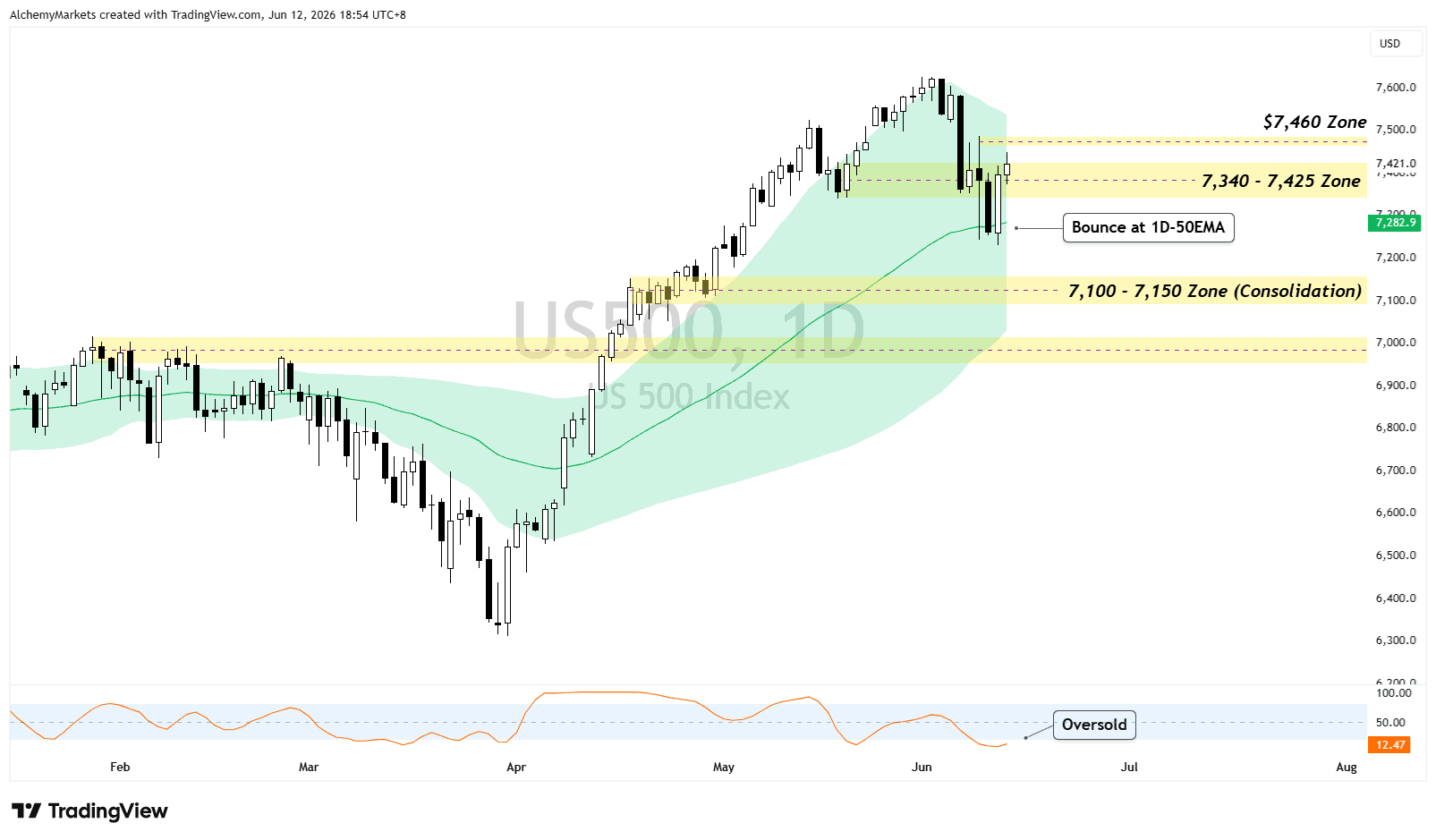
Jumping over to the CFD chart of the S&P 500, US500, which can trade before and after normal market hours, the market seems to be pricing in a push higher rather than lower, at least for now.
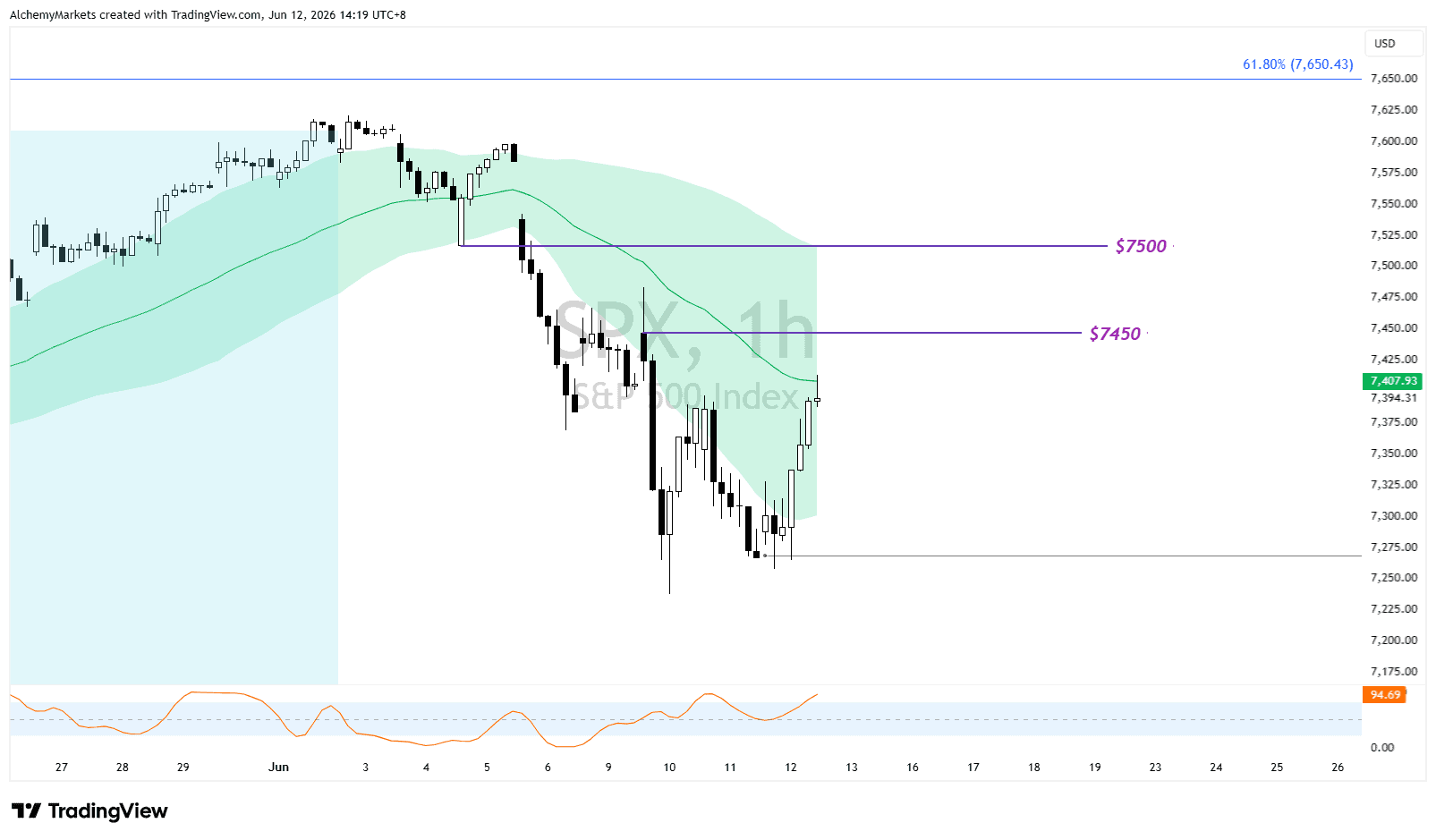
However, the actual SPX price chart still sits below the 1H 50 EMA and another previous high near the 7,450 region.
The 7,500 region should also be another level to watch, as it coincides with the edge of the band, which has previously acted as a useful support and resistance area.
Bottom line: If SPX pushes into these higher levels and rejects, it could support the idea that investors are using the rebound to rotate capital elsewhere, including into SpaceX.
RSP four-hour: Breadth is holding, but now testing resistance
The next chart to watch is RSP, the equal-weight S&P 500 ETF.
This is important because SPX can sometimes look strong simply because a few large-cap names are holding up the index. RSP gives us a cleaner read on whether the average S&P 500 stock is also participating in the rebound.
Right now, RSP is showing that breadth has not broken.
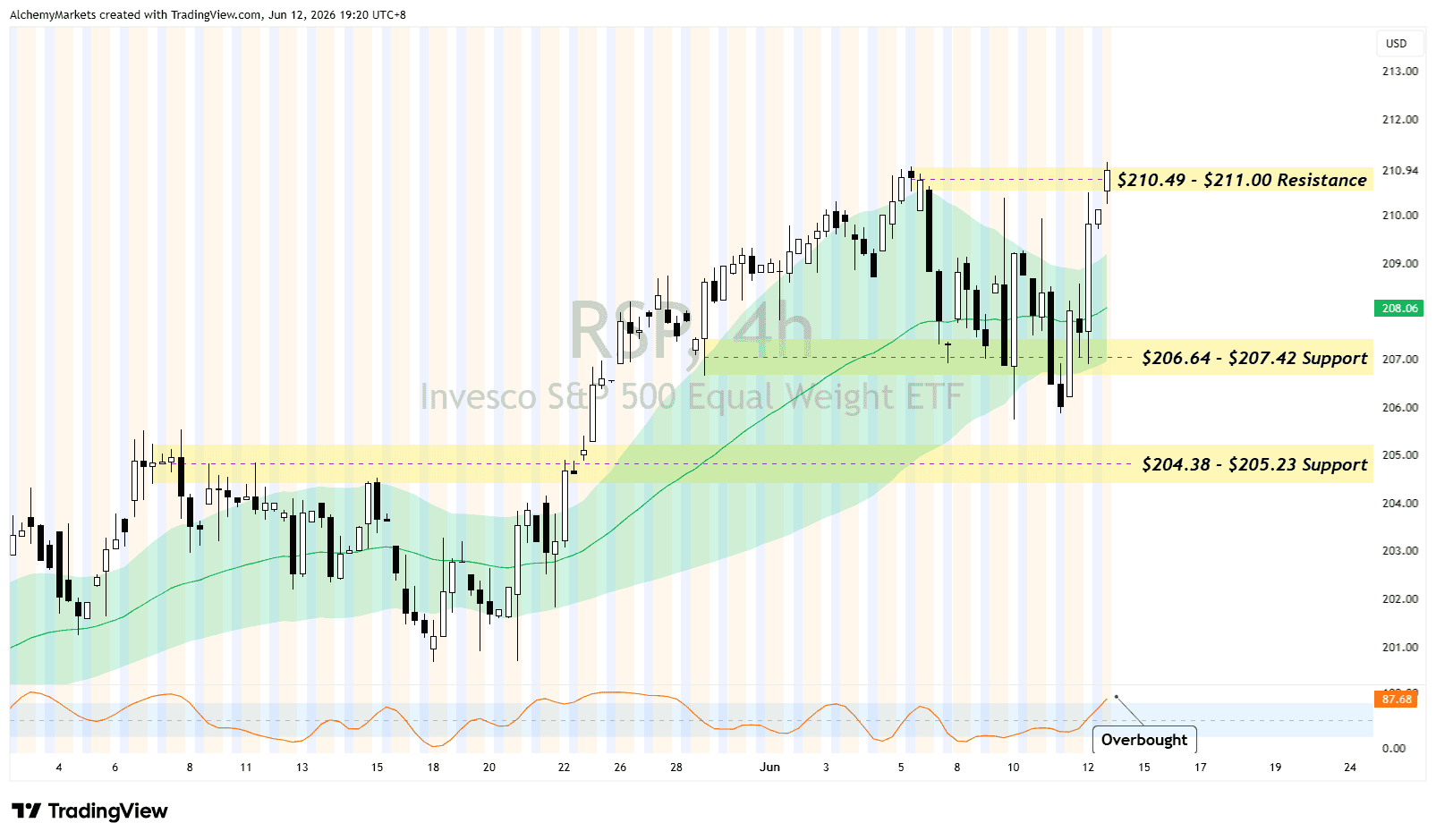
Price has rebounded from the $206.64–$207.42 support zone and is now testing the $210.49–$211.00 resistance area. This tells us that the broader market is still trying to participate in the recovery.
However, the move is also becoming stretched. The 4H Stoch RSI is already moving into overbought territory, which means buyers now need to prove that this is more than just a short-term relief bounce.
If RSP breaks above the $211 region and holds, it would support the bullish case and suggest that the SPX rebound is being confirmed by broader market participation.
But if RSP rejects from this resistance zone while SPX and NDX also struggle near their own resistance levels, it would suggest that the bounce is starting to lose breadth.
Bottom line: RSP is not confirming a bearish rotation yet. Breadth is still holding. But the ETF is now testing resistance, so today’s session will decide whether the broader market confirms the bounce or stalls with SPX.
MAGS one-day and one-hour: The main rotation chart
MAGS is the cleanest chart to watch for mega-cap rotation.
On the daily timeframe, MAGS has already broken down from its double-top neckline near the $68 region and pulled back into the $65 zone. This matters because the Magnificent Seven names have been a major driver of broader market strength.
If this basket is weakening while SpaceX attracts capital, it strengthens the idea that investors may be rotating out of existing mega-cap winners to make room for SPCX exposure. However, the daily chart alone does not confirm a fresh breakdown yet.
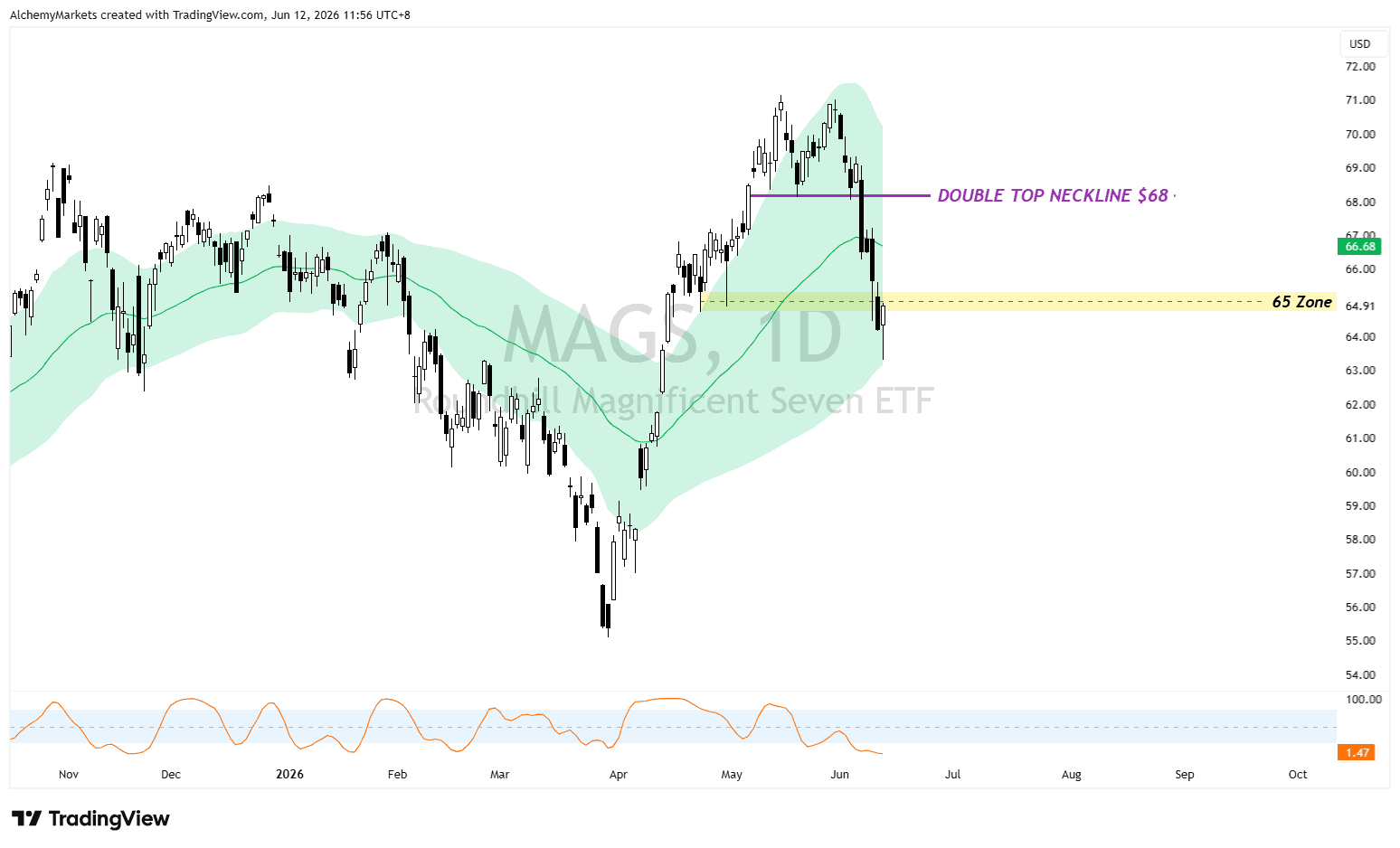
MAGS is now sitting near a major decision zone around $65 and the lower edge of the bands. Daily Stoch RSI is also deeply oversold, which means the basket is vulnerable to a short-term bounce even if the broader structure remains weak.
On the 1H timeframe, MAGS has already broken below the 50 EMA band, lost the $66.29 prior low, and pushed below the $65 zone before bouncing back into it. Price is now retesting the 50 EMA band from underneath, while 1H Stoch RSI is already overbought.
This creates a clear lower-timeframe test.
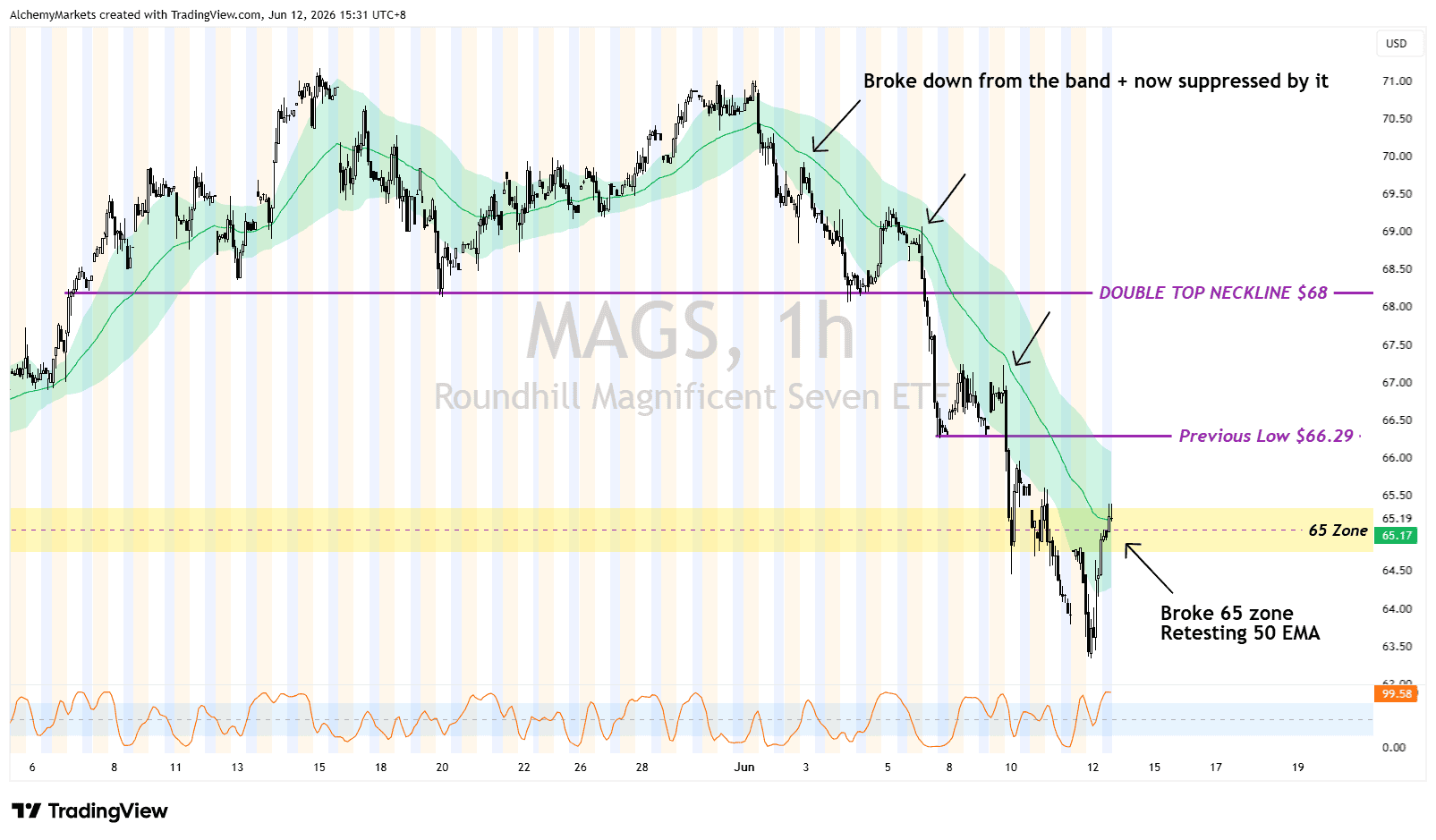
If MAGS rejects from the $65 region and fails to reclaim the 1H 50 EMA band, it would suggest that the bounce is only a relief move within a weaker structure.
But if MAGS reclaims $65 and holds above the 1H 50 EMA band, then the rotation-pressure argument weakens. That would suggest mega-cap leadership is stabilising rather than being sold aggressively ahead of the SpaceX listing.
Bottom line: MAGS is not confirming a clean recovery yet. The daily chart shows structural weakness, while the 1H chart shows a stretched bounce into resistance. If MAGS fails at $65 while SPCX attracts strong demand, the rotation story strengthens. If MAGS reclaims $65 and holds, the market may be absorbing the IPO better than feared.
NDX one-hour: Approaching resistance as index-flow expectations build
NDX matters because SpaceX is not just an IPO story. It may also become an index-flow story.
Under Nasdaq’s fast-entry framework, newly listed mega-cap companies can become eligible for Nasdaq-100 inclusion after roughly 15 trading days. Since SPCX is expected to begin trading on Friday, June 12, the earliest watch window would be around July 6 or July 7.
That does not mean SpaceX will automatically be added to the Nasdaq-100 by then, but it does mean traders may start positioning for possible index-related demand before any official inclusion happens.
This is where inventory becomes important… While Nasdaq itself does not need to buy SpaceX shares, ETFs and funds that track the Nasdaq-100 will need to build exposure to SpaceX while reducing weight elsewhere in the index.
These, by first glance, could be holdings of other large tech stocks such as Nvidia, Apple, Meta, Google, or Broadcom. That makes today’s Nasdaq reaction important.
On the 1H chart, NDX has bounced from the 28,600–28,810 support zone and is now approaching resistance near 29,600.
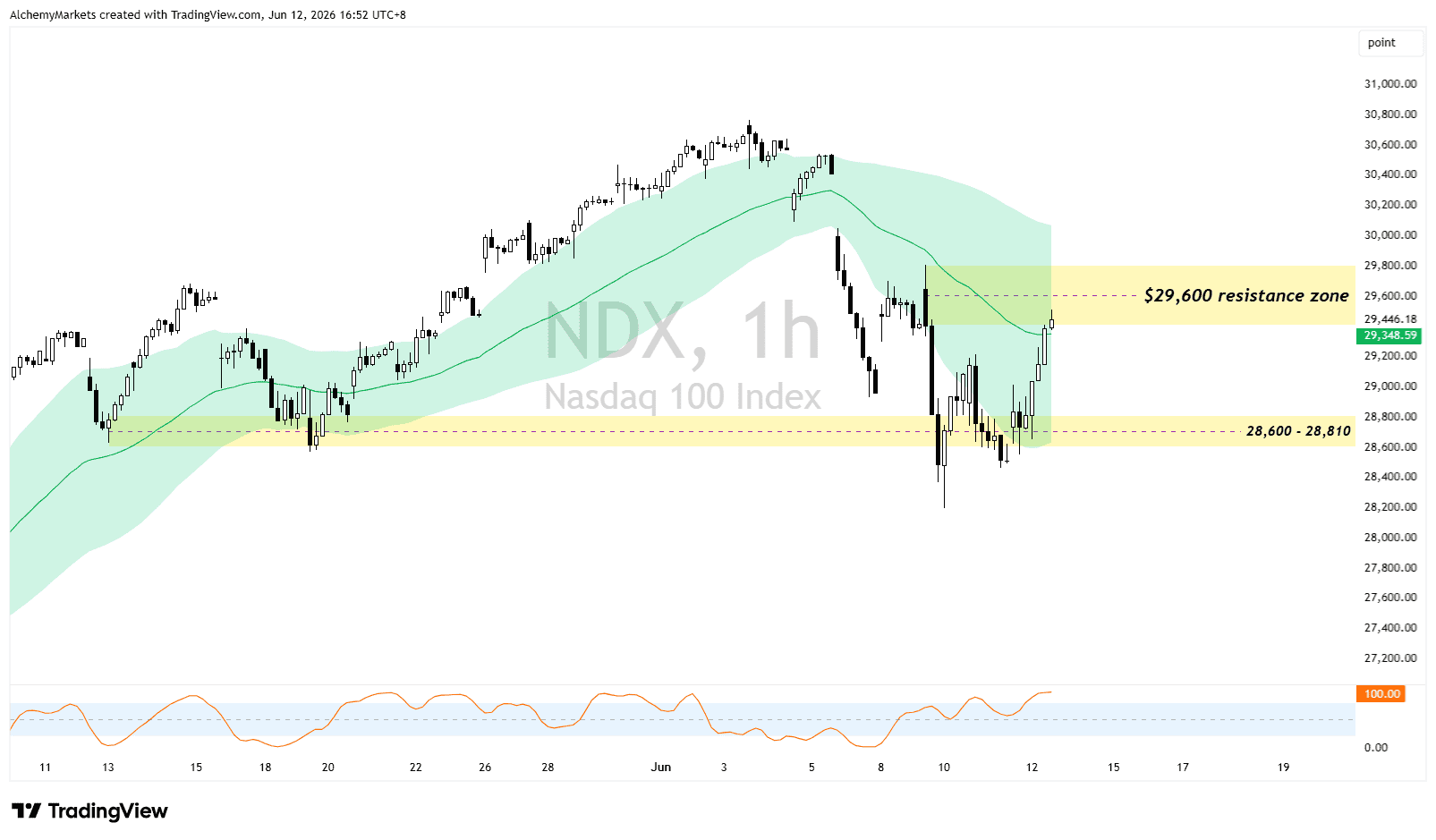
If NDX can reclaim 29,600, then Nasdaq buyers are showing strength despite the SpaceX IPO and possible future index-flow expectations.
But if NDX rejects from this area, the rebound may start to look more like a lower-high setup rather than a clean continuation move.
Stoch RSI is also already stretched, which means the rebound is no longer early. The market needs real acceptance above resistance, not just a fast relief move.
Bottom line: NDX reclaiming 29,600 would support the bullish case. Rejection from that zone would support the rotation thesis, especially if MAGS and RSP weaken at the same time.
Market reaction matrix: What to watch next
The SpaceX IPO is not automatically bullish or bearish for the broader market.
The real question is whether the market can absorb the listing without weakening breadth or mega-cap leadership.
Market Signal | Bullish Case | Bearish Case |
SPX | Holds the daily 50 EMA bounce and pushes through 7,450–7,500 | Rejects near 7,450–7,500 and turns lower |
RSP | Breaks above $211 and confirms broad participation | Rejects at $210.49–$211.00 and shows weakening breadth |
MAGS | Reclaims $65 and holds above the 1H 50 EMA band | Rejects near $65 and remains below the 1H 50 EMA band |
NDX | Reclaims 29,600 and confirms Nasdaq strength | Rejects near 29,600 and forms a lower-high setup |
SPCX | Trades strongly while SPX, RSP, MAGS, and NDX hold firm | Trades strongly while RSP, MAGS, and NDX weaken |
Bottom line: SPX, RSP, MAGS, and NDX are all testing important resistance areas as SpaceX begins trading. If they hold up, the market is absorbing the IPO well. If they reject while SPCX attracts heavy demand, rotation pressure becomes the main risk.
Author

Zorrays Junaid
Alchemy Markets
Zorrays Junaid has extensive combined experience in the financial markets as a portfolio manager and trading coach. More recently, he is an Analyst with Alchemy Markets, and has contributed to DailyFX and Elliott Wave Forecast in the past.