SpaceX beats in first earnings release, doubles Starlink customers
- SpaceX stock retracts despite big earnings beat.
- Revenue soars by 90% YoY as Connectivity business expands.
- SpaceX doubles Starlink customers to 12 million.
- AI division trims its quarterly losses to $1.26 billion.

SpaceX (SPCX) reported a beat in its first earnings release as a public company on Tuesday. The rocket, communications and AI company delivered GAAP earnings per share (EPS) of $-0.09 on revenue of $7.8 billion. The EPS figure beat estimates by between 7 to 20 cents, depending on which analyst you read, and revenue exploded by 90% YoY and beat the consensus by nearly $1 billion.
The share price, however, dipped over 6% to $117 following the 9.4% rally in Tuesday's regular session.
An impressive second quarter across all segments
Elon Musk's second trillion-dollar company reported extreme growth in its Connectivity segment, which uses Starlink satellites to transmit internet access to 12 million subscribers. That number doubled from the 6 million reported one year ago. The Connectivity business reported a 66% YoY spike in revenue and 79% growth in income from operations.
Making up the largest share of total company revenue, Connectivity's sales came in at $4.3 billion in the quarter. In addition, the Connectivity business reports $6 billion in multi-year US government contracts for its Starshield product.
The Space segment, from which it gets its name, saw revenues grow 55% sequentially and 29% YoY to $962 million. However, much of that revenue came from Starlink launches. Reuters reported earlier in the day that Starlink had accounted for 79% of Falcon 9 launches so far this year, up from 54% back in 2020. Reuters said competing satellite companies that use SpaceX's Falcon 9 have been told that launches are sold out until late 2028 or 2029.
Separately, the Space business has announced a partnership with Nvidia to design the compute aboard its upcoming Starmind AI1 satellites.
The AI business also impressed. AI division revenues climbed 247% YoY to $2.6 billion from $737 million in the quarter one year ago and $818 million in the first quarter of this year. SpaceX said the white-hot growth was "primarily driven by an increase in AI solutions and infrastructure revenues from new Cloud Service Agreements, as well as an increase in Grok and X subscription revenues."
The loss from operations in the AI segment also improved, rising from $-1.52 billion a year ago to $-1.26 billion.
SpaceX in charts
SpaceX shares initially surged to a high of $130.95 in the release, but the stock faltered rather quickly and trades near $117 at the time of writing.
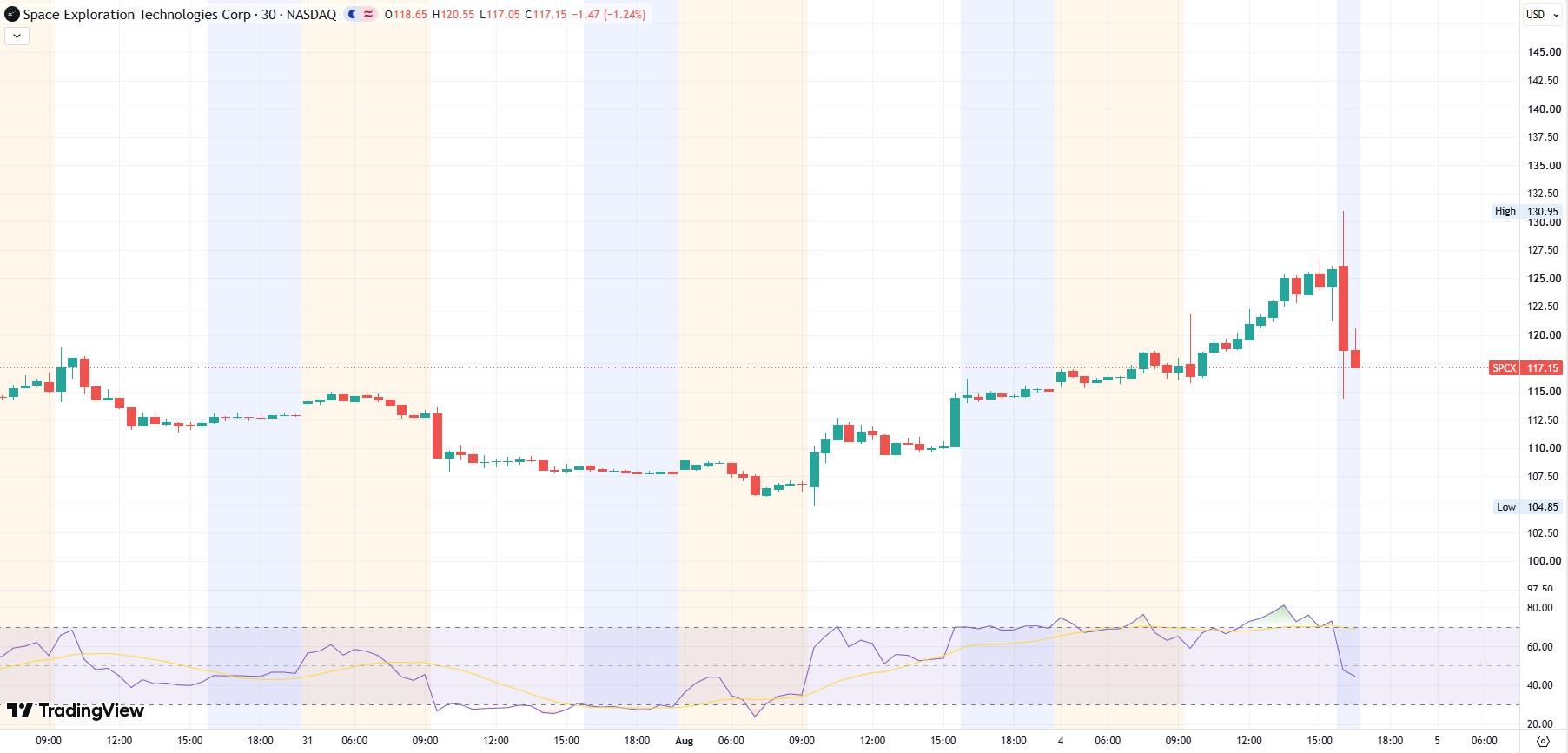
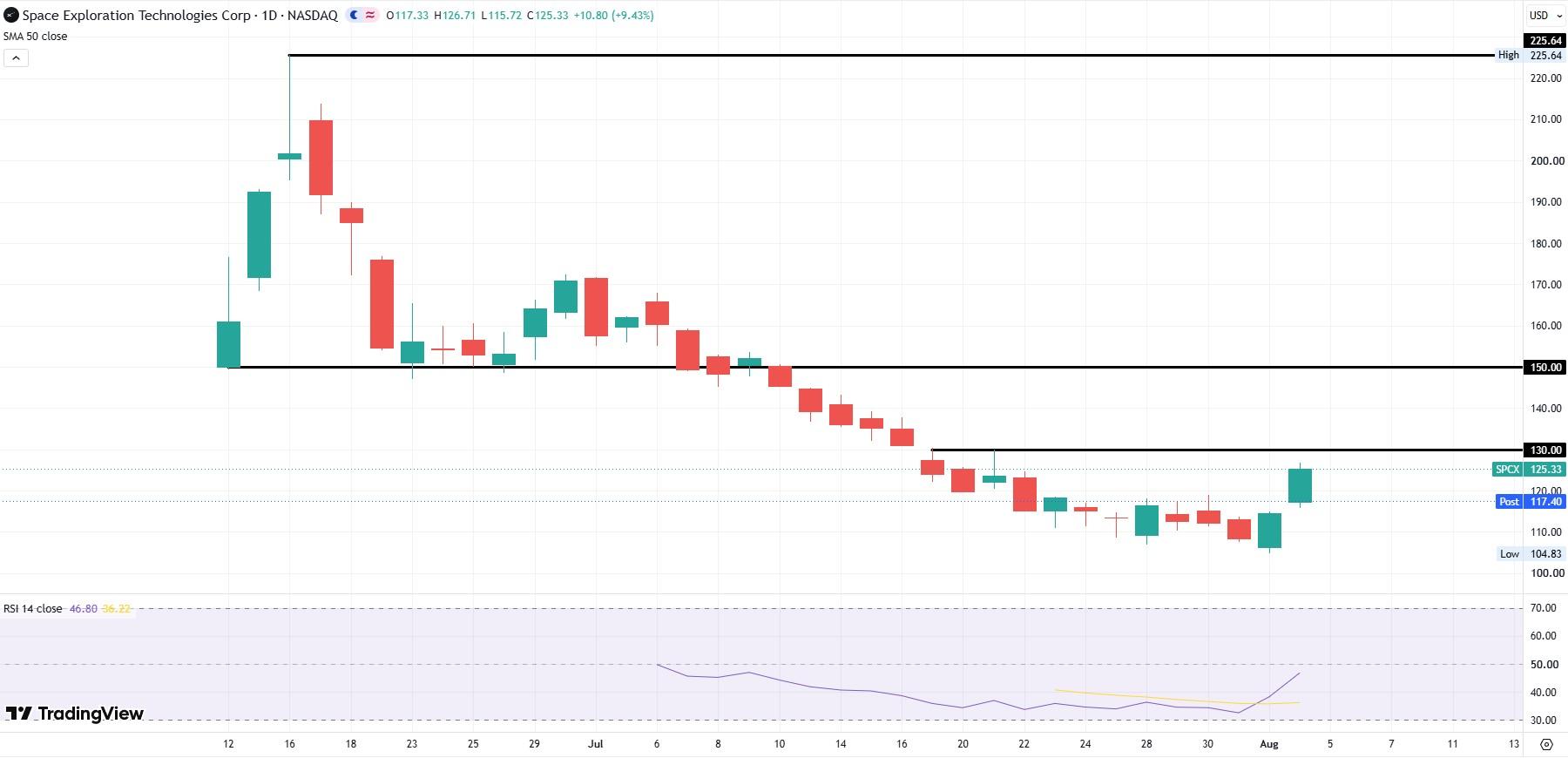
While SpaceX rallied into its first earnings release, the market's reaction spells doom for bulls. The stock just hit its all-time low on Monday near $104 and seems to be having trouble retaking the $130 level, having tested it twice in the past few weeks.
Bulls will be hoping to overtake the $130 level before making a run at prior support surrounding $150.
On the other hand, bears seem to be in control with the Relative Strength Index (RSI) remaining at or below the neutral 50 level for the past month. Most likely, SPCX will continue consolidating before emerging for its next rally. Most traders are cognizant that insider lockups begin to unlock later this week, allowing 91.5 million shares to enter the market.
Author

Clay Webster
FXStreet
Clay Webster grew up in the US outside Buffalo, New York and Lancaster, Pennsylvania. He began investing after college following the 2008 financial crisis.