S&P 500 News: Futures fall despite Fed backstopping all depositors at SBV, Signature banks
- US government backstops bank deposits.
- The S&P 500 lost 1.45% on Friday
- S&P 500 futures rise 1.5% on Monday.
- Wall Street analysts predict no rate hike in March.
.jpg)
After losing 4.85% last week, one of its worst performances in some time, the S&P 500 at first looked likely to charge ahead on Monday. S&P 500 futures rose by 1.5% at the start of the premarket but have since fallen to -0.7%. The initial optimism came from Wall Street analysts opining that the Federal Reserve is unlikely to raise interest rates later this month. As higher interest rates have been the primary barrier for equities over the past year, the market at first cheered this signal whole-heartedly. The reason for this is the banking upheavel caused by SBV Financial (SIBV). The parent of Silicon Valley Bank collapsed last Friday after tech and venture capital clients pulled their deposits.
However, the futures markets then fell across the board early Monday after it became clear that First Republic Bank (FRC) was not clear from market worries. Shares of FRC have fallen over 60% in the premarket.
On Monday, NASDAQ futures are dropping alonside the other indices. They are down -0.6% in Monday's premarket, while Dow Jones futures are off -0.8%.
S&P 500 news: US government saves all depositors
Following the Silicon Valley Bank run last week, Signature Bank (SBNY) went into receivership over the weekend. This bank had $82.6 billion in deposits at the end of 2022 but like Silvergate Capital (SI) saw a severe cutback in deposits due to its crypto industry exposure.
Following hedge fund maven Bill Ackman's call on the US government last week to stop the Silicon Valley Bank run from expanding throughout the banking industry, the US government came out strongly in support of multiple banks over the weekend.
“We are also announcing a similar systemic risk exception for Signature Bank, New York, New York, which was closed today by its state chartering authority,” the Treasury Department, Federal Depository Insurance Corporation (FDIC) and Federal Reserve said in a joint statement. “All depositors of this institution will be made whole. As with the resolution of Silicon Valley Bank, no losses will be borne by the taxpayer.”
Typically, only insured deposits up to $250,000 are protected by the FDIC, but because billions of dollars of corporate balance sheets were held by Silicon Valley Bank, the government thought it wise to extend their protection to all depositors.
The next shoe to drop might be First Republic Bank (FRC). The bank, which caters to high-net-worth individuals, is down 61% in Monday's premarket despite the fact that JPMorgan Chase (JPM) and the Fed boosted the bank's liquidity position to $70 billion over the weekend.
Federal Reserve might not raise rates at March meeting
Goldman Sachs said over the weekend that this turmoil in the banking sector should force the Fed to hesistate on rates hikes. The central bank meets in the latter part of March to determine the fed funds rate, and until now most analysts were expecting either a 25 or 50 basis-point hike.
"The biggest 3-day collapse in 2y UST yields since Black Monday in 1987 [...] is boosting S&P futures (SPX) (SPY) and causes the [US] dollar to retreat," Societe General's Kenneth Broux wrote in a note to clients. "The difficulty to quantify the immediate impact for US financial conditions makes a 25bp rate increase by the Fed next week more likely than 50bp. Some on the Street also suggest the Fed may pause, but this may be a step too far if the fallout is contained and CPI blows hot tomorrow."
The silver lining of the fallout from Silicon Valley Bank is that the market may finally get its much-sought-after Fed pivot, but the majority of analysts still think 25 basis points is the mostly likely direction. However, very few analysts still think 50 basis points is on the table. The 50-basis point thesis only arrived after the Personal Consumption Expenditures (PCE) figure came in hot for January, demonstrating that inflation is still a major worry.
Earnings of the week agenda
Monday, March 13 - GitLab (GTLB)
Tuesday, March 14 - Lennar (LEN)
Wednesday, March 15 - Adobe (ADBE)
Thursday, March 16 - FedEx (FDX) andDollar General (DG)
Friday, March 17 - XPeng (XPEV)
S&P 500 technical analysis: SPX heads to 3,800
From the pivots on the daily chart from Friday, you can see the S1 support was broken in that session. The S2 support is down at 3,783. Just above there is the former mid-term support level of 3,800. With the futures market placing the SPX around 3,830 in Monday's premarket, it seems likely that the index will drop to 3,800 where it found support at the turn of the year. Further support lies at 3,720. Breaking back above 4,000 is the ticket to a renewed rally.
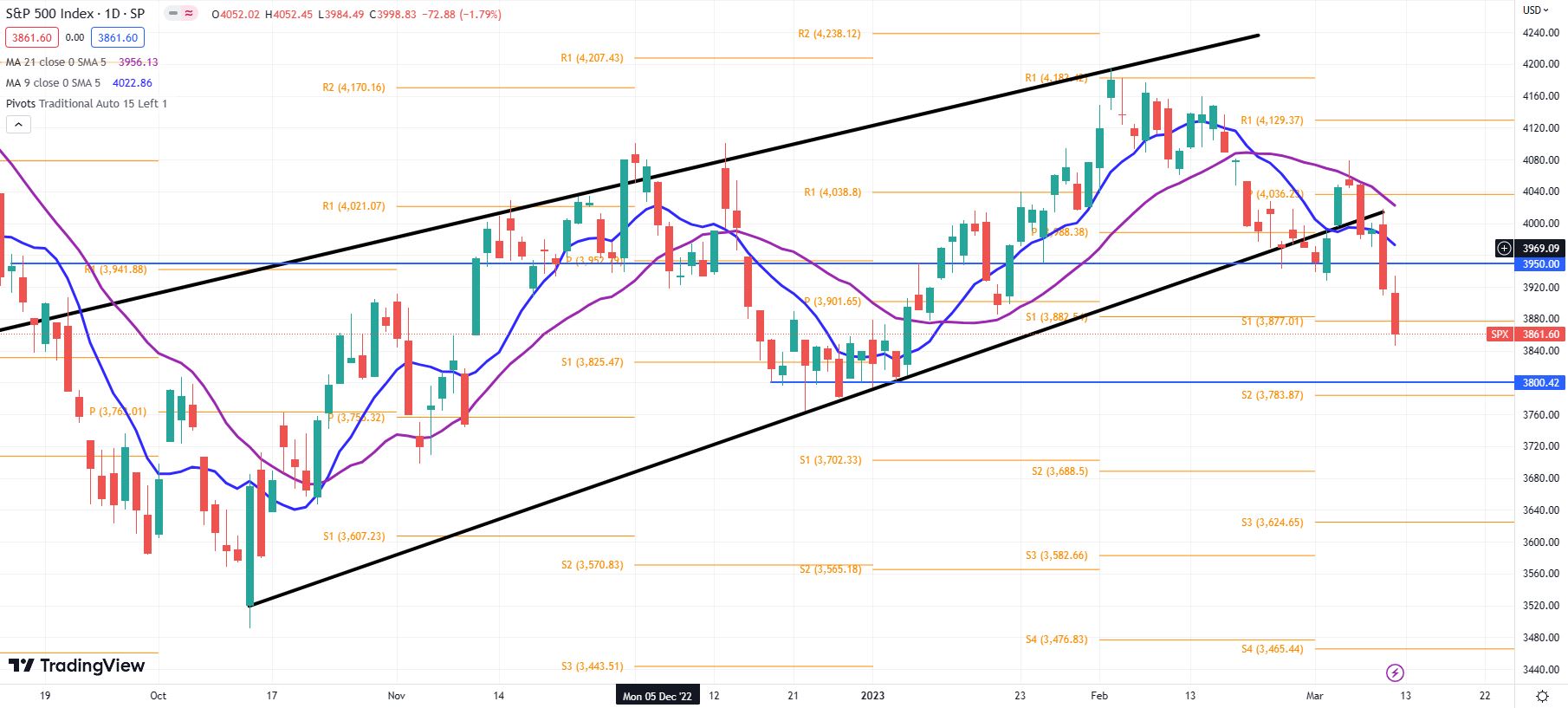
SPX daily chart
Author

Clay Webster
FXStreet
Clay Webster grew up in the US outside Buffalo, New York and Lancaster, Pennsylvania. He began investing after college following the 2008 financial crisis.

















