|

S&P 500 finds support at key zone as wave 5 could follow

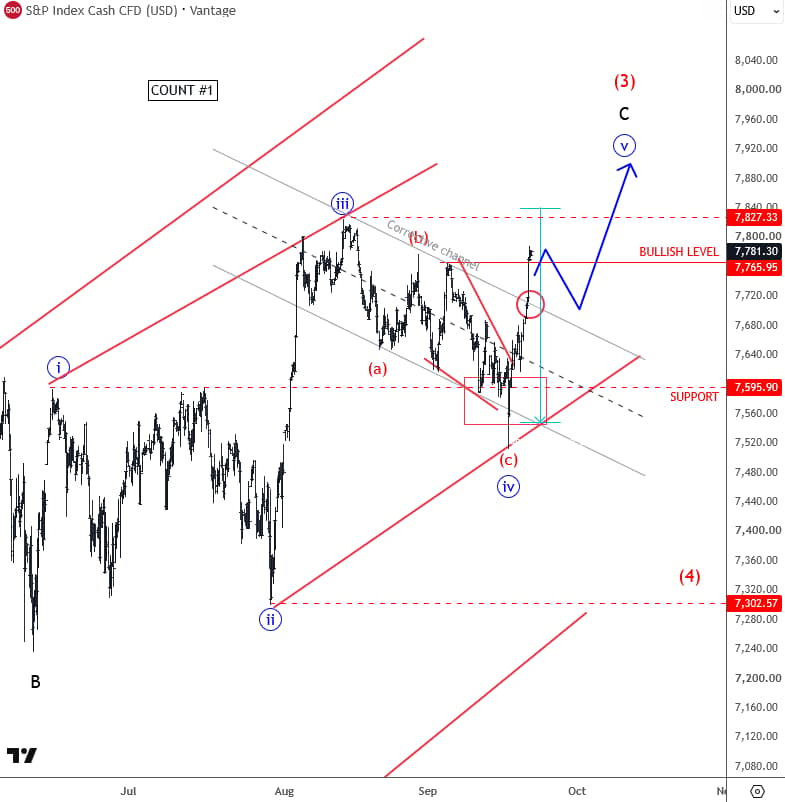
The S&P 500 has once again returned to the 7,500–7,600 area, which we previously highlighted as an important technical zone. This region is particularly interesting because it lines up with the previous swing highs from June and July, meaning that former resistance can now potentially act as support during the current correction.

From an Elliott Wave perspective, the decline from the recent highs still appears corrective, as we can so far count only three waves lower. This leaves the possibility that the index is forming a higher-degree wave 4 correction rather than starting a larger bearish trend. The reaction from the 7,500–7,600 area is also encouraging, as price has already produced a nice impulsive reversal higher from this support zone.
SP4H
SP500 4H Chart

The key level to watch now is the upper channel line, followed by the 7,700 area. A decisive recovery above this resistance would provide stronger confirmation that wave 4 has likely completed and that the S&P 500 is entering the final push higher within wave 5 of the projected ending diagonal.

As long as the structure remains supported above the recent lows, we can therefore still allow for another move to the upside. However, traders should remain aware that wave 5 would represent the final leg of the ending diagonal, so any further advance should be monitored carefully for signs of exhaustion and a potential larger-degree correction afterward.


Get Full Access To Our Premium Elliott Wave Analysis For 14 Days. Click here.

Author

Gregor Horvat

Gregor Horvat

Wavetraders

Experience Grega is based in Slovenia and has been in the Forex market since 2003.

More from Gregor Horvat
Share:

Editor's Picks

AUD/USD defends 0.7000 ahead of RBA on Tuesday

AUD/USD is defending 0.7000 at the start of a new week, trading near its lowest level since August 4 amid a bullish US Dollar. US yields hold near multi-year highs amid inflation risks from higher oil prices and rising bets on an October Fed rate hike. This, along with the US-Iran standoff, continues to underpin the safe-haven buck and weigh on the pair ahead of Tuesday's RBA policy announcements.

USD/JPY climbs back toward 158.00 after BoJ minutes amid firm USD

USD/JPY finds dip-buyers and reverses part of Friday's slide driven by speculation that authorities will step in again to prop up the Japanese Yen. However, the BoJ's dovish Minutes cap the JPY. Meanwhile, the US Dollar regains traction as the US-Iran standoff supports crude oil prices, fueling inflation fears and reaffirming bets for an October Fed rate hike. This further supports the pair, driving it back toward 158.00.

Gold sheds 3%, eyeing $4,100 on renewed US-Iran risks

Gold is falling hard at the start of a new week, targeting $4,100 for the first time in eight weeks. Firming October Fed rate-hike bets, along with oil-driven inflation risks, keep US bond yields elevated near multi-year highs, helping the US Dollar hold firm, particularly after Trump rejected Iran's truce offer. These factors weigh heavily on the bullion.

Zcash risks a decline below $1,500 as bullish momentum eases

Zcash price hovers below $1,550 on Monday, extending losses after a 4% decline the previous day. Institutional interest in the privacy coin holds firm, recording over $35 million in inflows last week, while retail speculation takes a hit, with ZEC futures Open Interest down around 10% in 24 hours.

Data back in the driver’s seat this week
Markets will look for fresh evidence of a hot US economy from this week as September figures start to flow in. Upside surprises in jobs data could take rate hike pricing for the October FOMC above 20bp. It’s not our baseline though, and we expect some stabilisation with modest downside risks for USD in the coming days. We expect a hawkish hike by the RBA tomorrow.
Fed vs BoJ: Both hiked. The market only believes one of them – and the chart shows which

The Fed and the BoJ have just done something remarkably similar. Both central banks raised interest rates by 25 bps last week, both are confronting inflation risks, and both signal that future decisions will depend on incoming economic data.