|

SOX Index rebounds from key Fibonacci target: Is a rally toward $13,500 next?

In our previous assessment of the Philadelphia Semiconductor Index (SOX), we preferred to look for higher prices but concluded that “The bounce scenario requires the index to hold above last week’s low [$11,960] as well, because a break below that price level targets, ideally, approximately $10,500-600 before the Bulls can try again. …. Thus, we have two plausible scenarios looking for higher prices, and we have clear warning levels (i.e., stop-loss levels) to indicate that our thesis/position was wrong.”

Fast-forward to today, and the index bottomed out at $10,445 yesterday. Thus, while our preferred paths for higher prices were wrong, the index did bottom right at the lower end of the target zone, having given us ample warning when it broke below ~$12K. As such, we are now, once again, looking for higher prices. See Figure 1 below.

Figure 1. The SOX index with intermediate-term Elliott Wave Principle count and several technical indicators
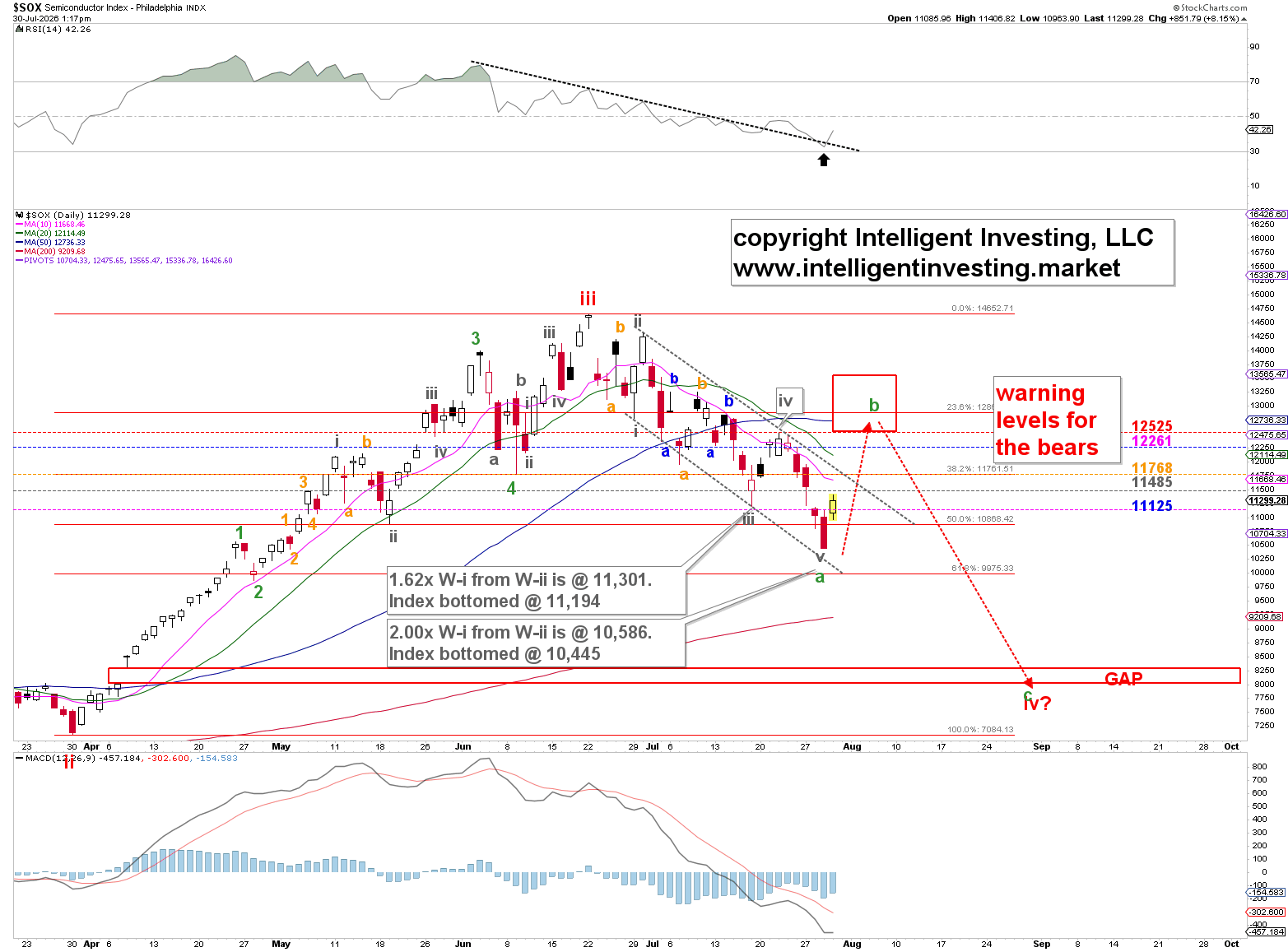
Namely, the price action since the June all-time high (ATH) counts best as a leading diagonal (green) W-a. Diagonals comprise five waves, each subdividing into three waves. In this case, the gray W-i, ii, iii, iv, and W-v form an abc-abc-abc-abc-abc pattern. In addition, the 3rd and 5th waves (gray W-iii and W-v) bottomed almost exactly at the ideal Fibonacci extensions: 1.62 and 2.00, respectively, adding weight to our Elliott Wave Principle (EWP) count.

Once the diagonals are complete, we can expect a retracement back to the start of the pattern, often considered to be at either the bottom of the 1st or the top of the 2nd wave, approximately $12,800-$14,300. In addition, B-waves typically retrace 50-76.4% of the prior decline, targeting $12,550-13,660. Thus, we have strong confluence in the $13,500 +/-1000 region before the next leg lower should announces itself.

Author

Dr. Arnout Ter Schure

Dr. Arnout Ter Schure

Intelligent Investing, LLC

After having worked for over ten years within the field of energy and the environment, Dr.

More from Dr. Arnout Ter Schure
Share:

Editor's Picks

AUD/USD: Recovery appears capped by 0.7000

AUD/USD has reversed a multi-day positive streak, briefly revisiting the 0.6940 region before trimming part of those gains to end the day modestly on the back foot. The better tone in the Greenback has kept the pair under pressure, which has so far met decent contention in the vicinity of the 0.6900 zone. Moving forward, the Melbourne Institute’s Consumer Inflation Expectations is next on tap in Oz.

USD/JPY holds firm near 158.50 ahead of Fed Minutes

USD/JPY hangs close to a one-and-a-half-week high near 158.50 in the Asian session on Wednesday, with bulls now awaiting a move beyond the 200-day SMA hurdle before positioning for further gains ahead of the FOMC Minutes. Meanwhile, a fresh leg up in US bond yields revives US Dollar demand amid geopolitical uncertainties, boosting the pair amid dovish BoJ commentary.

Gold trims losses, back above $4,100

Gold now manages to regain some balance, returning to the area above the key $4,100 mark per troy ounce following the closing bell in Europe on Wednesday. The yellow metal’s sharp pullback comes in tandem with marked gains in the US Dollar and a marked bounce in US Treasury yields across the curve.

Bitcoin vs Gold: BTC and XAU fall amid macro headwinds, but Ray Dalio still prefers Gold
Bitcoin (BTC) edges lower on Wednesday, trading near $83,000. The broader correction in the cryptocurrency market can be attributed to heavily leveraged long liquidations, macro and geopolitical pressure reducing risk appetite. Gold (XAU/USD), similarly, remains in bearish hands as it tests short-term support at $4,100.
Fed Minutes: Officials saw inflation risks worsening before September hike
All participants at the Federal Reserve's (Fed) September 15–16 meeting supported the 25-basis-point rate increase, while most judged that another hike would probably be appropriate by the end of the year. The Minutes show policymakers increasingly focused on upside inflation risks, a resilient economy and the possibility that strong AI investment could add to demand pressures.
The UK 30-year gilt just hit a 1998 high. Is that good or bad for the British Pound?
The yield on the UK's 30-year government bond, or gilt, went through 6% on October 1 for the first time since early 1998, and on Monday the Pound was at its strongest against the Euro since June 2025. The gilt market's 28-year high is mostly someone else's. Since early May, the 30-year gilt yield has risen about 0.15 of a percentage point and the US 30-year about 0.7.