Bitcoin vs Gold: BTC and XAU fall amid macro headwinds, but Ray Dalio still prefers Gold
- Bitcoin decline persists near $83,000 as US-Iran tensions fester amid rising Oil and energy prices.
- Gold drops and tests $4,100 support as focus shifts to the FOMC Minutes and the upcoming monetary policy decision.
- Ray Dalio leans toward a Gold-heavy portfolio with 10-15% exposure despite owning a bit of Bitcoin.

Bitcoin (BTC) edges lower on Wednesday, trading near $83,000. The broader correction in the cryptocurrency market can be attributed to heavily leveraged long liquidations, macro and geopolitical pressure reducing risk appetite.
Gold (XAU/USD), similarly, remains in bearish hands as it tests short-term support at $4,100. If this support caves in, investors may reengage toward the $4,000 area, potentially driven by reducing odds of an October rate hike.
Investors turn to FOMC Minutes as rate hike odds dwindle
The Federal Open Market Committee (FOMC) will release the Minutes of the September meeting, in which the Federal Reserve (Fed) raised interest rates by 25 basis points to the 3.75-4.00% range, on Wednesday. This release is closely watched as it marks the first rate hike since 2023 and was a unanimous decision.
Market participants will be looking for specifics behind the rate-hike decision and clues on the central bank’s policy direction. Softer inflation data following the meeting sharply reduced markets' odds of another rate hike in October.
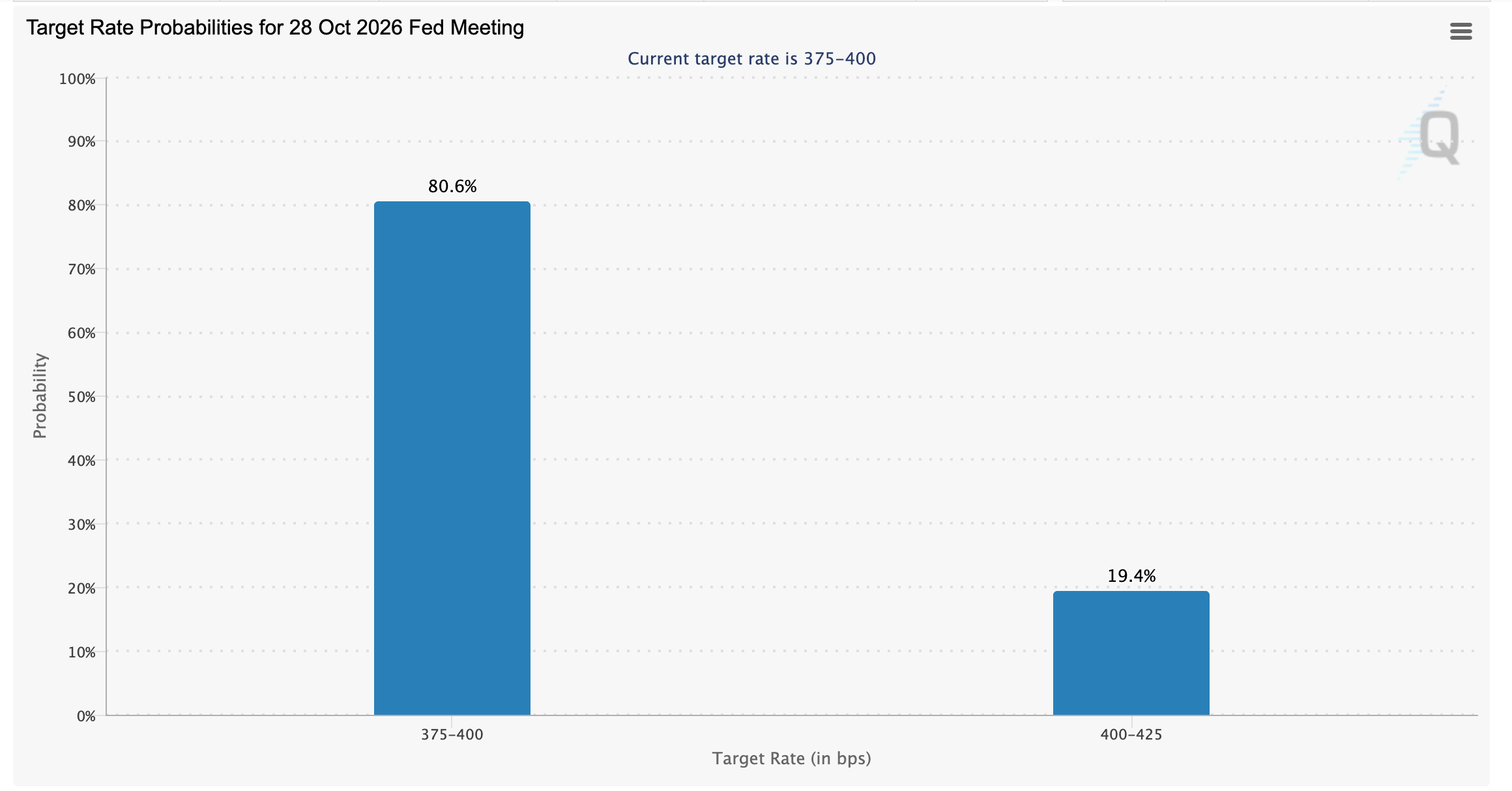
“What matters now is how divided the Fed was on the path ahead. Some officials still see inflation as persistent enough to justify further tightening, while others are increasingly focused on the weakening labor market and see less urgency to move,” Markus Levin, Co-founder of XYO, said via email, adding, “the [M]inutes should give investors a better sense of which side has the stronger hand.”
Geopolitical pressures prompt profit-taking
The goalposts for ending the US-Iran war continue to shift amid mounting geopolitical tensions in the Middle East. According to CBS News, US Vice President JD Vance appeared to soften demands for a lasting peace agreement with Tehran. Vance is reported to have told Reuters that Iran must do something “meaningful” to reduce its nuclear enrichment program. This is despite US President Donald Trump’s incessant hard-line statements that he wants a nuclear-free Iran with “no enrichment.”
Despite direct attacks between the US and Iran taking a breather, war in the Middle East continues with the Saudi Arabia-backed Yemeni government fighting with Iran-backed Houthis.
There is only one Gold — Ray Dalio
Ray Dalio, the founder of Bridgewater Associates, one of the largest hedge funds in the world, recently published an article titled “How Countries Go Broke: The Dynamic Behind What is Happening Now” that highlighted the debt crisis facing not only the US but also other leading economies, including the United Kingdom (UK), Japan and China.
Dalio said that he is “confident that the government’s financial condition is at an inflection point because, if this is not dealt with now, the debts will build up to levels where they can’t be managed without great trauma…”
Most economies dealing with growing deficits are, according to Dalio, likely to undertake a “debt and currency devaluation adjustment” in less than three years. He argues that, given the outlook, non-yielding assets such as Gold and Bitcoin could perform well.
Furthermore, Dalio advises investors to diversify their portfolios in “asset classes and countries that have strong income statements and balance sheets.” He urges investors to reduce exposure to debt assets such as bonds and increase exposure to Bitcoin and Gold. Precisely, Dalio prefers a diversified exposure with 10-15% in Gold and 1% in Bitcoin.
“There is only one Gold,” Dalio said on the All-In Podcast in March, adding, “Gold is the most established money… It’s the second-largest reserve currency that central banks hold.”
Technical analysis: Bitcoin corrects as headwinds intensify
Bitcoin trades at $83,173, extending a three-day sell-off. Recent attempts to break above the $87,200 supply failed, resulting in buyer exhaustion. Still, BTC maintains a bullish near-term bias as price holds well above a dense layer of Exponential Moving Average (EMA) support.
The SuperTrend indicator at $79,665 reinforces this demand zone, while the Relative Strength Index (RSI) at 52 sits near neutral, suggesting consolidation rather than exhaustion despite the broader uptrend. The Moving Average Convergence Divergence (MACD) remains below zero with a negative latest reading, hinting that bullish pressure is moderating even as the structural picture stays supportive.
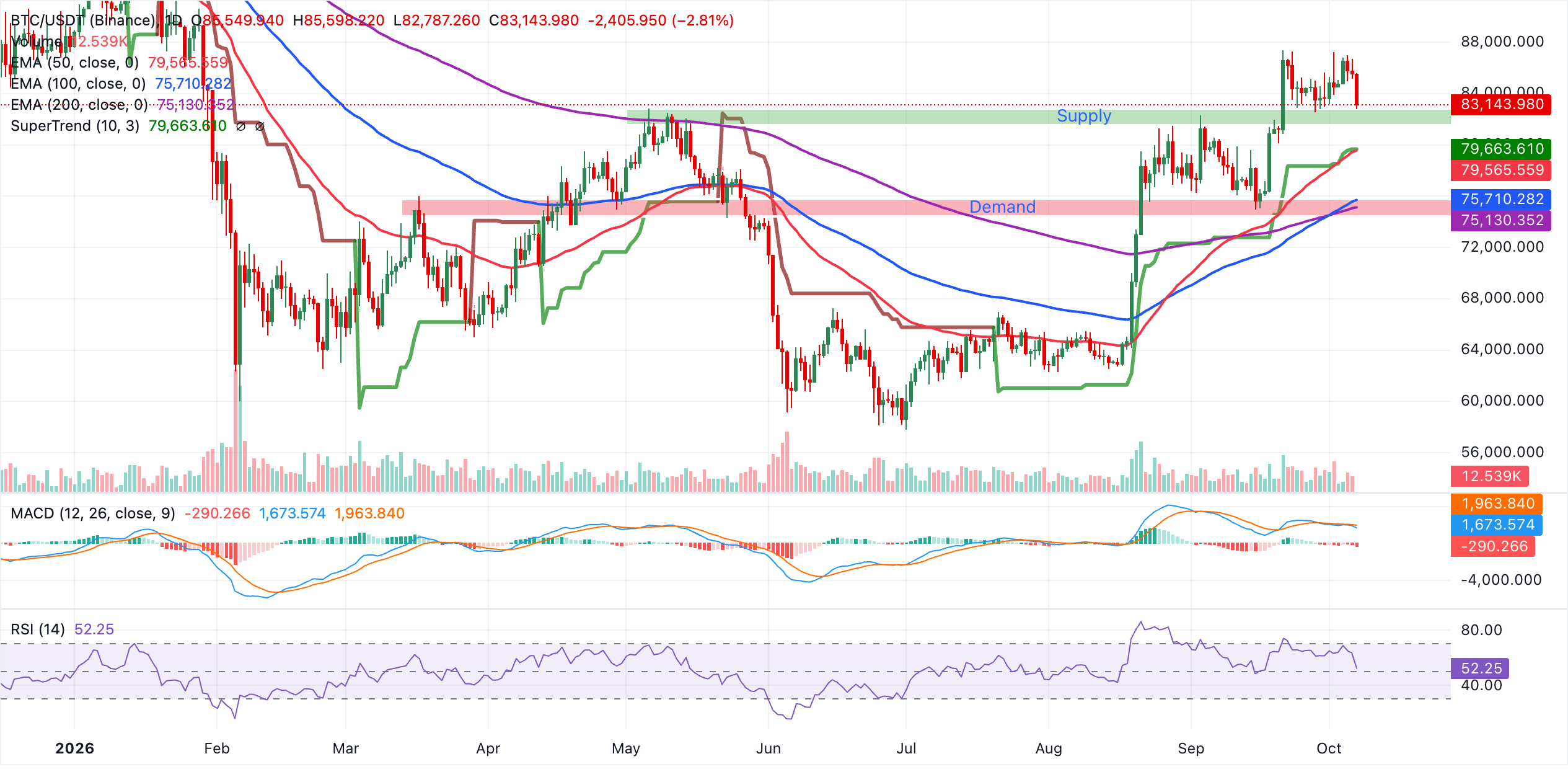
Immediate support lies near the current pivot zone near $83,000, ahead of a key cluster formed by the SuperTrend and the 50-day EMA between roughly $79,564 and $79,664. Below that, secondary demand appears at the 100-day EMA at $75,710, followed by the longer-term floor at the 200-day EMA at $75,130.
With no clear overhead resistance levels on the daily chart, a sustained hold above the SuperTrend and EMA cluster would keep the path of least resistance tilted to the upside. A daily close below that band would signal that the current bullish phase is losing momentum and could trigger a deeper corrective move toward the mid-$75,000s.
Technical analysis: Gold remains in bearish hands
Gold trades near $4,100, keeping a bearish near-term bias as spot remains decisively under the key EMAs. Price holds below the 50-day EMA at $4,285, the 200-day EMA at $4,305 and the 100-day EMA at $4,326, while the SuperTrend indicator at $4,380 stays overhead, suggesting rallies are still being sold.
The MACD indicator is in negative territory, and the RSI at 36 hovers just above oversold, reinforcing the impression of persistent downside pressure rather than an imminent bullish reversal.
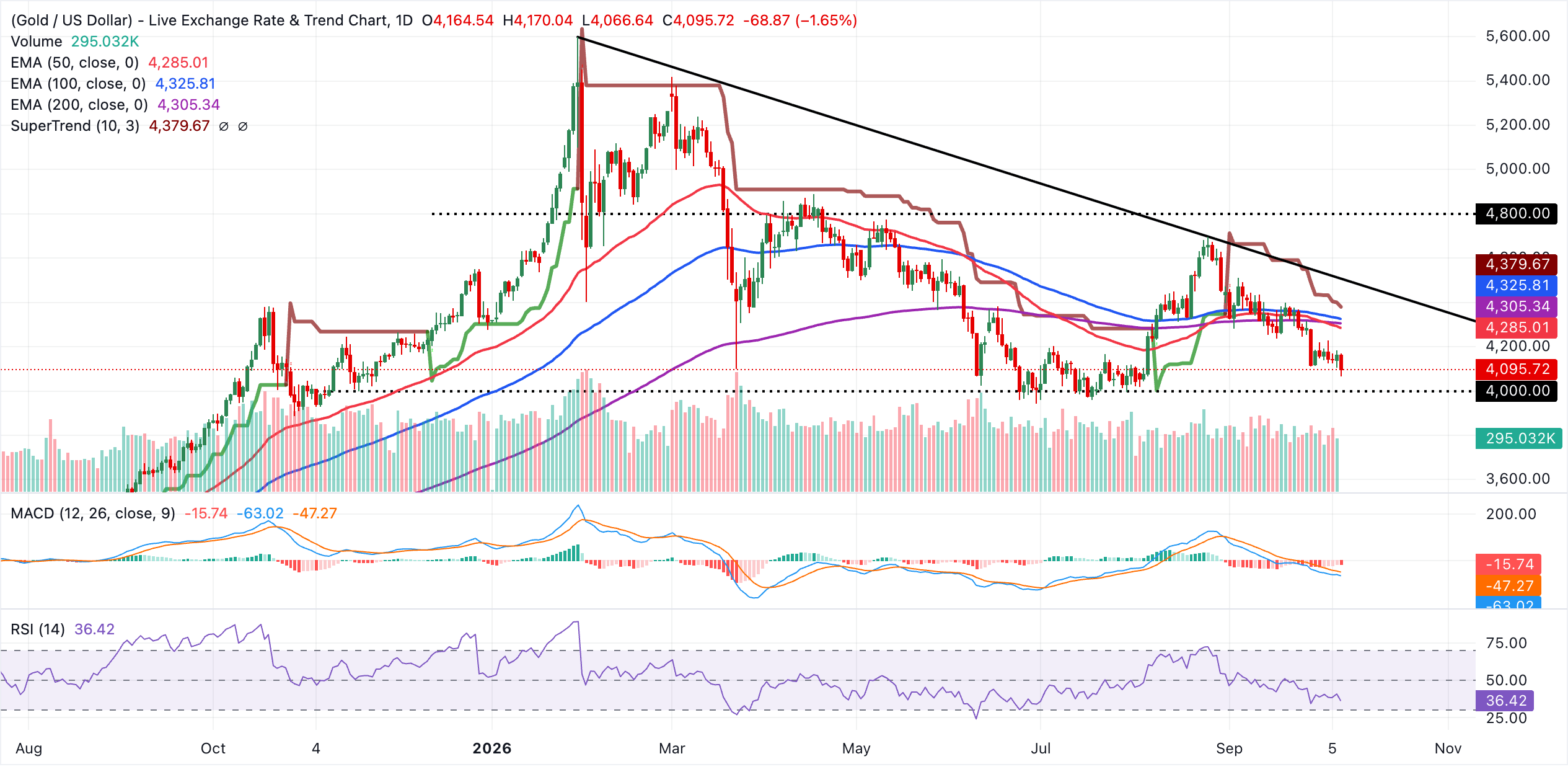
Immediate resistance emerges from the clustered short-term structure starting at the 50-day EMA near $4,285, followed by the 200-day EMA at about $4,305 and the 100-day EMA around $4,326, which together form a dense supply band that could cap any recovery attempts. Above these, the SuperTrend line at roughly $4,380 is the next barrier, while the broader downward resistance trendline, with a key reference around $4,449, marks a higher hurdle that would need to be reclaimed to ease the prevailing bearish tone.
With no clear nearby structural support shown on the daily chart, the metal remains vulnerable to further slippage as long as it trades beneath this layered resistance stack.
(The technical analysis of this story was written with the help of an AI tool. Know more.)
Bitcoin, altcoins, stablecoins FAQs
Bitcoin is the largest cryptocurrency by market capitalization, a virtual currency designed to serve as money. This form of payment cannot be controlled by any one person, group, or entity, which eliminates the need for third-party participation during financial transactions.
Altcoins are any cryptocurrency apart from Bitcoin, but some also regard Ethereum as a non-altcoin because it is from these two cryptocurrencies that forking happens. If this is true, then Litecoin is the first altcoin, forked from the Bitcoin protocol and, therefore, an “improved” version of it.
Stablecoins are cryptocurrencies designed to have a stable price, with their value backed by a reserve of the asset it represents. To achieve this, the value of any one stablecoin is pegged to a commodity or financial instrument, such as the US Dollar (USD), with its supply regulated by an algorithm or demand. The main goal of stablecoins is to provide an on/off-ramp for investors willing to trade and invest in cryptocurrencies. Stablecoins also allow investors to store value since cryptocurrencies, in general, are subject to volatility.
Bitcoin dominance is the ratio of Bitcoin's market capitalization to the total market capitalization of all cryptocurrencies combined. It provides a clear picture of Bitcoin’s interest among investors. A high BTC dominance typically happens before and during a bull run, in which investors resort to investing in relatively stable and high market capitalization cryptocurrency like Bitcoin. A drop in BTC dominance usually means that investors are moving their capital and/or profits to altcoins in a quest for higher returns, which usually triggers an explosion of altcoin rallies.
Author

John Isige
FXStreet
John Isige is a seasoned cryptocurrency journalist and markets analyst committed to delivering high-quality, actionable insights tailored to traders, investors, and crypto enthusiasts. He enjoys deep dives into emerging Web3 tren