Silver rebounds as dip-buyers step in ahead of delayed US jobs data
- Silver rebounds sharply as a softer US Dollar supports prices ahead of the delayed US NFP report.
- The Silver Institute flags continued physical tightness and a sixth straight global market deficit in 2026.
- XAG/USD stabilises near the 38.2% Fibonacci retracement, with volatility still elevated but starting to ease.

Silver (XAG/USD) climbs on Wednesday, reversing the previous day’s losses as a softer US Dollar (USD) offers support ahead of the delayed US Nonfarm Payrolls (NFP) report due at 13:30 GMT. At the time of writing, XAG/USD is trading near $85.45, up almost 5.47% on the day.
The short-term technical picture is beginning to stabilise after the recent sharp and disorderly price swings, with buyers gradually regaining control as the broader supportive macro backdrop continues to draw dip-buying interest.
The latest Silver Institute report, released on Monday, said geopolitical risks, persistent US policy uncertainty and concerns over the independence of the Federal Reserve (Fed) continue to underpin investor demand for the white metal.
The group expects the global Silver market to post a sixth consecutive annual deficit in 2026, adding that continued physical tightness has further amplified upward price momentum.
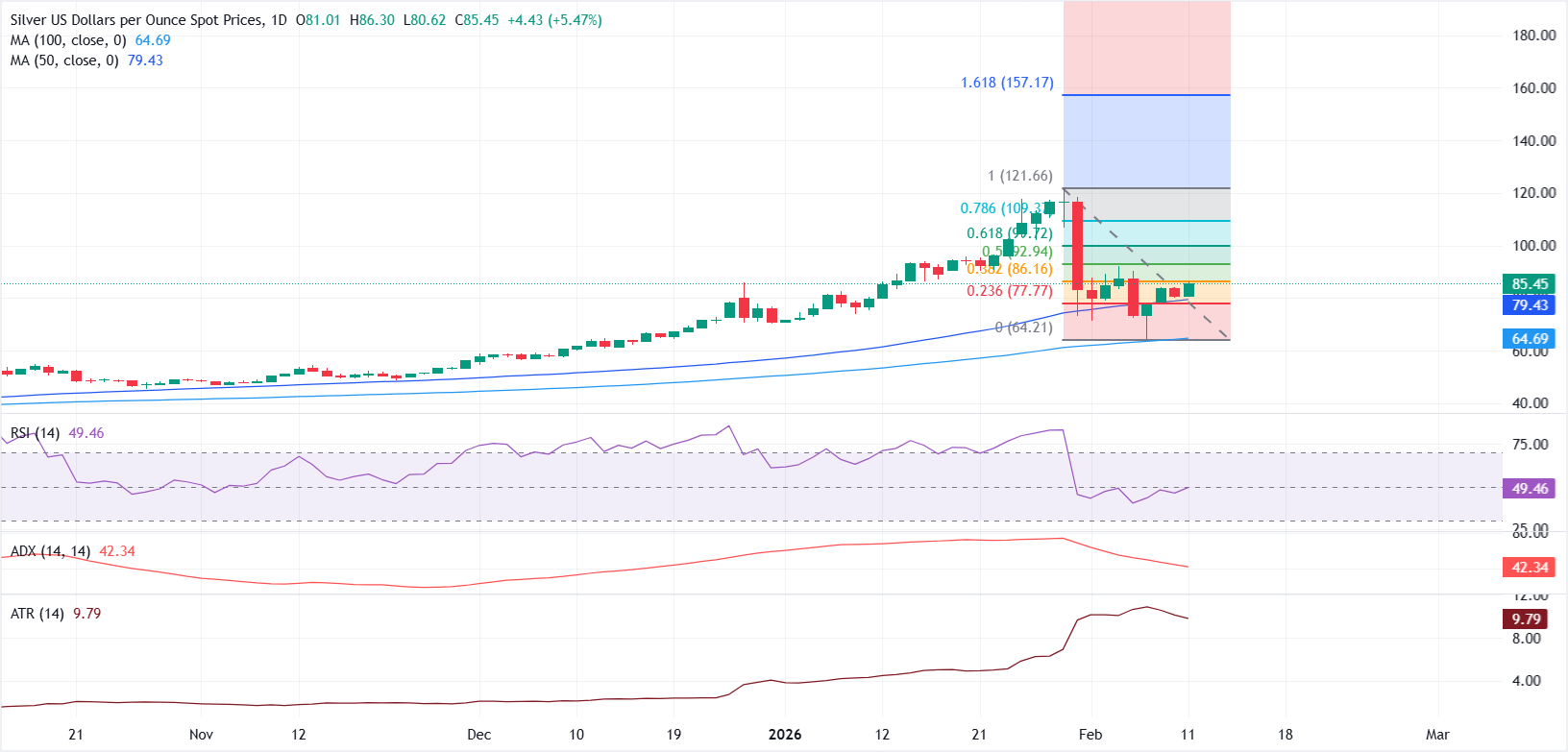
From a technical perspective, XAG/USD is attempting to stabilize after the sharp sell-off from recent highs, with price holding close to the 38.2% Fibonacci retracement of the rally from $64.04 to $121.66, located near $85.75.
A clear move back above this level could allow a recovery toward the 50% retracement near $92.50, followed by the 61.8% level around $99.25.
On the downside, failure to hold above the 38.2% retracement would keep pressure on prices and expose the next support at the 23.6% retracement near $77.40.
Momentum remains neutral, with the RSI hovering around the 50 mark, signalling a lack of clear directional conviction. Meanwhile, the ATR (14) remains elevated but is starting to ease, indicating that volatility is still high. Meanwhile, the still-elevated ADX near 42 suggests the broader trend remains strong, even as prices move sideways.
Silver FAQs
Silver is a precious metal highly traded among investors. It has been historically used as a store of value and a medium of exchange. Although less popular than Gold, traders may turn to Silver to diversify their investment portfolio, for its intrinsic value or as a potential hedge during high-inflation periods. Investors can buy physical Silver, in coins or in bars, or trade it through vehicles such as Exchange Traded Funds, which track its price on international markets.
Silver prices can move due to a wide range of factors. Geopolitical instability or fears of a deep recession can make Silver price escalate due to its safe-haven status, although to a lesser extent than Gold's. As a yieldless asset, Silver tends to rise with lower interest rates. Its moves also depend on how the US Dollar (USD) behaves as the asset is priced in dollars (XAG/USD). A strong Dollar tends to keep the price of Silver at bay, whereas a weaker Dollar is likely to propel prices up. Other factors such as investment demand, mining supply – Silver is much more abundant than Gold – and recycling rates can also affect prices.
Silver is widely used in industry, particularly in sectors such as electronics or solar energy, as it has one of the highest electric conductivity of all metals – more than Copper and Gold. A surge in demand can increase prices, while a decline tends to lower them. Dynamics in the US, Chinese and Indian economies can also contribute to price swings: for the US and particularly China, their big industrial sectors use Silver in various processes; in India, consumers’ demand for the precious metal for jewellery also plays a key role in setting prices.
Silver prices tend to follow Gold's moves. When Gold prices rise, Silver typically follows suit, as their status as safe-haven assets is similar. The Gold/Silver ratio, which shows the number of ounces of Silver needed to equal the value of one ounce of Gold, may help to determine the relative valuation between both metals. Some investors may consider a high ratio as an indicator that Silver is undervalued, or Gold is overvalued. On the contrary, a low ratio might suggest that Gold is undervalued relative to Silver.
Author

Vishal Chaturvedi
FXStreet
I am a macro-focused research analyst with over four years of experience covering forex and commodities market. I enjoy breaking down complex economic trends and turning them into clear, actionable insights that help traders stay ahead of the curve.