Bitcoin faces further downside risk amid growing short-term holder losses, weak ETF demand
- Bitcoin's recent drop left more than 95% of short-term holders underwater, according to Glassnode.
- The top crypto suffered its sharpest demand contraction since 2022 as buyer activity turned negative.
- US spot Bitcoin ETF demand fell to its weakest level since launch, signaling softer institutional participation.
Bitcoin's (BTC) recent decline toward the $60,000 level has pushed the market further into bearish territory, with new investors suffering huge unrealized losses, according to a Glassnode report on Wednesday.
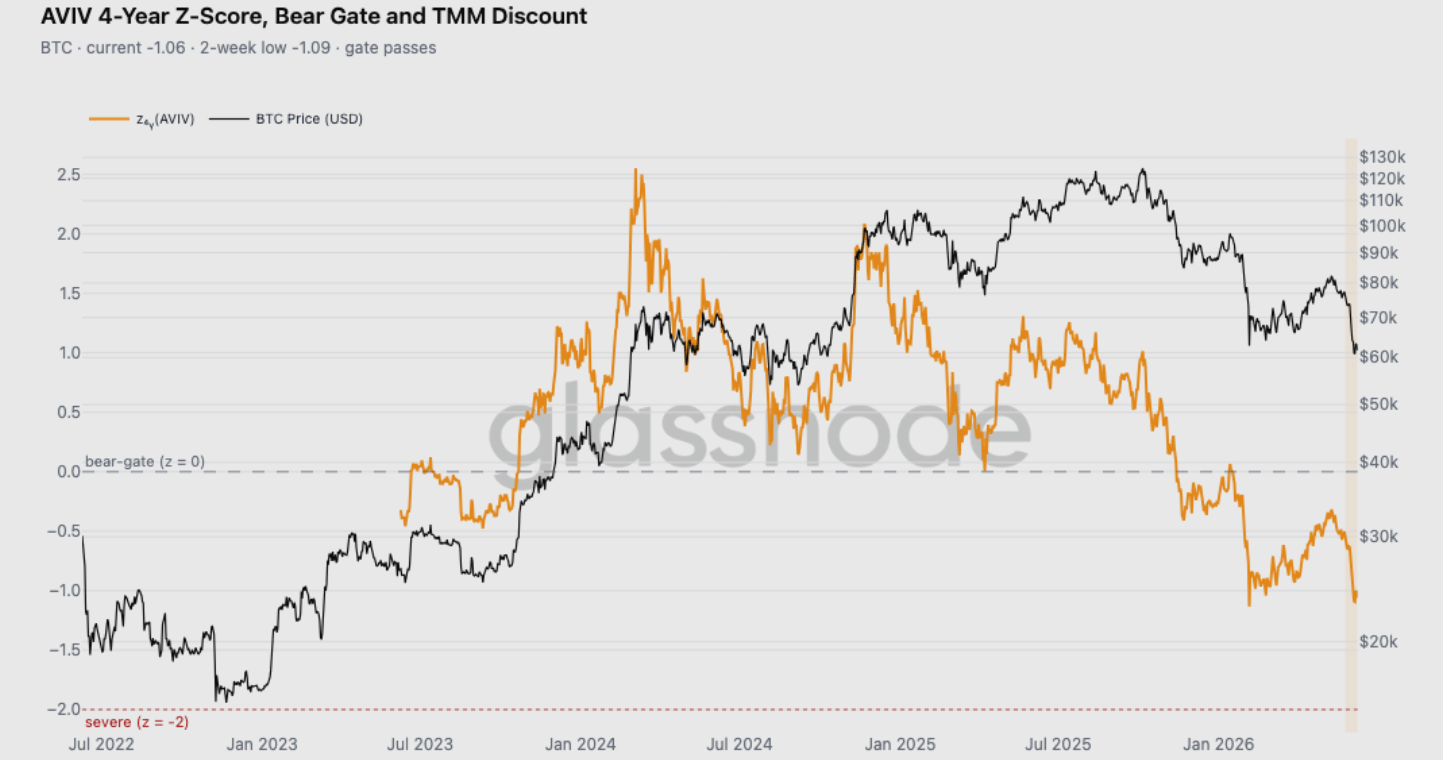
The firm noted that Bitcoin's earlier May rally now appears increasingly as a "bear bounce". An indicator highlighting the trend is the AVIV Ratio, which compares Bitcoin's spot price to the True Market Mean. The metric reached a four-year z-score low of -1.09 before recovering slightly to -1.06.
"The fact that price has not bounced meaningfully away from this cyclical low over the past week underscores the persistence of fear in current market sentiment," Glassnode wrote.
Recent Bitcoin buyers face expanding unrealized losses amid market stress
Recent buyers have likewise been affected by the price weakness. The Short-Term Holder Market Value to Realized Value (STH-MVRV) ratio fell to 0.81 before recovering marginally to 0.83, indicating that short-term investors remain approximately 17% to 19% underwater on average. BTC accumulated during the $78,000 to $82,000 range in May is also largely held at a loss.
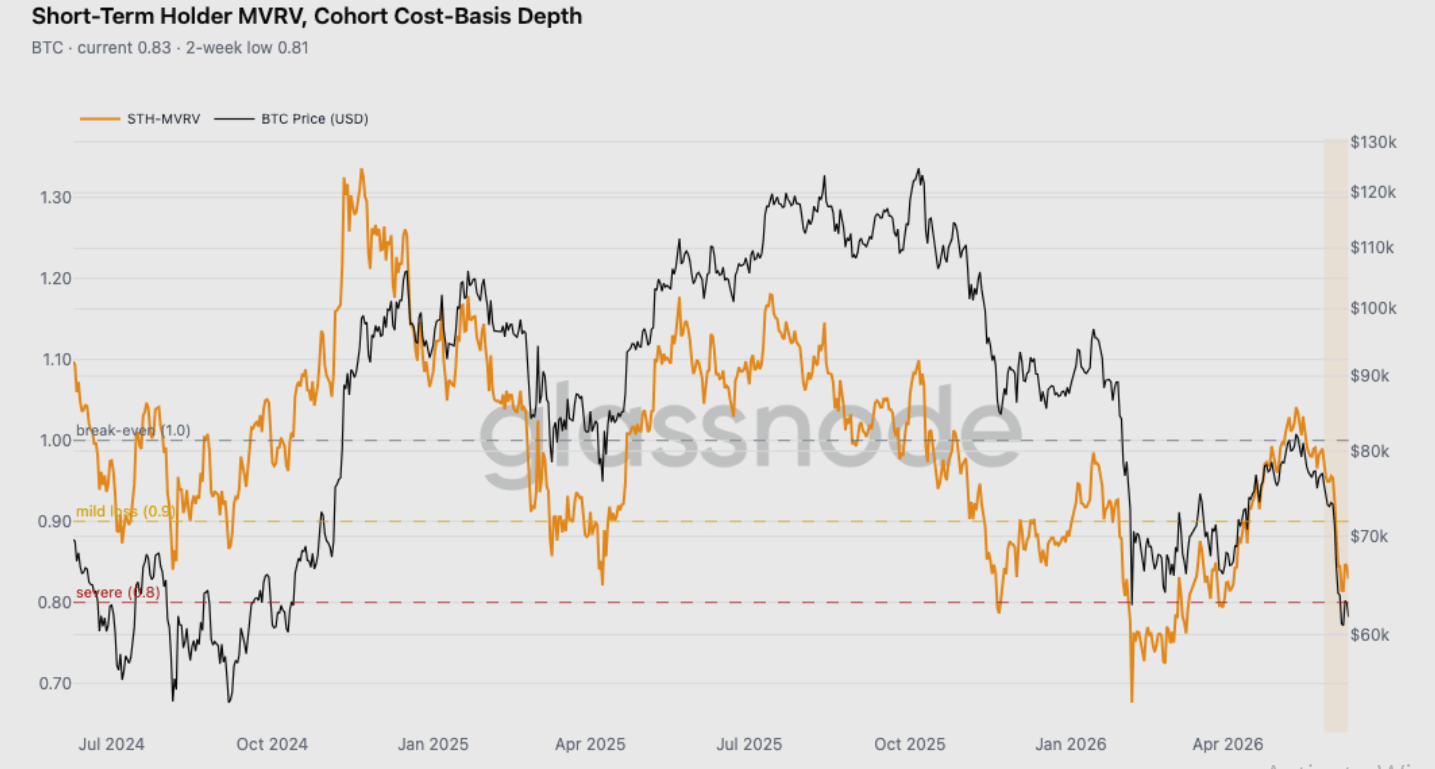
Glassnode likewise pointed to severe stress among newer market participants. The percentage of short-term holder supply in profit dropped to just 0.6% before recovering slightly to 3.3%, well below its four-year average of 55%.
"In practical terms, more than 95% of the recent buyer cohort is currently underwater," Glassnode said, adding that readings of this magnitude have historically coincided with capitulation phases that leave markets vulnerable to further downside.
The firm noted that stronger demand will be required to prevent another leg lower. Institutional spot demand via Coinbase remains subdued, with the Coinbase Premium Index continuing to trade in negative territory.
CryptoQuant suggests Bitcoin is yet to reach cycle bottom amid weak demand
On the other hand, CryptoQuant data suggests Bitcoin's decline to $59,000 places the asset just 9% above its realized price of $53,600. This level represents the aggregate onchain cost basis of all holders.
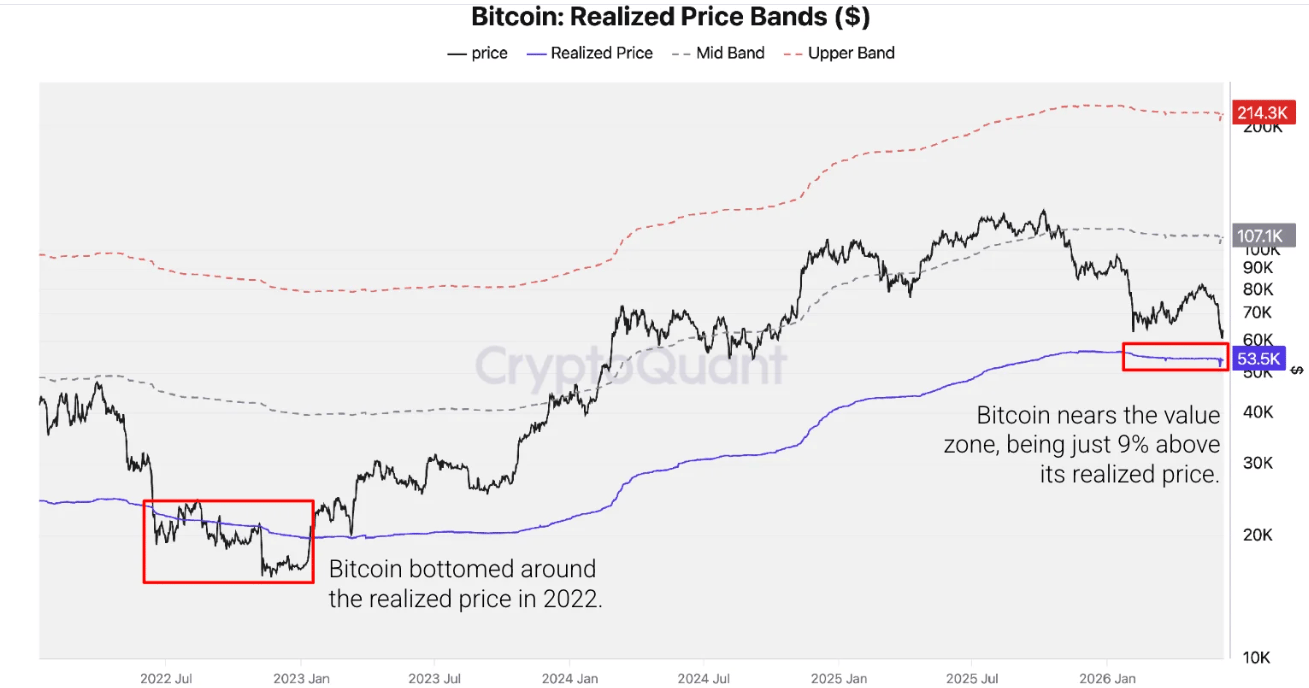
Historically, Bitcoin has formed major bear market bottoms at or slightly below the realized price, including during the November 2022 FTX collapse.
However, CryptoQuant acknowledged weak demand conditions surrounding the top crypto. The combined measure of speculative futures activity and apparent spot demand fell to -652,000 BTC over the past 30 days, marking the sharpest single-week contraction in demand since January 2022.
Likewise, the report noted that the one-year change in apparent demand has turned negative, indicating there are now fewer Bitcoin buyers than a year ago.
Institutional participation has also dipped further. CryptoQuant stated that the 30-day spot Bitcoin exchange-traded fund (ETF) demand growth has dropped to -74,000 BTC, its weakest reading since the US spot ETFs launched.
"Rather than absorbing the selling pressure from bear market distribution, ETFs are now contributing to net supply expansion as investors reduce their Bitcoin exposure," the report stated.
Despite mounting losses, CryptoQuant argues that capitulation has not yet reached levels typically associated with cycle bottoms. Bitcoin holders realized roughly 187,000 BTC in losses over the last month, well below the approximately 1.2 million BTC realized during the FTX-driven selloff.
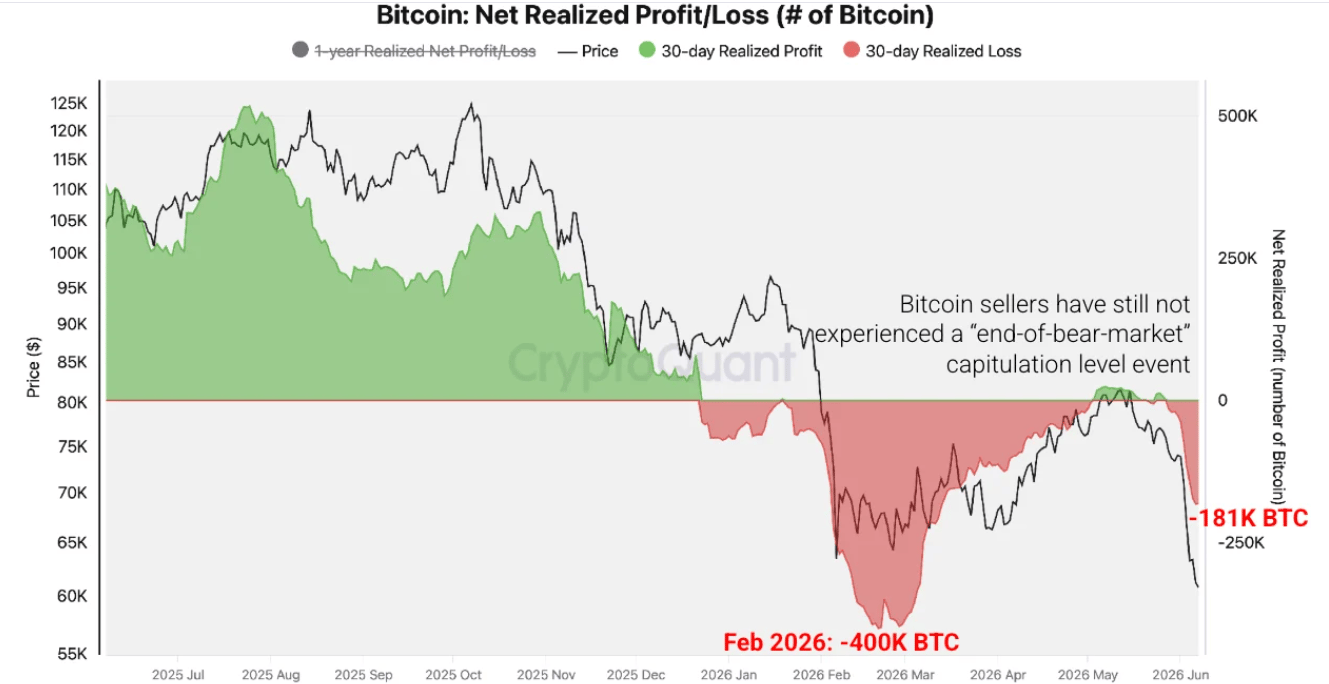
Bitcoin is trading at $62,100, up 0.5% over the past 24 hours at publication time.
Author

Michael Ebiekutan
FXStreet
With a deep passion for web3 technology, he's collaborated with industry-leading brands like Mara, ITAK, and FXStreet in delivering groundbreaking reports on web3's transformative potential across diverse sectors. In addition to