Silver Price Forecast: XAG/USD tumbles below $66 as US Dollar recovers ahead of US PPI data
- Silver price declines sharply to near $65.80 amid the US Dollar’s recovery.
- The US Dollar bounces back ahead of the US PPI data for August.
- The Fed is expected to hike interest rates in the policy meeting next week.

Silver price (XAG/USD) slides 2.3% to near $65.80 during the European trading session on Thursday. The white metal comes under pressure as the US Dollar (USD) turns slightly positive, with investors awaiting the United States (US) Producer Price Index (PPI) data for August releasing at 12:30 GMT.
At press time, the US Dollar Index (DXY), which gauges the Greenback’s value against six major currencies, trades marginally higher at around 99.86 after a subdued performance in the Asian trade.
Signs of recovery in the US Dollar make the Silver price an unfavorable risk-reward bet for investors.
According to estimates, the US headline PPI rose at a faster pace of 5.3% Year-on-Year (YoY) against 4.7% in July. The core PPI – which excludes volatile food and energy items – is also seen higher, arriving at 4.6% YoY from the previous reading of 4.2%.
Meanwhile, the major trigger for the Silver price will be the US Consumer Price Index (CPI) data for August, which is scheduled for Friday. Both the US PPI and CPI data are expected to have a significant impact on the Federal Reserve’s (Fed) interest rate expectations for the September policy meeting.
Analysts at Commerzbank observe that the recent repricing along the curve has been accompanied by a notable shift in policy expectations, with Fed funds futures markets now "pricing around a 60% probability of a 25bp increase at next week’s meeting." They add that "August CPI data due tomorrow" is widely "seen as the decisive input," likely determining whether the Fed ultimately delivers another hike or opts to extend its pause.
Silver Technical Analysis
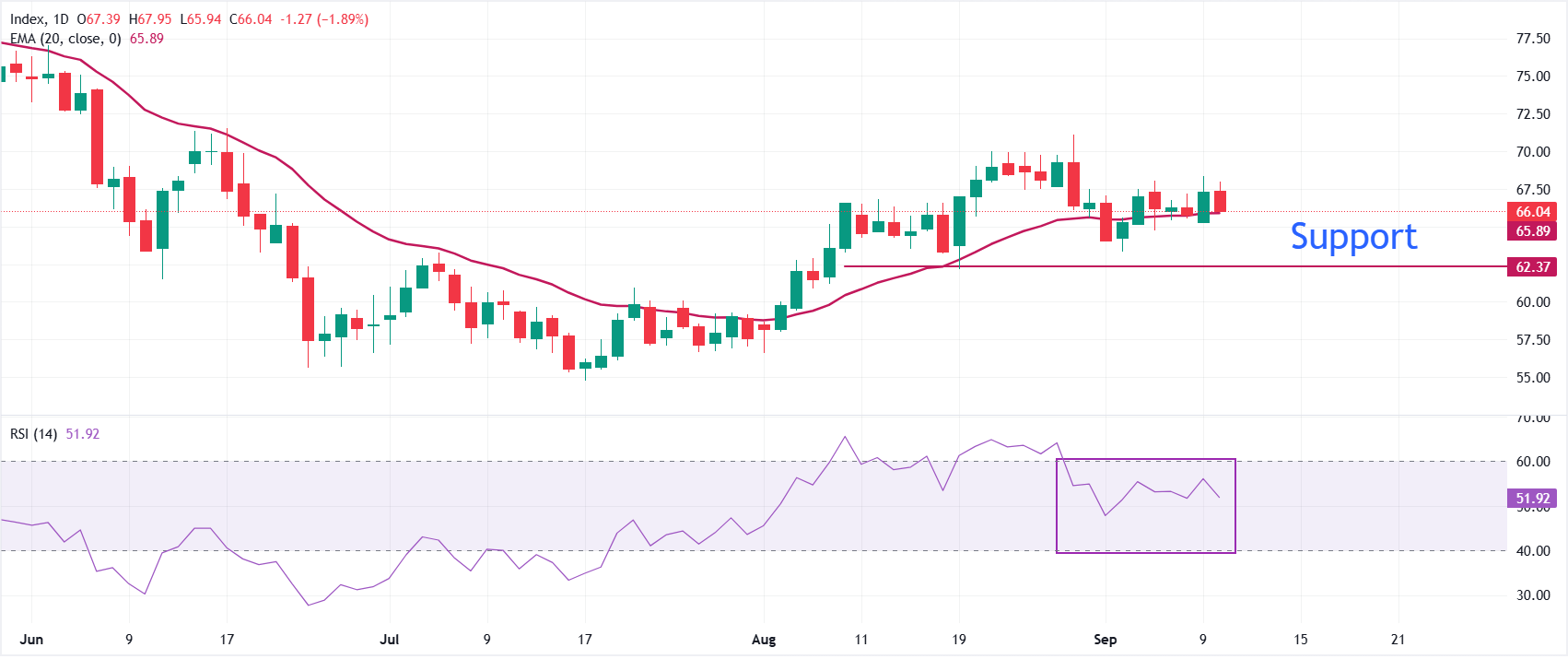
In the daily chart, XAG/USD trades at $65.80, holding a modest bullish bias as price hovers just above the 20-day exponential moving average (EMA) at $65.88. This positioning suggests the metal remains underpinned by short-term trend support, while the Relative Strength Index (RSI) around 52 stays near neutral territory, hinting that upside momentum is tentative rather than impulsive.
On the downside, the August 19 low at $62.19 is the key support level. Looking up, the September 9 high at $68.33 is the major hurdle, followed by the August high at $71.12.
(The technical analysis of this story was written with the help of an AI tool. Know more.)
Silver FAQs
Silver is a precious metal highly traded among investors. It has been historically used as a store of value and a medium of exchange. Although less popular than Gold, traders may turn to Silver to diversify their investment portfolio, for its intrinsic value or as a potential hedge during high-inflation periods. Investors can buy physical Silver, in coins or in bars, or trade it through vehicles such as Exchange Traded Funds, which track its price on international markets.
Silver prices can move due to a wide range of factors. Geopolitical instability or fears of a deep recession can make Silver price escalate due to its safe-haven status, although to a lesser extent than Gold's. As a yieldless asset, Silver tends to rise with lower interest rates. Its moves also depend on how the US Dollar (USD) behaves as the asset is priced in dollars (XAG/USD). A strong Dollar tends to keep the price of Silver at bay, whereas a weaker Dollar is likely to propel prices up. Other factors such as investment demand, mining supply – Silver is much more abundant than Gold – and recycling rates can also affect prices.
Silver is widely used in industry, particularly in sectors such as electronics or solar energy, as it has one of the highest electric conductivity of all metals – more than Copper and Gold. A surge in demand can increase prices, while a decline tends to lower them. Dynamics in the US, Chinese and Indian economies can also contribute to price swings: for the US and particularly China, their big industrial sectors use Silver in various processes; in India, consumers’ demand for the precious metal for jewellery also plays a key role in setting prices.
Silver prices tend to follow Gold's moves. When Gold prices rise, Silver typically follows suit, as their status as safe-haven assets is similar. The Gold/Silver ratio, which shows the number of ounces of Silver needed to equal the value of one ounce of Gold, may help to determine the relative valuation between both metals. Some investors may consider a high ratio as an indicator that Silver is undervalued, or Gold is overvalued. On the contrary, a low ratio might suggest that Gold is undervalued relative to Silver.
Author

Sagar Dua
FXStreet
Sagar Dua is associated with the financial markets from his college days. Along with pursuing post-graduation in Commerce in 2014, he started his markets training with chart analysis.