Silver Price Forecast: XAG/USD extends correction as energy supply concerns remain intact
- Silver price slumps to near $63.80 as global supply concerns keep inflation projections de-anchored.
- Traffic through key passages, the the Strait of Hormuz and Bab al-Mandab Strait, remains almost negligible.
- The Fed is unlikely to deliver an interest rate hike in the September meeting.
Silver price (XAG/USD) is down 1% to near $63.80 during the Asian trading session on Friday. The white metal faces selling pressure as financial markets remain worried about the global energy supply disruption due to the blockade on the Strait of Hormuz and Bab al-Mandab Strait, which together account for almost 27% of global energy supply.
Minimal traffic through these straits is keeping oil prices higher, a scenario that boosts inflation expectations and prompts fears of interest rate hikes by central banks. Such a case bodes poorly for non-yielding assets, like Silver.
As of writing, the WTI Oil price trades flat at around $80.45. The oil price has faced slight selling pressure in the past few days; however, supply concerns are expected to keep the downside limited.
Oil momentum cools, but TD Securities still sees upside ahead
According to TD Securities, the recent loss of steam in the rally has seen “easing near-term momentum” and has “also catalysed modest selling in WTI crude on the day.” However, the bank’s commodity strategists “continue to highlight that fundamental tightness across crude and product markets should ultimately support further upside,” suggesting that the latest bout of selling is viewed as a temporary setback within an otherwise constructive medium-term outlook for Oil prices.
Meanwhile, traders pricing out the possibility of a Federal Reserve (Fed) interest rate hike in the September meeting due to a slight slowdown in United States (US) inflation growth and rising labor market concerns are expected to limit the downside in the Silver price.
According to the CME FedWatch tool, the odds of the Fed holding policy rates steady in the September meeting have increased to almost 65%. This is a sharp turnaround from a 75% chance that the Fed would deliver two interest rate hikes by the end of the September policy meeting, recorded a month ago.
Silver Technical Analysis
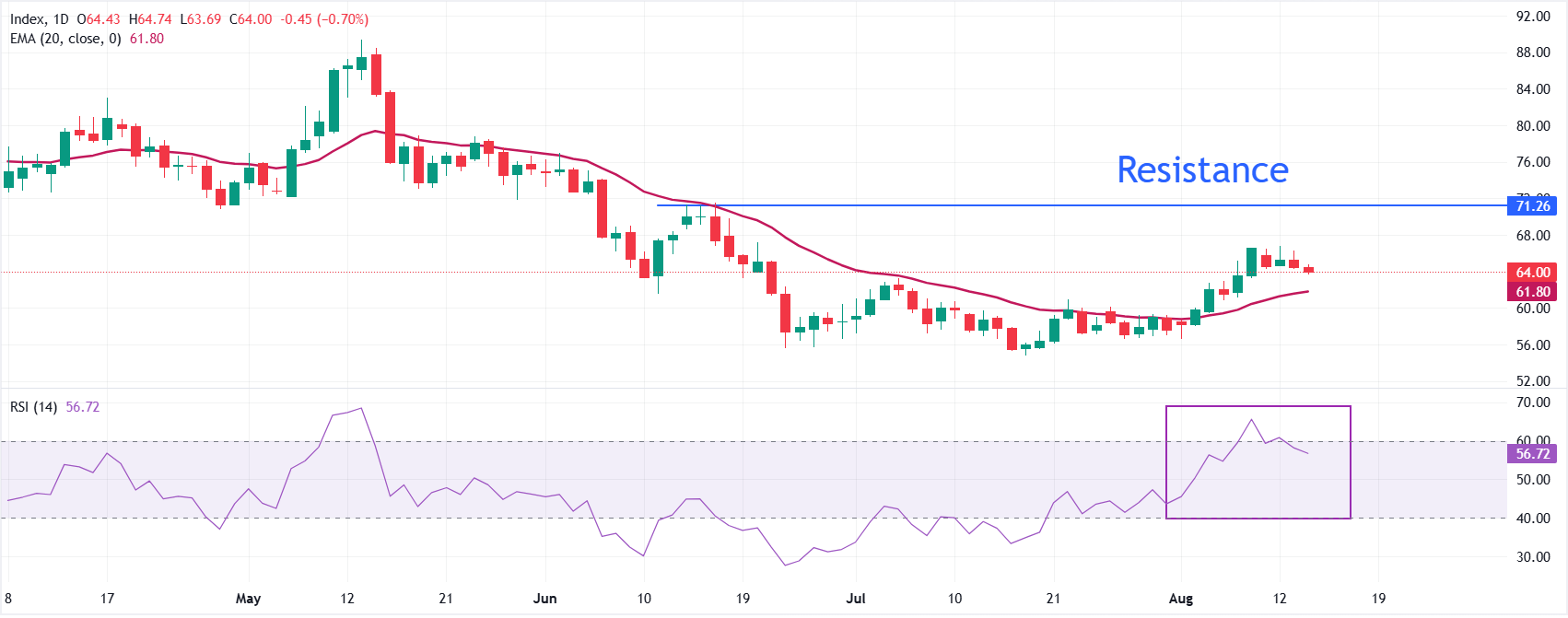
XAG/USD trades at around $63.78, extending its advance above the 20-day Exponential Moving Average (EMA) at $61.78 and hinting at a bullish near-term bias.
The metal is holding comfortably over its short-term trend indicator, while the Relative Strength Index (RSI) at 56 stays in positive territory without reaching overbought conditions, suggesting that buyers retain control but still have room to push prices higher.
On the downside, initial support is seen at the 20-day EMA near $61.78, which underpins the current bullish structure and would be the first level to watch on any pullback. A deeper slide would expose the broader momentum floor implied by the RSI zone around 56, where dip-buying interest could re-emerge as long as price holds above the $61 handle. On the upside, the June 16 high near $71.20 would be the key hurdle.
(The technical analysis of this story was written with the help of an AI tool. Know more.)
Silver FAQs
Silver is a precious metal highly traded among investors. It has been historically used as a store of value and a medium of exchange. Although less popular than Gold, traders may turn to Silver to diversify their investment portfolio, for its intrinsic value or as a potential hedge during high-inflation periods. Investors can buy physical Silver, in coins or in bars, or trade it through vehicles such as Exchange Traded Funds, which track its price on international markets.
Silver prices can move due to a wide range of factors. Geopolitical instability or fears of a deep recession can make Silver price escalate due to its safe-haven status, although to a lesser extent than Gold's. As a yieldless asset, Silver tends to rise with lower interest rates. Its moves also depend on how the US Dollar (USD) behaves as the asset is priced in dollars (XAG/USD). A strong Dollar tends to keep the price of Silver at bay, whereas a weaker Dollar is likely to propel prices up. Other factors such as investment demand, mining supply – Silver is much more abundant than Gold – and recycling rates can also affect prices.
Silver is widely used in industry, particularly in sectors such as electronics or solar energy, as it has one of the highest electric conductivity of all metals – more than Copper and Gold. A surge in demand can increase prices, while a decline tends to lower them. Dynamics in the US, Chinese and Indian economies can also contribute to price swings: for the US and particularly China, their big industrial sectors use Silver in various processes; in India, consumers’ demand for the precious metal for jewellery also plays a key role in setting prices.
Silver prices tend to follow Gold's moves. When Gold prices rise, Silver typically follows suit, as their status as safe-haven assets is similar. The Gold/Silver ratio, which shows the number of ounces of Silver needed to equal the value of one ounce of Gold, may help to determine the relative valuation between both metals. Some investors may consider a high ratio as an indicator that Silver is undervalued, or Gold is overvalued. On the contrary, a low ratio might suggest that Gold is undervalued relative to Silver.
Author

Sagar Dua
FXStreet
Sagar Dua is associated with the financial markets from his college days. Along with pursuing post-graduation in Commerce in 2014, he started his markets training with chart analysis.