Silver Price Forecast: Safe-haven XAG/USD surges as US Dollar slides
- Silver shoots higher after US President Trump accuses China of violating its trade agreement.
- The US Dollar plunges as tariff fears weigh on sentiment, supporting the XAG/USD.
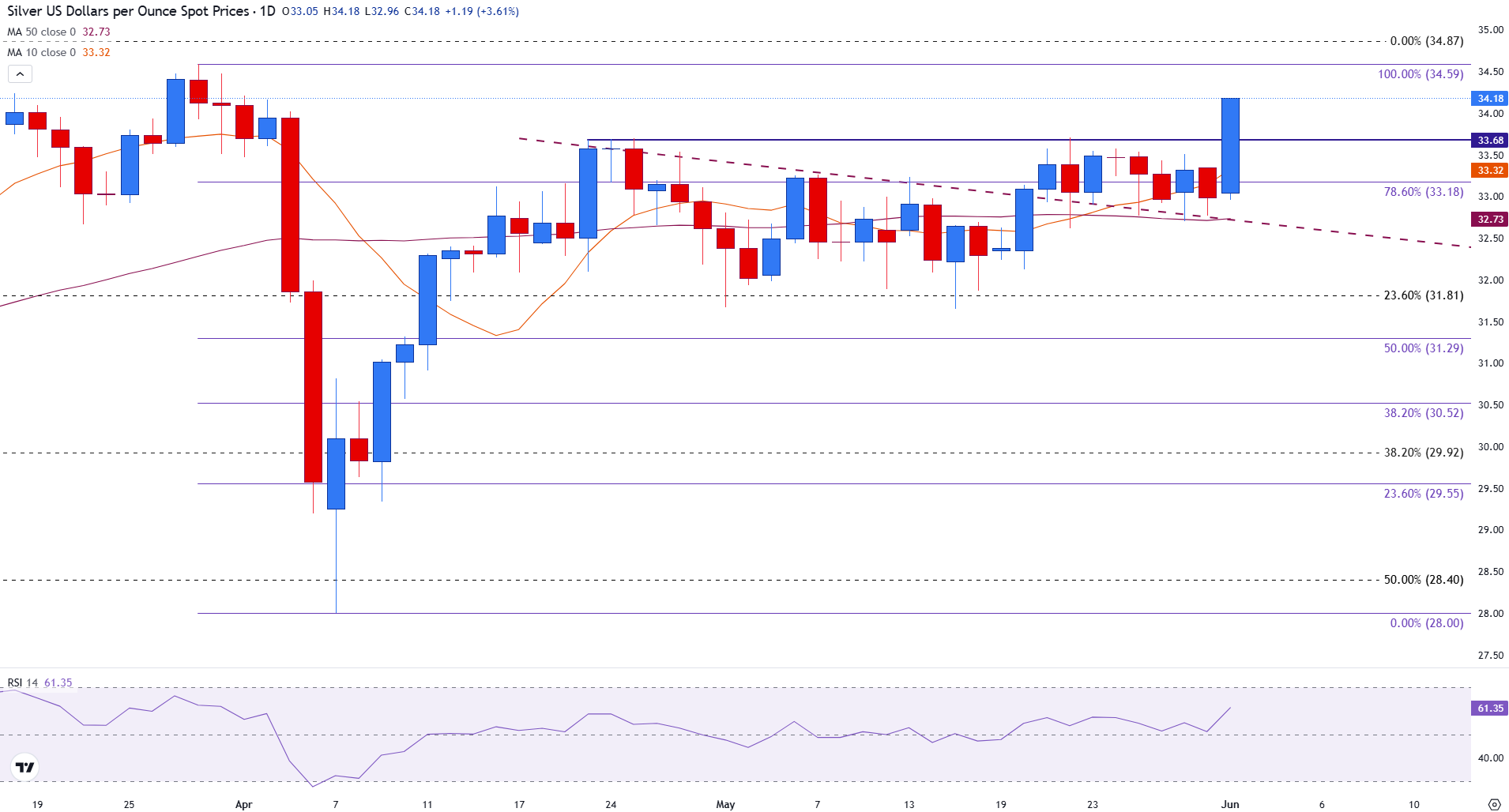
- Silver prices advance above the 10-day SMA, climbing over 3% at the time of writing.
Silver (XAG/USD) is shining brightly on Monday, with prices rallying in response to a weaker US Dollar (USD). With the white precious metal trading over 3% higher on the day, prices have moved above the 10-day Simple Moving Average (SMA), providing support at $33.28 at the time of writing.
Market sentiment and the general mood soured over the weekend, after the US President Donald Trump accused China of violating the temporary trade agreement reached in Geneva on May 12.
In a post released on Truth Social, Trump stated that "China, perhaps not surprisingly to some, HAS TOTALLY VIOLATED ITS AGREEMENT WITH US. So much for being Mr. NICE GUY!"
Although little context was provided, a Reuters article suggested that the frustration appears to stem from China's lack of progress in fast-tracking the development of its rare earth minerals.
According to a report by Reuters on Friday, top global automotive leaders are warning about a looming shortage of rare-earth magnets, which are sourced from China. These magnets are essential components in various automotive applications, including windshield-wiper motors and anti-lock braking systems. This shortage could lead to the shutdown of car manufacturing plants in the near future.
On Thursday, Treasury Secretary Scott Bessent stated during an appearance on Fox News Channel that US trade negotiations with China were "a bit stalled" and that completing a deal would likely require direct engagement from both President Trump and Chinese President Xi Jinping.
The renewed tensions and market jitters tend to boost demand for safe havens, such as Gold and Silver, while reducing demand for risk-sensitive assets.
Silver daily chart
Silver FAQs
Silver is a precious metal highly traded among investors. It has been historically used as a store of value and a medium of exchange. Although less popular than Gold, traders may turn to Silver to diversify their investment portfolio, for its intrinsic value or as a potential hedge during high-inflation periods. Investors can buy physical Silver, in coins or in bars, or trade it through vehicles such as Exchange Traded Funds, which track its price on international markets.
Silver prices can move due to a wide range of factors. Geopolitical instability or fears of a deep recession can make Silver price escalate due to its safe-haven status, although to a lesser extent than Gold's. As a yieldless asset, Silver tends to rise with lower interest rates. Its moves also depend on how the US Dollar (USD) behaves as the asset is priced in dollars (XAG/USD). A strong Dollar tends to keep the price of Silver at bay, whereas a weaker Dollar is likely to propel prices up. Other factors such as investment demand, mining supply – Silver is much more abundant than Gold – and recycling rates can also affect prices.
Silver is widely used in industry, particularly in sectors such as electronics or solar energy, as it has one of the highest electric conductivity of all metals – more than Copper and Gold. A surge in demand can increase prices, while a decline tends to lower them. Dynamics in the US, Chinese and Indian economies can also contribute to price swings: for the US and particularly China, their big industrial sectors use Silver in various processes; in India, consumers’ demand for the precious metal for jewellery also plays a key role in setting prices.
Silver prices tend to follow Gold's moves. When Gold prices rise, Silver typically follows suit, as their status as safe-haven assets is similar. The Gold/Silver ratio, which shows the number of ounces of Silver needed to equal the value of one ounce of Gold, may help to determine the relative valuation between both metals. Some investors may consider a high ratio as an indicator that Silver is undervalued, or Gold is overvalued. On the contrary, a low ratio might suggest that Gold is undervalued relative to Silver.
Author

Tammy Da Costa, CFTe®
FXStreet
Tammy is an economist and market analyst with a deep passion for financial markets, particularly commodities and geopolitics.