|

Semiconductor Index outlook: Upside target reached, correction underway

In our May 26 update on the semiconductor index (SOX), we found, using the Elliott Wave Principle (EWP), that

Based on Fibonacci relationships between 1st, 3rd, and 5th waves, we expect the smaller, green 5th Wave (W-5) to reach $13,400-14,000. Thus, the larger (red) W-iii is rapidly approaching its end, as its 5th wave (green W-5) is underway. Once reached, the odds of a retrace (red W-iv) to about $9,600 increase significantly.”

Fast-forward to today: the index peaked at $13,998 on June 3 and has since fallen 15.9% in just four days, now trading around $11,900. See Figure 1 below. Thus, the updates we’ve presented for the SOX using forward returns and for the EWP since late April have all been on track.

Figure 1. Daily chart of the SOX with short-term Elliott Wave Count (linear scale)
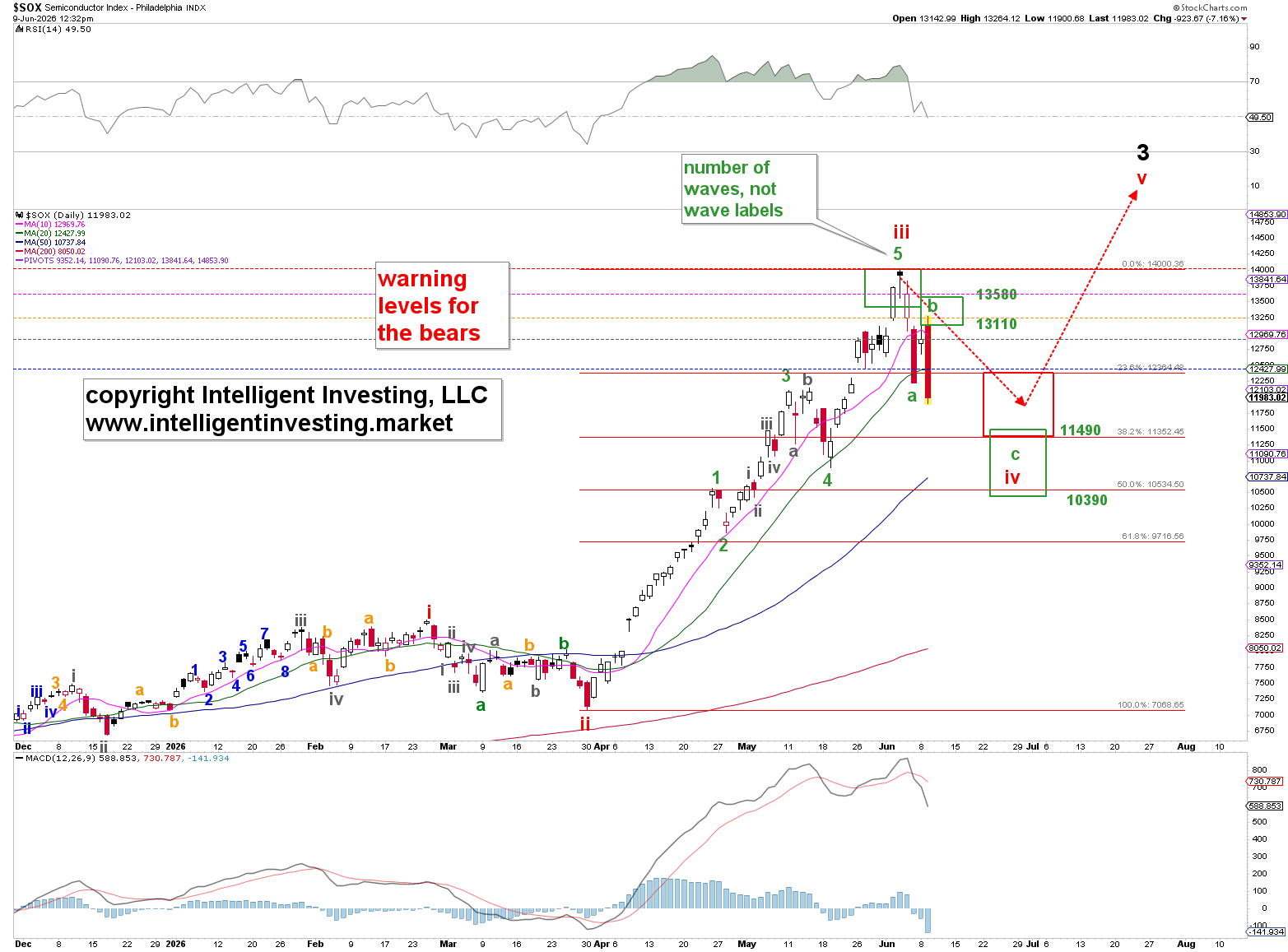
The EWP count remains in line with the index’s price action, having peaked on June 3 at $13,998, right at the top of the ideal target zone for the red 3rd wave; W-iii. Now the red 4th Wave (W-iv) is underway, subdividing into three smaller (green) waves. Unless this 4th wave becomes more complex, which can’t be foreseen, the index should now be in the green W-c, after topping today within the ideal green W-b target zone.

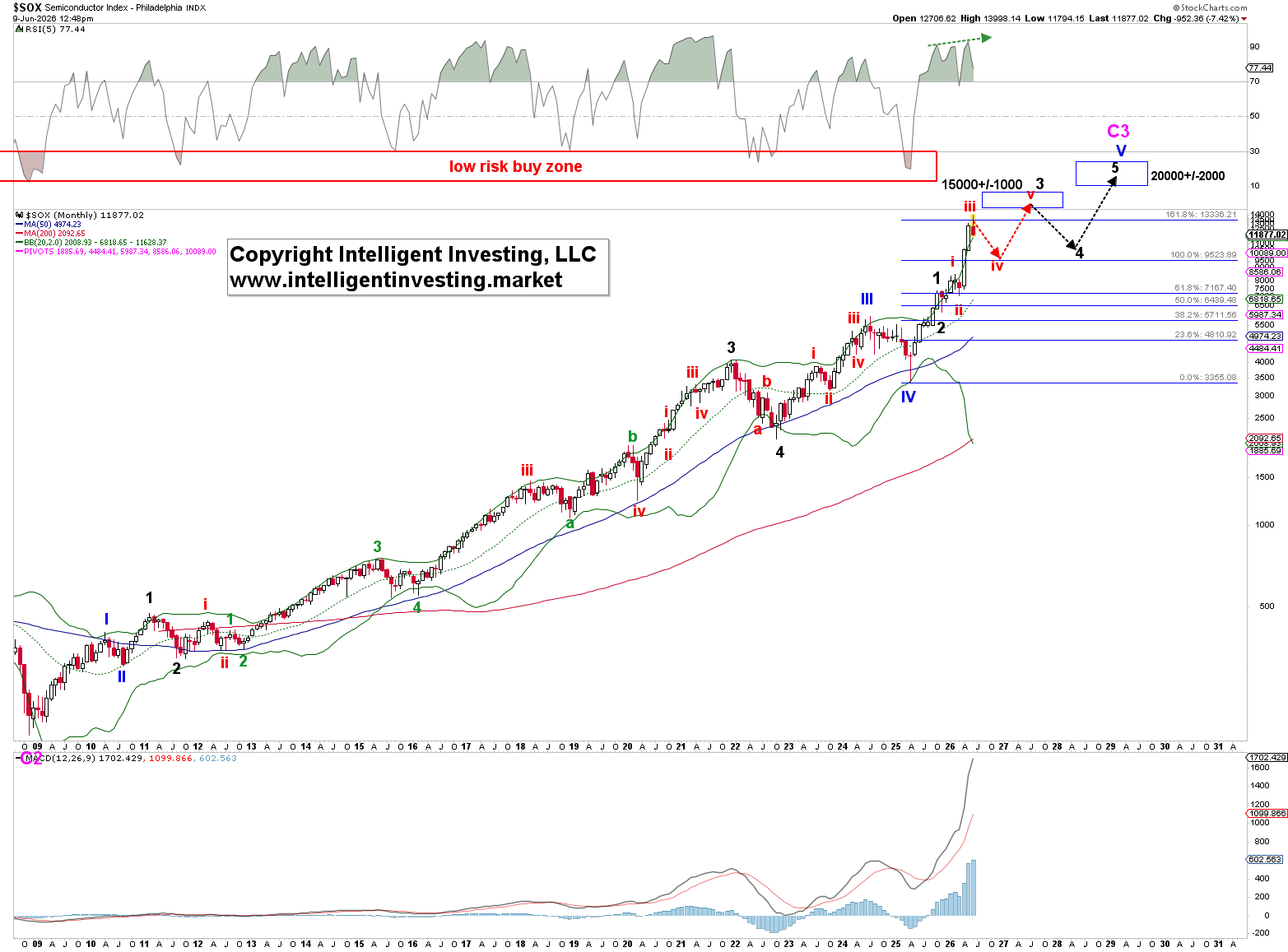
Zooming out, we see that the blue 161.8% extension mentioned in our previous update was reached. See Figure 2 below. With the red W-iii complete and exceeding the 161.80% level at $13,336 by 662p, we can now expect the red W-iv, which often targets the (blue) 100.0%, to stall ~662p north of it ($9,523 + $662 = $10,185), which aligns with the $10,390-11,490 target zone shown in Figure 1. After four comes five, so the red W-v, ideally to $15,000 +/- $1,000, is still pending.

Figure 2. Monthly chart of the SOX with long-term Elliott Wave Count (log-scale)
Author

Dr. Arnout Ter Schure

Dr. Arnout Ter Schure

Intelligent Investing, LLC

After having worked for over ten years within the field of energy and the environment, Dr.

More from Dr. Arnout Ter Schure
Share:

Editor's Picks

GBP/USD defends 1.3300 after strong UK PMI data

Following Thursday's sharp decline, GBP/USD clings to small gains above 1.3300 in the American session on Friday, supported by the upbeat UK Retail Sales and July PMI data. Nevertheless, the pair's upside remains capped as investors cling to a cautious stance amid a further escalation of tensions in the Middle East. The US July PMI data failed to trigger relevant price action.

EUR/USD remains below 1.1400 after mixed US PMIs

EUR/USD pressures daily lows below the 1.1400 mark in the American session on Friday. Mixed S&P Global PMIs, as manufacturing output contracted while services activity expanded in July, triggered no relevant market reaction. The focus remains in Middle East developments and inflation-related concerns.

Gold holds above $4,050 but momentum still missing

Gold builds on its modest intraday bounce and climbs above the $4,050 level on Friday, hitting a fresh daily high amid a modest US Dollar pullback. The fundamental backdrop, however, warrants some caution before confirming that the pullback from an over two-week high, touched on Wednesday, has run its course and positioning for any meaningful upside.

Ethereum: Derivatives interest in ETH improves, but signs of caution remain

Ethereum is hovering slightly below the $1,900 level, down 3% on Thursday following a slight expansion in derivatives interest. The top altcoin's open interest has increased to 14.60 million ETH, marking a 600K ETH increase over the past two days and its highest level since June 7.

XRP retreats as ETF interest cools
Ripple (XRP) slides toward the short-term $1.10 support on Friday, as broader crypto market sentiment weighs on crypto assets. The sell-off mainly stems from fears of inflation in the United States (US) amid the ongoing war in the Middle East and rising Oil prices.
US Dollar mid-year outlook: Exceptional currency, exceptional risks?
The US Dollar enters the second half of 2026 in a markedly different position from a year ago. The King currency has recovered, reflecting persistent US inflation, changing expectations for Fed policy, geopolitical tensions and renewed demand for defensive assets.