Rivian Automotive Stock News: Earnings miss sends RIVN down 9% on Wednesday
- Rivian announced Q4 results late Tuesday.
- EV truck maker missed revenue consensus for the fourth quarter.
- RIVN stock sold off nearly 9% in Wednesday's premarket.
- Rivian projects it will produce 50,000 vehicles in fiscal 2023.

Rivian Automotive (RIVN) shareholders cannot be feeling their best on Wednesday. Tuesday's post-market release of the electric vehicle brand known for its pickup trucks left a sour taste in traders' mouths as Rivian missed the $729.5 million consensus estimate by more than 9%. Additionally, management's guidance for 50,000 vehicles produced during fiscal 2023 was viewed as unimpressive by the market. Shares of RIVN sold off nearly 9% to $17.60.
Rivian stock news: 10K vehicles produced in Q4
Rivian posted $663 million in revenue during the fourth quarter after delivering 8,054 vehicles to customers. The company produced 10,020 vehicles during the quarter, which appears quite positive. This was 36% higher than the third quarter and made up a large segment of the full-year production of 24,337 for 2022. The 20%-odd difference between production and deliveries was caused by delays in rail shipments combined with heavier production toward the back end of the quarter that was a feature of Rivian adding a second shift to its production line.
On the bottom line front, Rivian both produced extremely large losses but performed much better than Wall Street had expected. The automaker reported $-1.73 in adjusted earnings per share, which outdid the $-1.95 predicted by analysts. Also management predicted the company would lose $4.3 billion in adjusted EBITDA for the full year rather than consensus of $4.2 billion.
The 50,000 full-year production guidance was simply unimpressive when placed side by side with the fourth quarter's production level. It would mean Rivian producing on average just 12,500 vehicles per quarter in 2023 – only 25% above the level from Q4. Previously, analysts had seen consensus at 62,200 vehicles for the year. Rivian has experienced numerous setbacks during 2022 that were blamed on logistics, and again those issues appear to be seeping into 2023.
"Our core priorities for 2023 are ramping production of our R1 and RCV platforms, driving cost reductions, developing the R2 platform and its future technologies and delivering an outstanding end-to-end customer experience," said founder, CEO and Chairman Robert Scaringe during the earnings call.
Scaringe focused his remarks on the automaker's drive toward profitability. He said Rivian had called in 400 of its suppliers during the quarter in order to readjust, reengineer and renegotiate its supply agreements. Additionally, he poinpointed the production of the Enduro drive units and lithium iron phosphate battery packs as wholesale products the company will be selling to competitors in the near term. He also boasted about the company's new 390-mile range battery pack for its RS1 model.
Rivian stock forecast
Dropping back to the low $17s here on Wednesday puts Rivian stock on a trajectory to break below the February 24 range low at $16.91. From there it is likely that RIVN stock continues its sell-off until the January demand zone is reached in the mid-$15s. While the Relative Strength Index (RSI) was neutral headed into Tuesday's earnings, bulls will wait to re-enter once the RSI drops to 30 over the next two months. Make no mistake – Rivian stock remains in a bearish trend. This can be seen by the 9-day and 21-day moving averages both acting as resistance in Tuesday's regular trading session.
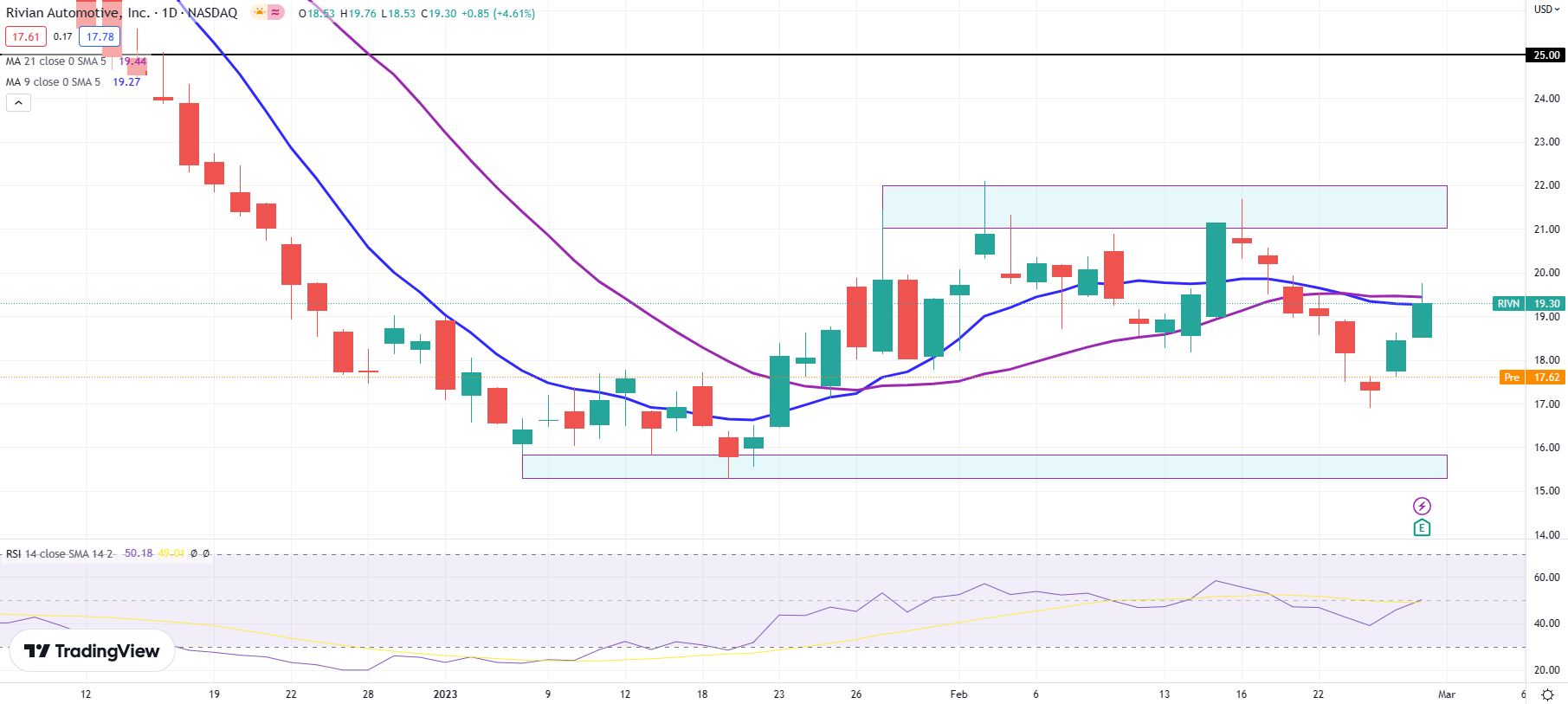
RIVN daily chart
Author

Clay Webster
FXStreet
Clay Webster grew up in the US outside Buffalo, New York and Lancaster, Pennsylvania. He began investing after college following the 2008 financial crisis.