Q3 earnings on track for 8th consecutive quarter of double-digit growth

Here are the key points
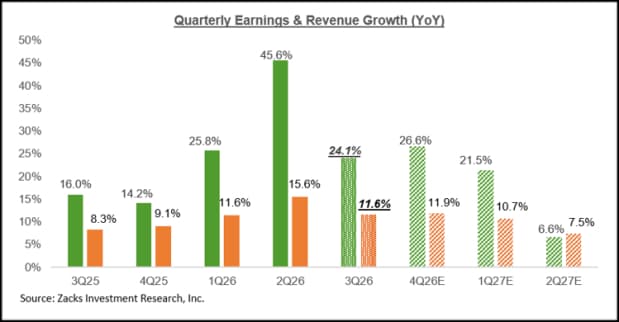
- Total S&P 500 earnings in Q3 are currently expected to increase +24.1% from the same period last year on +11.6% higher revenues, with 14 of the 16 Zacks sectors expected to enjoy positive earnings growth and 6 sectors producing double-digit growth. This will be the most broad-based earnings growth performance in recent times.
- With Conglomerates (-35.2%) and Consumer Staples (-0.1%) as the only Zacks sectors expected to have lower Q3 earnings relative to the year-earlier period, the quarter is on track to produce an impressively broad-based growth performance. Q3 will also be the 8th straight quarter of double-digit earnings growth for the S&P 500 index.
- Sectors expected to enjoy double-digit earnings growth in Q3 are Aerospace (+159.7%), Energy (+111.8%), Tech (+42.1%), Basic Materials (+29.7%), Transportation (+14.4%), and Industrial Products (+13.1%).
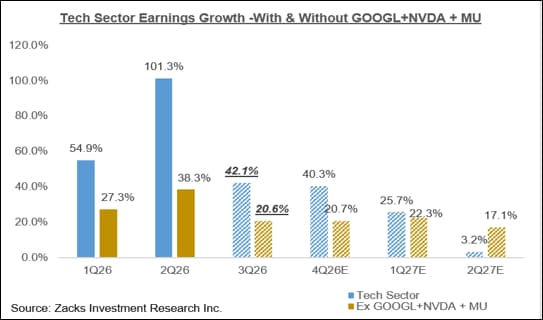
- Micron (MU) and Nvidia (NVDA) continue to be material contributors to the Tech sector’s growth picture. Excluding Nvidia, Micron, and Alphabet (GOOGL), which enjoyed an outsized gain in the preceding period, Q3 earnings for the rest of the Tech sector would be +20.6% (vs. +42.1% otherwise).
The earnings big picture
The chart below shows S&P 500 expectations for 2026 Q3 in terms of what was achieved in the preceding four periods and what is currently expected for the following three quarters.
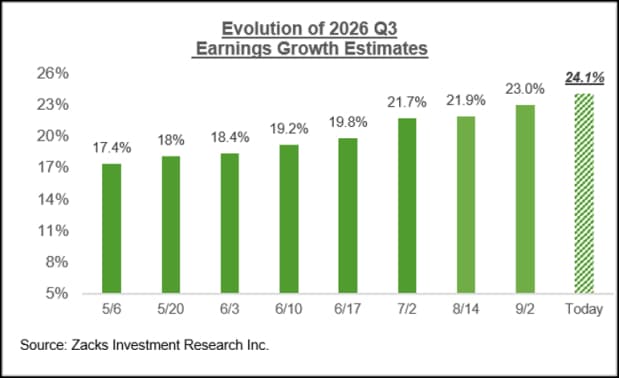
The chart below shows how Q3 earnings growth expectations have evolved lately.
Since the start of Q3, the Energy sector has enjoyed the most pronounced upgrade to its earnings outlook, reflecting elevated oil prices as a result of the Persian Gulf situation. Other sectors enjoying positive estimate revisions since the start of Q3 include Aerospace, Industrial Products, Tech, Autos, Transportation, Finance, and Utilities. It is significant to note that the aggregate revisions trend would still be positive if we excluded the positive revisions to the Energy or Tech sector.
The Tech sector remains a major contributor to aggregate earnings growth, with Q3 earnings growth dropping to +14.5% once the sector’s contribution is excluded from the index. The semiconductor industry within the Tech sector has enjoyed a particularly robust demand environment lately, and that trend remains in place in Q3 as well.
The Zacks Semiconductor industry at the mezzanine level is expected to enjoy +85.5% earnings growth in 2026 Q3 on +62.8% revenue growth, following the industry’s +110.1% and +96% earnings growth in each of the preceding two periods.
The Tech sector’s +42.1% earnings growth in Q3 drops to +29.6% once the semiconductor’s contribution is excluded. If we exclude Nvidia, Micron, and Alphabet, Q3 earnings growth for the rest of the Zacks Tech sector drops to +20.6%, as the chart below shows.
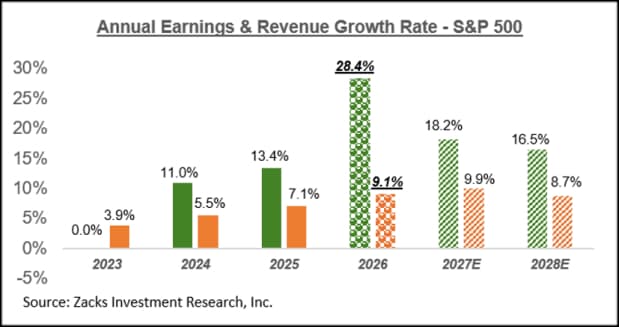
The chart below shows the overall earnings picture for the S&P 500 index on an annual basis.
The favorable revisions trend noted earlier in the context of Q3 estimates is also at play with estimates for the last quarter of the year, with mostly the same sectors enjoying positive revisions.
Want the latest recommendations from Zacks Investment Research? Download 7 Best Stocks for the Next 30 Days. Click to get this free report
Author

Zacks
Zacks Investment Research
Zacks Investment Research provides unbiased investment research and tools to help individuals and institutional investors make confident investing decisions.