Pound Sterling's best level since May was made in Washington
- GBP/USD closed 0.53% higher, the best close in three months.
- UK core inflation held at 2.6% against a 2.5% consensus.
- Retail sales and August PMIs both forecast lower on Friday.

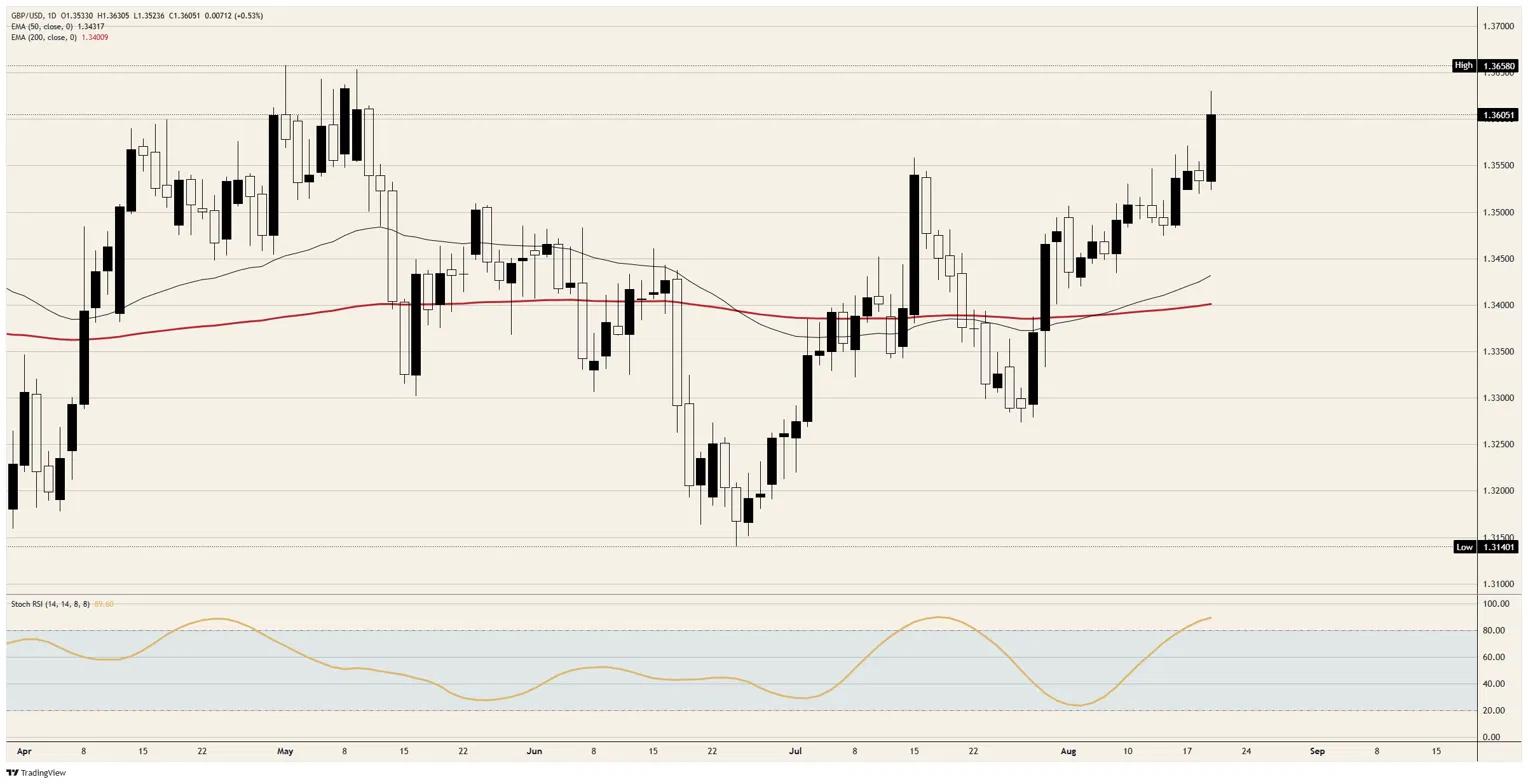
GBP/USD closed Wednesday 0.53% higher just above 1.3600, its best close in three months, and the United Kingdom inflation report that opened the session had almost nothing to do with it. Sterling spent the London morning up barely twenty pips on the day. The entire advance arrived after midday, when a Treasury notice in New York pulled the floor out from under the Dollar.
An energy cap is not a hike case
Annual Consumer Price Index (CPI) inflation rose to 2.9% in July from 2.6%, matching consensus and marking the first increase in the headline rate since March. Core held at 2.6% against a 2.5% forecast, the only line on the page that beat. Services inflation, the series the Bank of England (BoE) actually watches, slowed to 3.4% from 3.6%.
The composition kills the hawkish reading. The move came out of a 13.5% increase in the regulated household energy cap that took effect in July, with domestic gas prices up 14.7% on the month, against transport inflation falling to 3.6% from 5.7% on cheaper diesel and food easing to 1.3%. That is an administered price working through an index rather than domestic demand pushing on it, and a committee that already held 6-3 in July has been handed no new reason to move on September 17.
None of it was a surprise to the people setting the rate. The July projection already had inflation peaking near 3.2% in the final quarter of the year on exactly this energy passthrough, which means Wednesday's rise was forecast, absorbed and priced long before it printed. Tuesday's labour market report had gone the other way and pressured Sterling, so the pair arrived into Wednesday carrying a domestic negative and left it carrying a foreign positive.
The move was made in Washington
The Treasury said on Wednesday it would at least double the size of its liquidity support buyback operations in longer-dated bonds, taking each operation from 2 billion Dollars to at least 4 billion from September 9. Long yields fell hard, the thirty-year giving back close to ten basis points from a print above 5.33% the previous day, and the Dollar was sold against every major counterpart into the American afternoon.
Sterling was not among the leaders of that move. The Swiss Franc gained close to 1.8% against the Dollar on the session and the New Zealand Dollar roughly 1%, which is what a broad unwind looks like when the seller is indifferent to what it buys instead. A three-month high built on another country's fiscal housekeeping is a Dollar position wearing a Sterling label, and it cleared the moving average band near 1.3400 that capped this pair through June and July with no domestic catalyst in it anywhere.
The mechanism is worth naming because it decides how durable the level is. An issuer announcing that it will buy back more of its own long-dated paper reduces yields by supplying a bid rather than by improving the inflation outlook, and currency markets treat those two routes to the same yield very differently. Gold ran toward $4,500 an ounce on the same news, which is not the behaviour of a market that thinks American inflation risk just fell.
Every British number left this week is forecast lower
GfK consumer confidence for August lands Thursday at 23:01 GMT with a consensus of -18 against a -17 prior. Friday opens at 06:00 GMT with July retail sales, forecast at -0.5% on the month against a 1% prior, -0.5% excluding fuel from 1.1%, and 2.2% annually against 4.2%. The annual line roughly halving is the number that matters, because it converts one soft month into a direction.
The preliminary August S&P Global Purchasing Managers Index (PMI) series follows at 08:30 GMT, composite at 51.5 from 52.2, services 51.8 from 52.1 and manufacturing 51.5 from 51.9. Every domestic release left on the week is forecast beneath its prior, which leaves the Pound at its best level since May going into a calendar consensus already expects to disappoint. The Dollar leg is the only thing holding this trade together, and it is the only leg worth watching.
Pound Sterling levels
Resistance: The session high short of 1.3650 is the first barrier, then the early-May peak just above 1.3650, with 1.3700 the level that turns this into a trend break rather than a Dollar accident.
Support: The 1.3600 handle now has to hold as the floor of the breakout, then 1.3550, with the 50-day Exponential Moving Average (EMA) near 1.3450 and the 200-day near 1.3400 far beneath. Daily Stochastic Relative Strength Index (Stoch RSI) near 90 sits deep in overbought territory and argues for consolidation before any extension.
Bias: Bullish while 1.3550 holds, objectives the early-May peak just above 1.3650 then 1.3700, invalidation on a daily close back beneath 1.3550.
GBP/USD daily chart
Pound Sterling FAQs
The Pound Sterling (GBP) is the oldest currency in the world (886 AD) and the official currency of the United Kingdom. It is the fourth most traded unit for foreign exchange (FX) in the world, accounting for 12% of all transactions, averaging $630 billion a day, according to 2022 data. Its key trading pairs are GBP/USD, also known as ‘Cable’, which accounts for 11% of FX, GBP/JPY, or the ‘Dragon’ as it is known by traders (3%), and EUR/GBP (2%). The Pound Sterling is issued by the Bank of England (BoE).
The single most important factor influencing the value of the Pound Sterling is monetary policy decided by the Bank of England. The BoE bases its decisions on whether it has achieved its primary goal of “price stability” – a steady inflation rate of around 2%. Its primary tool for achieving this is the adjustment of interest rates. When inflation is too high, the BoE will try to rein it in by raising interest rates, making it more expensive for people and businesses to access credit. This is generally positive for GBP, as higher interest rates make the UK a more attractive place for global investors to park their money. When inflation falls too low it is a sign economic growth is slowing. In this scenario, the BoE will consider lowering interest rates to cheapen credit so businesses will borrow more to invest in growth-generating projects.
Data releases gauge the health of the economy and can impact the value of the Pound Sterling. Indicators such as GDP, Manufacturing and Services PMIs, and employment can all influence the direction of the GBP. A strong economy is good for Sterling. Not only does it attract more foreign investment but it may encourage the BoE to put up interest rates, which will directly strengthen GBP. Otherwise, if economic data is weak, the Pound Sterling is likely to fall.
Another significant data release for the Pound Sterling is the Trade Balance. This indicator measures the difference between what a country earns from its exports and what it spends on imports over a given period. If a country produces highly sought-after exports, its currency will benefit purely from the extra demand created from foreign buyers seeking to purchase these goods. Therefore, a positive net Trade Balance strengthens a currency and vice versa for a negative balance.
Author

Joshua Gibson
FXStreet
Joshua joins the FXStreet team as an Economics and Finance double major from Vancouver Island University with twelve years' experience as an independent trader focusing on technical analysis.

















