|

Pound Sterling Price News and Forecast: GBP/USD soars above 1.3400 [Video]

GBP/USD soars above 1.3400 as threat to Fed’s independence batters US Dollar

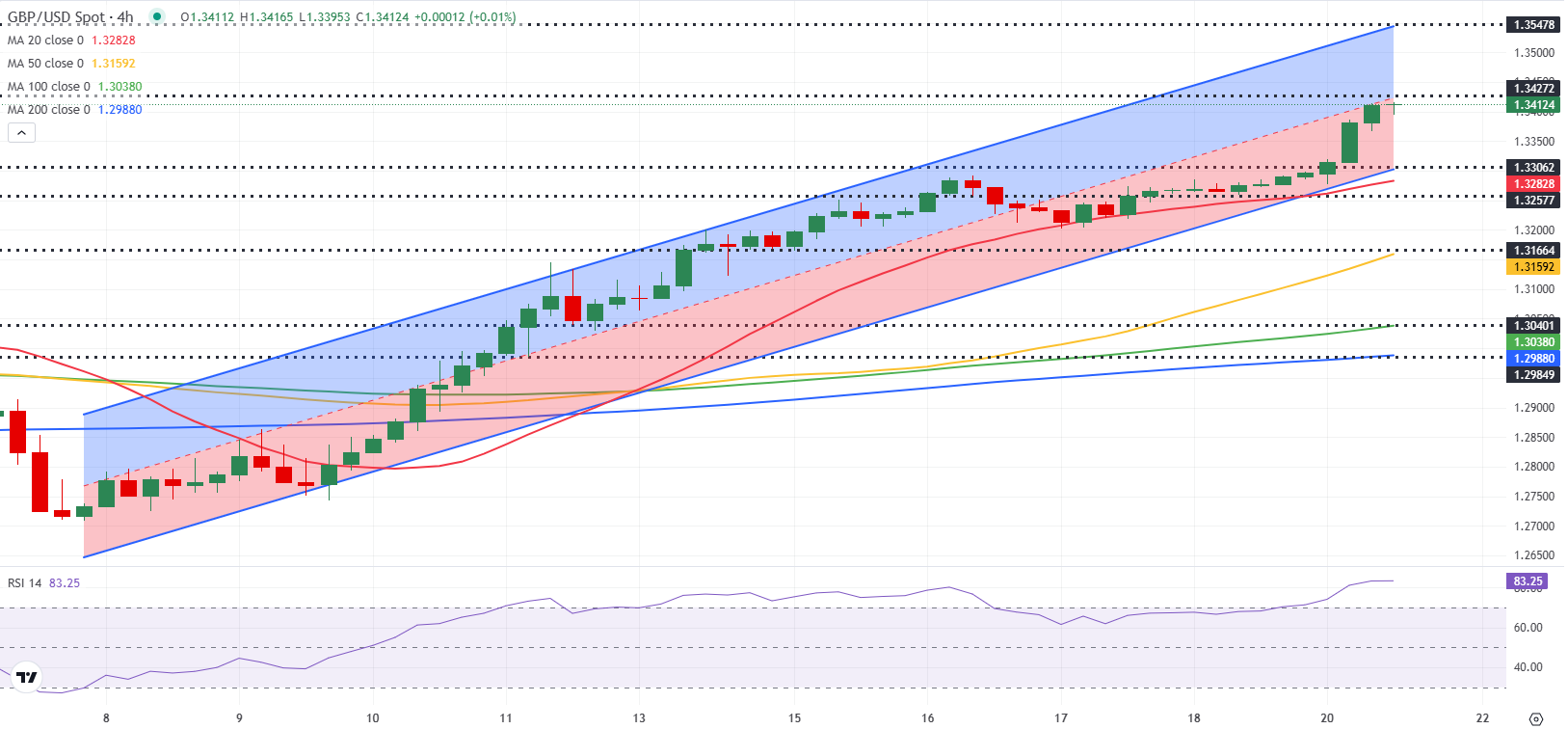
The GBP/USD pair rallies to near 1.3400 during European trading hours on Monday, the highest level seen in seven months. The Cable strengthens as the US Dollar (USD) has been battered by the threat to the Federal Reserve’s (Fed) independence after United States (US) President Donald Trump.

The US Dollar Index (DXY), which tracks the Greenback’s value against six major currencies, is down over 1% to a fresh three-year low near 98.00. Read more...

GBP/USD Forecast: Pound Sterling could face next resistance at 1.3430

GBP/USD extends its uptrend to start the week and trades at its highest level since September near 1.3400. The pair could face stiff resistance at 1.3430.

Following the long weekend, the US Dollar (USD) comes under a strong selling pressure on Monday as the US-China trade conflict shows no signs of de-escalation anytime soon. Read more...
GBP/USD Elliott Wave technical analysis [Video]

The GBPUSD daily chart displays a clear trending pattern using the Elliott Wave theory. Currently, the currency pair is moving within navy blue wave 1, part of the broader gray wave 1. This positioning indicates the beginning of a new impulse wave, which could gain momentum in upcoming sessions. The structure suggests this is the first wave in what might develop into a complete five-wave impulse pattern across current and higher timeframes. Read more...

Youtube preview

Author

FXStreet Team

Composed of a group of economic journalists and FX experts, the FXStreet content team produces and oversees all content published on FXStreet. It provides a purely journalistic approach to the Forex market.


More from FXStreet Team
Share:

Editor's Picks

AUD/USD sits at two-month lows near 0.6950 after Australian CPI data

AUD/USD is sitting at two-month lows near 0.6950 in the Asian session on Wednesday, as below-expectations August Australian underlying CPI data pours cold water on expectations for further RBA interest rate hikes. Chinese PMI data also fail to inspire the Australian Dollar, despite a pause in the US Dollar advance.

USD/JPY stays weak below 157.00 amid Japanese intervention risks

USD/JPY keeps losses below 157.00 in the Asian session on Wednesday, as hawkish BoJ expectations, along with intervention risks, underpin the Japanese Yen, countering dismal domestic factory output and retail sales data. Meanwhile, a broad US Dollar retreat also collaborates to the pair's downside.

Gold flat lines below $4,200 as traders await US PCE data for Fed rate cues

Gold extends its consolidative price move heading into the European session, trading below the $4,200 mark amid mixed fundamental cues. Falling US bond yields drag the US Dollar away from the two-month high, touched on Tuesday, and act as a tailwind for the commodity. However, hawkish US Federal Reserve expectations cap the upside as traders await important US macro data before placing fresh directional bets on the non-yielding bullion.

Aave Price consolidates below $161 as profit-taking emerges after 10% surge

Aave slips below $161 on Wednesday after surging more than 10% the previous day, with on-chain data suggesting increased profit-taking. Meanwhile, Aave founder Stani Kulechov is considering an AAVE token-burn mechanism under Aavenomics 3.0, adding a potential catalyst for AAVE.

US core PCE inflation set to rise in August, pressuring the Federal Reserve

The United States Bureau of Economic Analysis will publish the Personal Consumption Expenditures Price Index data for August on Wednesday at 12:30 GMT. Market participants closely watch the PCE Price Index because it is the Federal Reserve’s preferred measure of inflation and could influence its policy outlook.

Silver is more volatile than Gold ahead of PCE and NFP. This chart shows the positioning gap
The market’s attention is focused on American data this week, but there’s something only those with a trained eye may be looking at: Gold and Silver positioning gap. Financial markets are moving on fears, mostly related to persistently high energy prices driven by the Middle East war. Sure, the US Dollar (USD) is strong, but at what cost?