Pound Sterling holds the line, on loan from a cracking Dollar
- GBP/USD is clawing back toward its moving-average cluster after defending a long-term floor near its seven-month lows.
- The recovery is a Dollar story, with a soft US jobs report doing the heavy lifting rather than any fresh strength at home.
- A leaderless government and a US-heavy data week leave the Pound a passenger, with the Bank of England's July meeting the only domestic catalyst that matters.
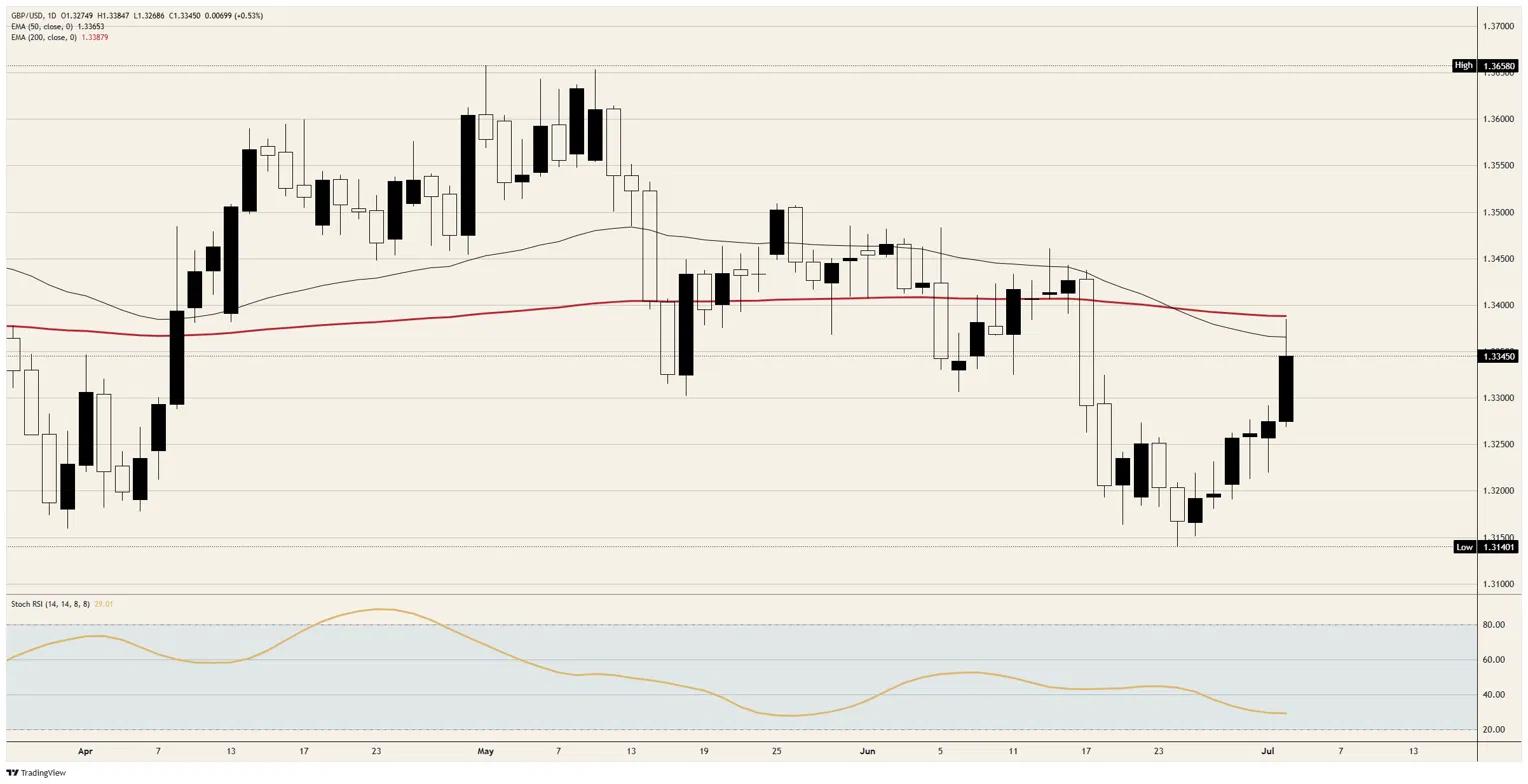
The Pound bounced off the long-term support line that has repeatedly held near its seven-month lows, clawing back toward the cluster of moving averages overhead. The honest read, though, is that this is a Dollar story more than a Sterling one: a soft US jobs report did the work while the Pound simply caught the updraft. A leaderless government back home keeps a firm lid on any talk of a durable rally in the Pound.
A bounce the Dollar paid for
The catalyst sits entirely on the US side of the pair. June Nonfarm Payrolls (NFP) landed at just 57K against expectations near 110K, reviving doubts about further Federal Reserve (Fed) tightening and dragging the Dollar lower across the board. GBP/USD is a beneficiary of that move rather than a leader of it. Its floor held this week because the greenback wobbled, not because anyone suddenly decided they wanted to own the Pound.
Westminster's leadership vacuum
The political backdrop is what turns a routine Dollar-driven bounce into a capped one. Prime Minister Keir Starmer resigned in late June, triggering a Labour leadership contest in which Greater Manchester mayor Andy Burnham has emerged as the clear frontrunner and the market's main focus. Fiscal-credibility fears around spending and taxes have kept a political risk premium on both the Pound and gilts. Burnham's pledge of fiscal discipline has taken some of the edge off, yet a central bank flirting with another hike into a leaderless government is a fragile foundation for any durable rally.
The Bank offers a floor, not a launchpad
The Bank of England (BoE) is the other reason the Pound has any floor at all. Rates are being held at 3.75% after a hawkish split on the Monetary Policy Committee (MPC). While the Governor keeps striking a patient tone and ruling out imminent cuts, the committee's hawks remain vocal and the market is still pricing a possible hike at the July 30 meeting. That yield support is real, but the policy-divergence story that favoured the Pound now cuts both ways, because the US data has softened and the gap that mattered is starting to narrow from the other side.
What comes next is a US-shaped week
The immediate test is a speech from the BoE Governor on Friday at 15:00 GMT, where another patient, dovish-leaning message would likely cap the bounce before it reaches the moving-average cluster. US markets are closed on Friday for the Independence Day holiday, and next week's docket is decidedly US-based. The Institute for Supply Management (ISM) services survey arrives Monday at 14:00 GMT; the Federal Open Market Committee (FOMC) minutes land Wednesday at 18:00 GMT, read from the hawkish June meeting against fresher and softer data; and weekly jobless claims follow Thursday. The only domestic inputs are BoE speakers and Tuesday's Financial Stability Report, which leaves the Pound's near-term direction as a US call rather than a British one.
Levels to watch
Resistance: The recovery runs into a wall of moving averages just overhead, with the 50-period Exponential Moving Average (EMA) near 1.3350 and the 200 EMA close to 1.3400. Momentum is on the bounce's side for now, as the Stochastic Relative Strength Index (Stoch RSI) turns up from near-oversold, but a daily close above the moving-average band is what would open the door to 1.3450 and then the 1.3500 handle.
Support: The long-term line near 1.3200 is the level that defines the whole setup, defended repeatedly through the Pound's seven-month lows. Just above it, 1.3300 is the first minor shelf on any pullback. A daily close below 1.3200 would expose 1.3150 and then the 1.3100 handle, confirming the Dollar-driven bounce has run out of road.
Bias: The near-term path points higher toward the 1.3400 cluster while 1.3200 survives, but this is a rally built on Dollar weakness rather than Sterling strength, so it lives and dies by the US data. A decisive break of 1.3200 flips the bias lower toward 1.3150; given how much of the move is borrowed, that floor deserves close watching into next week's American releases.
GBP/USD daily chart
Pound Sterling FAQs
The Pound Sterling (GBP) is the oldest currency in the world (886 AD) and the official currency of the United Kingdom. It is the fourth most traded unit for foreign exchange (FX) in the world, accounting for 12% of all transactions, averaging $630 billion a day, according to 2022 data. Its key trading pairs are GBP/USD, also known as ‘Cable’, which accounts for 11% of FX, GBP/JPY, or the ‘Dragon’ as it is known by traders (3%), and EUR/GBP (2%). The Pound Sterling is issued by the Bank of England (BoE).
The single most important factor influencing the value of the Pound Sterling is monetary policy decided by the Bank of England. The BoE bases its decisions on whether it has achieved its primary goal of “price stability” – a steady inflation rate of around 2%. Its primary tool for achieving this is the adjustment of interest rates. When inflation is too high, the BoE will try to rein it in by raising interest rates, making it more expensive for people and businesses to access credit. This is generally positive for GBP, as higher interest rates make the UK a more attractive place for global investors to park their money. When inflation falls too low it is a sign economic growth is slowing. In this scenario, the BoE will consider lowering interest rates to cheapen credit so businesses will borrow more to invest in growth-generating projects.
Data releases gauge the health of the economy and can impact the value of the Pound Sterling. Indicators such as GDP, Manufacturing and Services PMIs, and employment can all influence the direction of the GBP. A strong economy is good for Sterling. Not only does it attract more foreign investment but it may encourage the BoE to put up interest rates, which will directly strengthen GBP. Otherwise, if economic data is weak, the Pound Sterling is likely to fall.
Another significant data release for the Pound Sterling is the Trade Balance. This indicator measures the difference between what a country earns from its exports and what it spends on imports over a given period. If a country produces highly sought-after exports, its currency will benefit purely from the extra demand created from foreign buyers seeking to purchase these goods. Therefore, a positive net Trade Balance strengthens a currency and vice versa for a negative balance.
Author

Joshua Gibson
FXStreet
Joshua joins the FXStreet team as an Economics and Finance double major from Vancouver Island University with twelve years' experience as an independent trader focusing on technical analysis.