Pound Sterling extends losing spell as UK yields soar further
- The Pound Sterling faces a sharp sell-off as rising borrowing costs for the UK government could force the administration to cut public spending.
- Surprisingly upbeat US NFP data has forced traders to pare dovish Fed bets.
- Investors await the UK-US inflation data for December, which will be released on Wednesday.

The Pound Sterling (GBP) extends its losing streak against its major peers at the start of the week. The British currency continues to face selling pressure as soaring yields on United Kingdom (UK) 30-year gilts deepen concerns over the nation’s economic outlook.
30-year UK gilt yields roar to near 5.47%, the highest level since 1998. Market experts view the surge in gilt yields as partly driven by the uncertainty over incoming trade policies by United States (US) President-elect Donald Trump, who is set to enter the White House on January 20, and the UK’s heavy reliance on foreign financing to address their funds’ demand for domestic spending.
"The more a country relies on foreign financing for its domestic debt issuance, the more exposed it is to the global environment," Deutsche Bank said and added that from the perspective of external flows, the UK is one of the “most vulnerable in the G10".
Soaring UK government’s borrowing costs have jeopardized Chancellor of the Exchequer Rachel Reeves’s decision to fund day-to-day spending through tax receipts and cut public spending. However, UK Treasury Minister Darren Jones clarified at the House of Commons on Thursday that the government's decision to only borrow for investment was "non-negotiable”.
Going forward, the next trigger for the Pound Sterling will be the UK Consumer Price Index (CPI) data for December, which will be released on Wednesday. The consumer inflation data will significantly influence market speculation about the Bank of England’s (BoE) monetary policy outlook. Currently, UK rate futures show that traders pare BoE dovish bets and see a 44 basis points (bps) interest rate reduction this year against the 50 bps recorded last week.
Daily digest market movers: Pound Sterling underperforms US Dollar, UK-US inflation takes center stage
- The Pound Sterling posts a fresh yearly low to near 1.2100 against the US Dollar (USD) on Monday. The GBP/USD pair weakens as the US Dollar strengthens as traders pare Federal Reserve (Fed) dovish bets this year after the release of the surprisingly robust US Nonfarm Payrolls (NFP) data for December.
- The US Dollar Index (DXY), which gauges the Greenback’s value against six major currencies, moves higher to a more-than-two-year high above 110.00. The US NFP report showed that labor demand remained strong and the Unemployment Rate decelerated, easing fears of a slowdown in the job market, which forced Fed policymakers to pivot to a policy-easing cycle with a larger-than-usual pace of 50 basis points (bps) in September.
- Analysts at Macquarie expect the Fed to cut borrowing rates only once this year, with the current interest rate cycle bottoming in the range of 4.00%-4.25%.
- This week, investors will focus on the US Producer Price Index (PPI) and Consumer Price Index (CPI) data for December, which will be published on Tuesday and Wednesday, respectively. Signs of stubborn inflation data would further weigh on the Fed’s dovish bets.
Technical Analysis: Pound Sterling sees support near 1.2100 amid strong bearish momentum
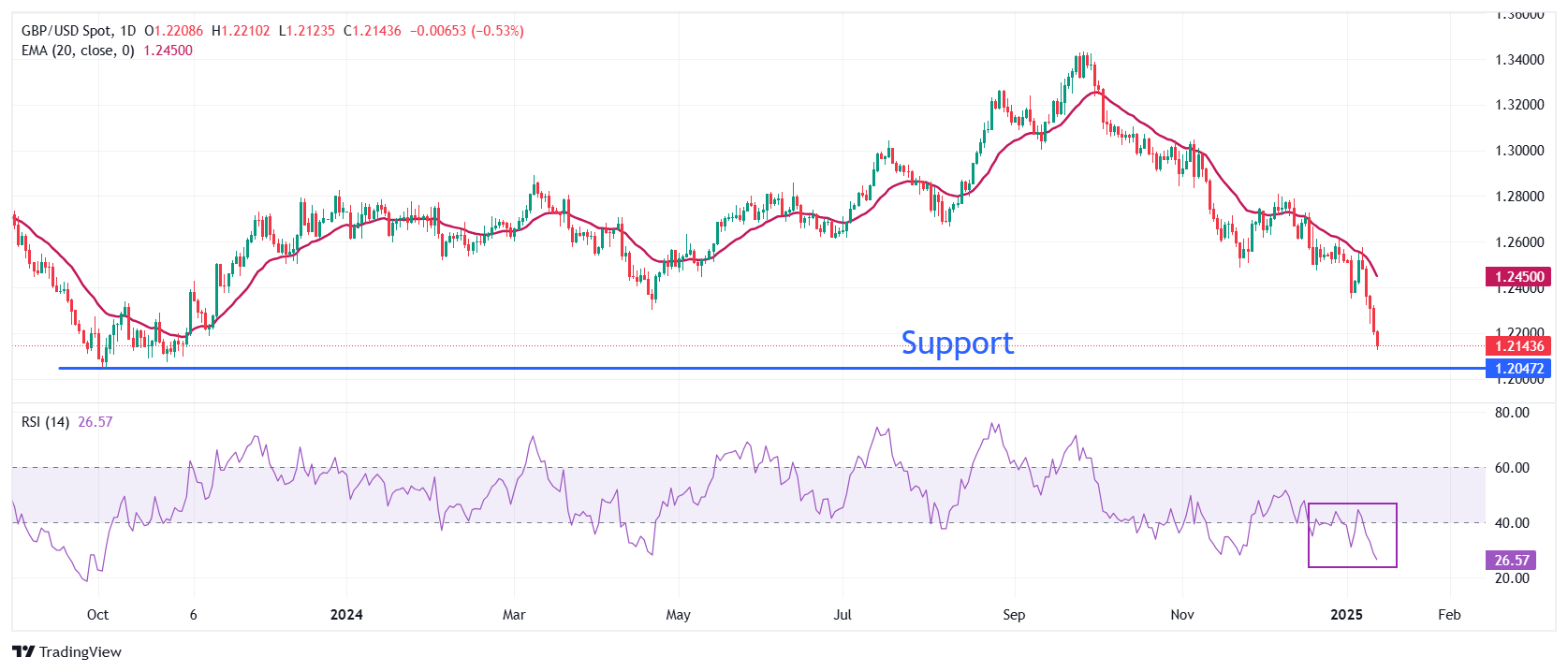
The Pound Sterling refreshes its more-than-a-year low to near 1.2120 against the US Dollar in Monday’s European session. The selling pressure in the GBP/USD pair was triggered after the pair broke below the January 2 low of 1.2350.
Vertically declining 20-day Exponential Moving Average (EMA) near 1.2450 suggests that the near-term trend is extremely bearish.
The 14-day Relative Strength Index (RSI) slides to nearly 26.70, the lowest since October 2023. This scenario suggests a strong bearish momentum. However, a slight recovery cannot be ruled out as the momentum oscillator is in oversold territory.
Looking down, the pair is expected to find support near the October 2023 low of 1.2050. On the upside, the 20-day EMA will act as key resistance.
UK gilt yields FAQs
UK Gilt Yields measure the annual return an investor can expect from holding UK government bonds, or Gilts. Like other bonds, Gilts pay interest to holders at regular intervals, the ‘coupon’, followed by the full value of the bond at maturity. The coupon is fixed but the Yield varies as it takes into account changes in the bond's price. For example, a Gilt worth 100 Pounds Sterling might have a coupon of 5.0%. If the Gilt's price were to fall to 98 Pounds, the coupon would still be 5.0%, but the Gilt Yield would rise to 5.102% to reflect the decline in price.
Many factors influence Gilt yields, but the main ones are interest rates, the strength of the British economy, the liquidity of the bond market and the value of the Pound Sterling. Rising inflation will generally weaken Gilt prices and lead to higher Gilt yields because Gilts are long-term investments susceptible to inflation, which erodes their value. Higher interest rates impact existing Gilt yields because newly-issued Gilts will carry a higher, more attractive coupon. Liquidity can be a risk when there is a lack of buyers or sellers due to panic or preference for riskier assets.
Probably the most important factor influencing the level of Gilt yields is interest rates. These are set by the Bank of England (BoE) to ensure price stability. Higher interest rates will raise yields and lower the price of Gilts because new Gilts issued will bear a higher, more attractive coupon, reducing demand for older Gilts, which will see a corresponding decline in price.
Inflation is a key factor affecting Gilt yields as it impacts the value of the principal received by the holder at the end of the term, as well as the relative value of the repayments. Higher inflation deteriorates the value of Gilts over time, reflected in a higher yield (lower price). The opposite is true of lower inflation. In rare cases of deflation, a Gilt may rise in price – represented by a negative yield.
Foreign holders of Gilts are exposed to exchange-rate risk since Gilts are denominated in Pound Sterling. If the currency strengthens investors will realize a higher return and vice versa if it weakens. In addition, Gilt yields are highly correlated to the Pound Sterling. This is because yields are a reflection of interest rates and interest rate expectations, a key driver of Pound Sterling. Higher interest rates, raise the coupon on newly-issued Gilts, attracting more global investors. Since they are priced in Pounds, this increases demand for Pound Sterling.
Author

Sagar Dua
FXStreet
Sagar Dua is associated with the financial markets from his college days. Along with pursuing post-graduation in Commerce in 2014, he started his markets training with chart analysis.

















