Pound Sterling cannot break its range with Britain on recess
- GBP/USD trades near 1.3450, inside Monday's range for a second session.
- Bank of England held at 3.75% on 30 July with a third hawkish dissent.
- No Bank of England decision until 17 September and no Budget until 28 October.

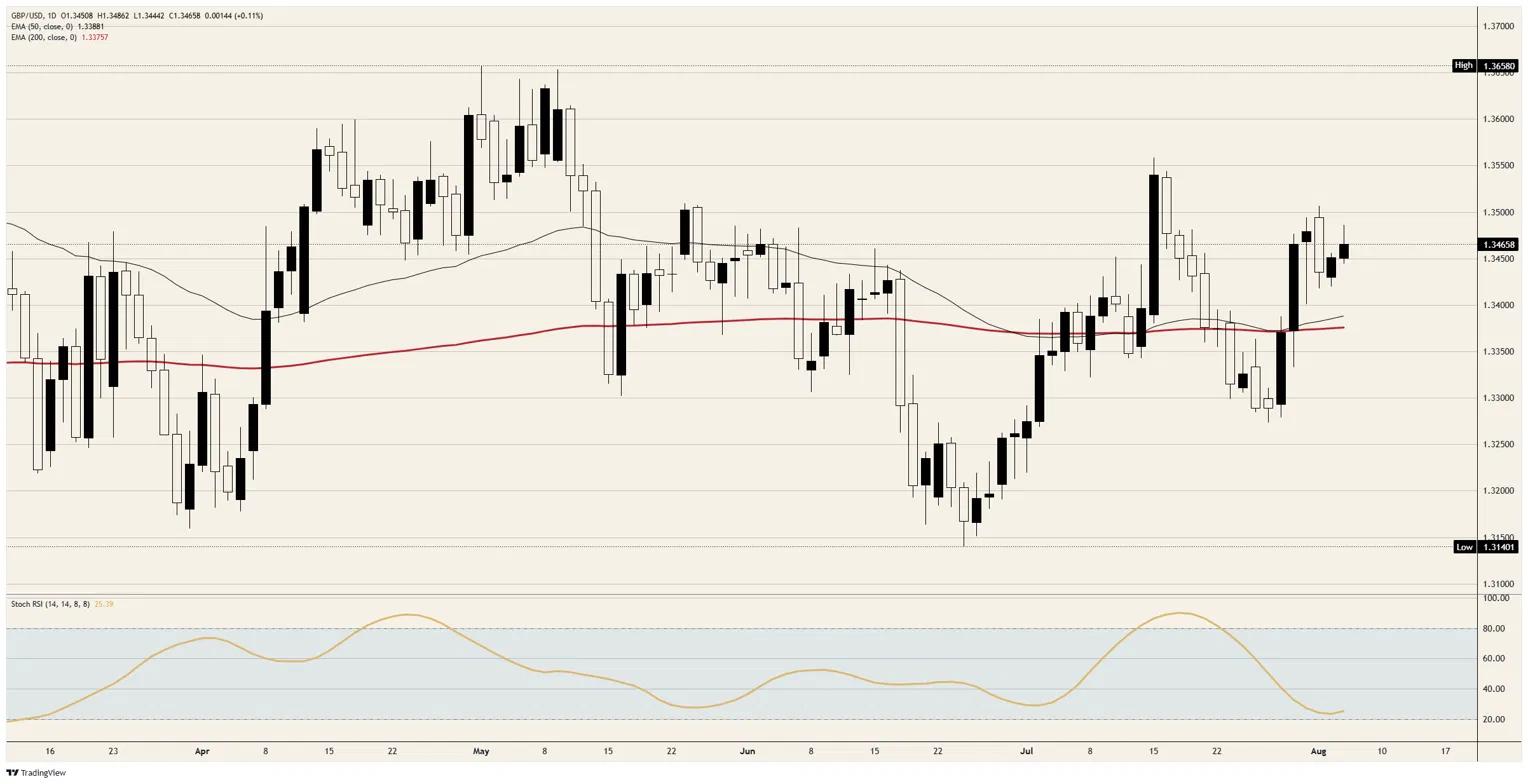
Monday's session did the entire week's work in a single candle, reclaiming the moving-average band that had capped every rally since mid-July and stalling just short of 1.3500. The two sessions since have traded wholly inside it. Price changes hands near 1.3450, up a tenth of a percent, and forty-eight hours of trading have added nothing to Monday's result.
The 50-day and 200-day Exponential Moving Averages (EMA) sit converged a shade beneath 1.3400, and price holds the better part of a cent above both. That reclaim is the only thing this tape has achieved. Today's range runs barely 40 pips, the daily Stochastic Relative Strength Index (Stoch RSI) sits near 25, and nothing British is responsible for any of it.
The Dollar is doing all the work
The American releases between 12:15 and 14:00 GMT handed the Greenback two reasons to fall and one reason not to. Private payrolls printed 44K against a 70K consensus, less than half of June's 98K, and the Institute for Supply Management (ISM) services employment index dropped to 47.4 from 51.2, into outright contraction.
The same survey then put prices paid at 70.3 from 67.7, new orders at 57.2 from 55.1 and the headline index at 54.1. Demand is fine, hiring is not, and input costs are accelerating. That combination is stagflationary rather than dovish, which is why a labour miss of this size bought Sterling fourteen pips.
Rate pricing tells the same story from the other end. Odds on a September increase have been trimmed toward the high fifties from the high sixties over the past two sessions, and the softening owes as much to the collapse in Crude Oil as to the labour data. A cut remains priced nowhere in 2026, so a weak American jobs number no longer buys the easing it once did.
Two hawkish holds, twenty-four hours apart
The Federal Reserve held at 3.50% to 3.75% on 29 July with three policymakers dissenting for a quarter-point increase. The Bank of England held at 3.75% the following day with three members voting for 4.00%, up from two in June. Two central banks, two holds, three dissenters apiece, filed inside a single day.
The arithmetic underneath is not symmetric. Three of twelve votes on the American committee is a quarter of it. Three of nine on the British committee is a third, which makes the Monetary Policy Committee the more hawkish of the pair on paper. Sterling has done nothing with that for a week, because rate differentials are not what is moving this exchange rate.
The British case for tightening rests on where energy goes next rather than where inflation has been. June headline Consumer Price Index (CPI) came in at 2.6% against a 2.7% consensus, with core at 2.6% and services down to 3.6%, and the accompanying communication leaned on higher bills feeding through to business pricing later in the year. A market that entered 2026 pricing two British cuts now argues about increases, and the Hormuz negotiation makes that entire argument conditional on a waterway.
Six weeks of nothing scheduled
Westminster has risen for the summer recess and does not sit again until September, which switches off the fiscal newsflow that has driven the Pound since the leadership change in July. The next Bank of England decision is 17 September. The autumn Budget, where the new government's retained fiscal rules meet its spending promises, is pencilled for 28 October.
That leaves Sterling as a pure Dollar expression for six weeks, priced off American payrolls and a Middle East negotiation rather than anything domestic. It also defers the only real downside catalyst on the board. Long-dated gilt yields backed up on the first mention of flexibility inside those rules, and the Budget is where that argument gets resolved.
What lands before Friday
Weekly jobless claims are due Thursday at 12:30 GMT, consensus 202K against 197K prior, alongside preliminary second-quarter productivity at 0.6% and unit labour costs at 2%. Crude Oil is down roughly a tenth on the week on reports that Washington, Tehran and Muscat are close to an interim arrangement reopening the Strait of Hormuz, which is the other half of the Dollar's problem.
Friday's 12:30 GMT payrolls report is the one that counts. Consensus sits at 80K after 57K, the unemployment rate is seen unchanged at 4.2% and average hourly earnings at 3.5% YoY. A second soft labour reading in three days, on top of a services employment index already contracting, is what forces the September question into the open. The route through 1.3500 runs through that number.
Levels and bias
Resistance: 1.3500 caps the week, unbroken through Monday's surge and the two sessions held inside it, and is the gateway to the mid-July peak near 1.3550. Above that, the early-May high near 1.3650 is the only mark left on the frame.
Support: The reclaimed EMA band just beneath 1.3400 is the floor that matters now, with 1.3350 under it and the late-June base near 1.3150 as the summer low.
Bias: Bullish while the EMA band holds, with a daily close above Monday's high through 1.3500 the trigger for a run at 1.3550. A daily close back beneath 1.3400 buries price under both averages again and reopens 1.3300. Momentum is not confirming any of this, so treat strength above 1.3500 as a Dollar event rather than a Sterling one.
GBP/USD daily chart
Pound Sterling FAQs
The Pound Sterling (GBP) is the oldest currency in the world (886 AD) and the official currency of the United Kingdom. It is the fourth most traded unit for foreign exchange (FX) in the world, accounting for 12% of all transactions, averaging $630 billion a day, according to 2022 data. Its key trading pairs are GBP/USD, also known as ‘Cable’, which accounts for 11% of FX, GBP/JPY, or the ‘Dragon’ as it is known by traders (3%), and EUR/GBP (2%). The Pound Sterling is issued by the Bank of England (BoE).
The single most important factor influencing the value of the Pound Sterling is monetary policy decided by the Bank of England. The BoE bases its decisions on whether it has achieved its primary goal of “price stability” – a steady inflation rate of around 2%. Its primary tool for achieving this is the adjustment of interest rates. When inflation is too high, the BoE will try to rein it in by raising interest rates, making it more expensive for people and businesses to access credit. This is generally positive for GBP, as higher interest rates make the UK a more attractive place for global investors to park their money. When inflation falls too low it is a sign economic growth is slowing. In this scenario, the BoE will consider lowering interest rates to cheapen credit so businesses will borrow more to invest in growth-generating projects.
Data releases gauge the health of the economy and can impact the value of the Pound Sterling. Indicators such as GDP, Manufacturing and Services PMIs, and employment can all influence the direction of the GBP. A strong economy is good for Sterling. Not only does it attract more foreign investment but it may encourage the BoE to put up interest rates, which will directly strengthen GBP. Otherwise, if economic data is weak, the Pound Sterling is likely to fall.
Another significant data release for the Pound Sterling is the Trade Balance. This indicator measures the difference between what a country earns from its exports and what it spends on imports over a given period. If a country produces highly sought-after exports, its currency will benefit purely from the extra demand created from foreign buyers seeking to purchase these goods. Therefore, a positive net Trade Balance strengthens a currency and vice versa for a negative balance.
Author

Joshua Gibson
FXStreet
Joshua joins the FXStreet team as an Economics and Finance double major from Vancouver Island University with twelve years' experience as an independent trader focusing on technical analysis.