|

Polish central bank cites geopolitical risks as rates stay unchanged

The National Bank of Poland (NBP) met the broad consensus among market participants and held interest rates steady, adopting a cautious tone on Tuesday, saying that future data would guide policy choices but also that inflation concerns are very much alive.

The central bank kept rates at 3.75%, but policymakers said the next measures would depend on how the economic outlook unfolds, leaving the bank firmly in wait-and-see mode for now.

In addition, the NBP cited a number of variables that might complicate the inflation picture, including fiscal policy, robust wage growth and laws impacting fuel costs, all of which could put consumer prices under upward pressure.

Furthermore, rate setters also said that the larger global environment remains a danger to the Polish economy, with increased geopolitical uncertainty being a significant factor for holding rates.

One interesting inclusion was the NBP’s reminder that it remains prepared to intervene in the FX market if necessary, a signal that policymakers are keeping a close watch on Zloty (PLN) volatility.

FX impact: The Polish currency gathers some pace following the bank’s decision, enough to prompt EUR/PLN to leave the area of daily highs near 4.2370 and slip back to the 4.2340 zone, just below its key 200-day SMA.
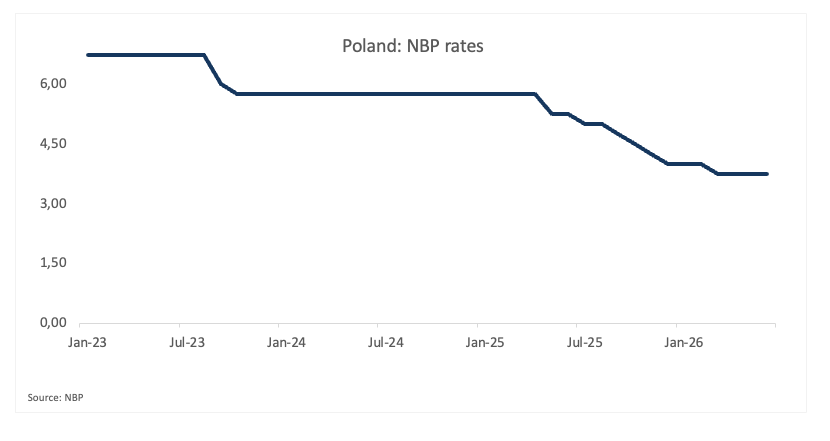
Bottom line: The NBP is in no rush to signal its next move. While rates remain unchanged, policymakers continue to see inflation risks on the horizon and appear determined to retain maximum flexibility as they assess incoming data and an increasingly uncertain geopolitical environment.

Author

Pablo Piovano

Born and bred in Argentina, Pablo has been carrying on with his passion for FX markets and trading since his first college years.


More from Pablo Piovano
Share:

Editor's Picks

AUD/USD remains above 0.7200 after China's trade data

AUD/USD sits above 0.7200 in the Asian session on Tuesday, near its highest level since May 14. The US Dollar stays under pressure as a rallying Japanese Yen outweighs support from hawkish Fed bets and geopolitical tensions. This, along with firming expectations for another RBA rate hike later this month, acts as a tailwind for the Aussie. However, mixed China trade balance data keep the pair restricted.

USD/JPY stabilizes at around 154.00 as markets assess BoJ outlook

USD/JPY fluctuates at around 154.00 in the American session on Tuesday after rebounding from the six-month low it touched below 153.00 earlier in the day. Nevertheless, the upside attempts resemble technical corrections for now as Japan's upbeat wage growth data and Q2 GDP revision cement bets on a BoJ rate hike next week and continue to support the Japanese Yen.

Gold holds around $4,400, but for how long?
Gold (XAU/USD) remains on the back foot during American trading hours on Tuesday, even as the US Dollar (USD) remains on the defensive. Rising Oil prices and expectations of a Federal Reserve (Fed) rate hike weigh on the precious metal. At the time of writing, XAU/USD trades around $4,400 after reaching an intraday high near $4,443.
Bitcoin remains highly sensitive to macro signals amid changing derivatives narrative
Bitcoin’s (BTC) sensitivity to US economic data has become increasingly evident this year. As the market approaches several important data dumps this week, BTC traders are keenly aware of the significance just like their counterparts in TradFi. And just like the stock market, crypto traders are focused squarely on the US central bank's interest rate policy.
Europe in focus: September 2026
Six major net contributors demanded substantial cuts to the European Commission’s proposed 2028–2034 EU budget. Germany, Denmark, the Netherlands, Austria, Finland and Sweden issued a joint position on 27 August calling for the nearly €2 trillion proposal to be reduced by several hundred billion euros and rejecting additional common EU borrowing.
Diesel’s record $100 warning: The oil shock hiding in plain sight

The Oil market may look calmer than it did a few months ago, but diesel is sending a very different message. The US diesel crack spread, the premium of ultra-low sulphur diesel futures over WTI, recently surged above $100 per barrel for the first time, reaching an intraday record of just over $102.00.