Palo Alto Networks stock down despite earnings beat
- Palo Alto Networks provides full-year fiscal guidance that underwhelms on adjusted EPS.
- CEO Nikesh Arora complains that Wall Street doesn't understand dilution stemming from CyberArk Deal.
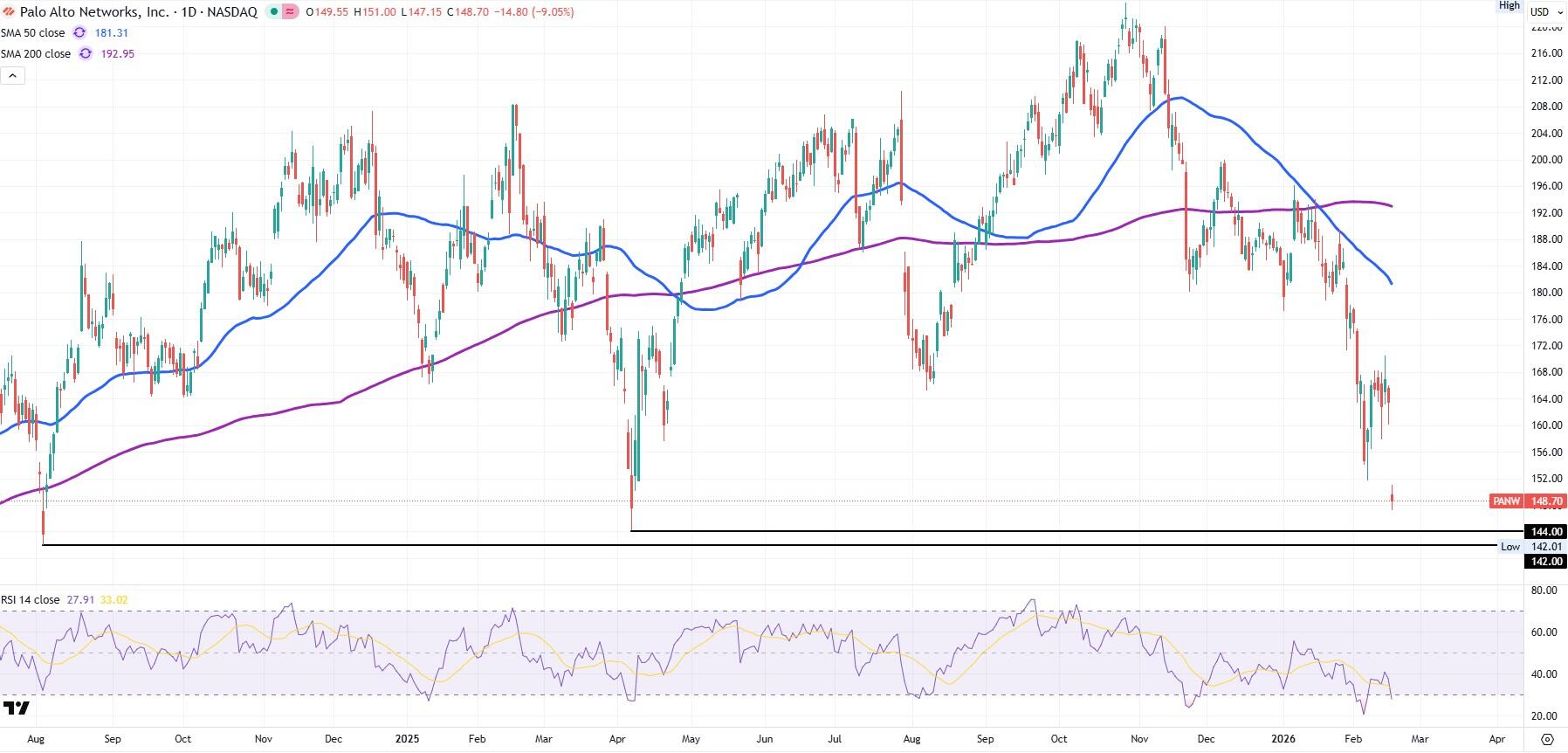
- PANW stock, down 9%, is now trading close to support at $144 and $142.
- Fiscal Q2 adjusted EPS of $1.03 beats consensus by $0.09.

Palo Alto Networks (PANW) stock sold off sharply on Wednesday morning following the company's second-quarter fiscal 2026 earnings release. Shares of the digital security company fell about 9% to $149, a price Wall Street hasn't seen since the April 7, 2025, low caused by President Donald Trump's imposition of tariffs.
Analysts are pointing to full-year guidance for adjusted earnings per share (EPS) coming in below expectations as the culprit. But CEO Nikesh Arora panned Wall Street, arguing that the market isn't "paying attention to our numbers carefully."
US indices, including the Dow Jones Industrial Average, S&P 500 and NASDAQ Composite, all rose at the open on Wednesday, while US Treasury yields and Gold also rallied.
Palo Alto Networks stock earnings buzz
Palo Alto Networks reported $1.03 in adjusted EPS, a beat of $0.09 above consensus, on revenue of $2.59 billion, a narrow beat of $10 million.
But guidance was the focus of stock sellers. The security firm issued fiscal year guidance of between $3.65 and $3.70 for adjusted EPS, which came in short of the Street's $3.87 average. Meanwhile, the full-year revenue guidance clobbered the estimate at $11.3 billion compared with the $10.5 billion sought by Wall Street.
CEO Arora complained on Bloomberg on Wednesday morning that analysts were not taking into account the share dilution via the outfit's acquisition of CyberArk. In order to fund its largest acquisition to date, a $25 billion deal, Palo Alto Networks issued approximately 56.6 million shares to CyberArk investors, besides $45 per share in cash.
"The market is not understanding that our guidance for the next two quarters includes CyberArk," Arora told the Bloomberg Business News Live show. "If you take the consensus of CyberArk and ours, you're actually getting above the collective consensus, but the market hasn't understood the dilution of shares, so I think they're getting it wrong."
Separately, the CEO pointed to AI security needs as being a long-term trend that is already bearing fruit. The company's annual recurring revenue for Next-Generation Security rose 33% YoY to $6.3 billion. Palo Alto Networks' combined ARR guidance rose to $8.67 billion, well above the Street's $7.07 billion estimate.
Palo Alto Networks stock technical analysis
The gap down on Wednesday will surely offer an opportunity for some. This is especially true since Palo Alto Networks is a beloved tech stock that rarely trades this far below its 200-day Simple Moving Average, which is just below $193.
Bulls will seek to enter at either the April 7, 2025, low near $144 or the August 2024 low near $142. Having two range lows so close together signals that the market is unlikely to allow it to trade much lower than this region. And bulls should note that PANW has a history of rallying quite strongly off severe sell-offs, as it did in 2024 and 2025.
A break of $142, however, would allow PANW to move to historical support near $130 seen in 2023. Bears will note that it is unusual for PANW to fall back into the oversold regions (below 30) on the Relative Strength Index (RSI) after breaking out of its just two weeks ago. Historically, PANW stock only reaches the RSI momentarily every six months or so.
Author

Clay Webster
FXStreet
Clay Webster grew up in the US outside Buffalo, New York and Lancaster, Pennsylvania. He began investing after college following the 2008 financial crisis.
















