NZD/USD slumps below 0.6300 amid strong US Dollar as US jobs market remains hot
- US Bureau of Labor Statistics (BLS) report reveals lower-than-expected initial jobless claims, spurring a rally in US Treasury bond yields.
- The 2-year and 10-year US Treasury note yields increased by ten basis points each, reaching 4.873% and 3.852%, respectively.
- Diverging monetary policies of the Fed and RBNZ might influence the NZD/USD to continue its downward trend.

NZD/USD slides for the fifth consecutive day as the US Dollar (USD) strengthens on jobs data that still portrays the tightness of the labor market, triggering a reaction in US Treasury bond yields, edging higher. Therefore, the NZD/USD Is trading at 0.6229, losing 0.4%, after reaching a daily high above the 0.6300 figure.
Kiwi faces headwinds as US labor market tightness bolsters the USD, triggering a rise in Treasury bond yields
A report by the US Bureau of Labor Statistics (BLS) showed that unemployment claims for the week ending July 15 cane lower than estimates, spurring a rally in US Treasury bond yields. Initial Jobless Claims rose by 228K, below forecasts of 240K, while Continuing Claims, which lagged the current claims week reported, jumped 33K, to 1.754 million, from 1721K.
After the data, as mentioned, the US 2 and 10-year Treasury note yields skyrocketed, 2s jumping ten basis points (bps) at 4.873, while the 10-year Treasury note followed suit, gaining ten bps at 3.852%.
Per the US bond yields reaction, the greenback rose, as shown by the US Dollar Index (DXY). The DXY, which tracks the buck’s performance against a basket of six currencies, advances 0.51%, up at 100.796, a headwind for the NZD/USD pair resulting from traders reassessing a possible Federal Reserve rate hike past the July meeting.
The CME FedWatch Tool depicts investors fully priced in a 25 bps hike in July. Nevertheless, odds for a November rate increase are lingering back on investors’ minds, with odds standing at 32.2%, higher than one week ago 19.8% chance.
On the New Zealand (NZ) front, the recent monetary policy of the Reserve Bank of New Zealand (RBNZ) witnessed the RBNZ holding rates unchanged at 5.5%, as the central bank noted that consumer spending has eased, helping to cool down inflation. The latest inflation report witnessed the Consumer Price Index (CPI) for Q2 YoY slowing from 6.7% to 6%, aligned with RBNZ’s projections.
Given the fundamental backdrop, with the Fed and RBNZ monetary policy divergences, the NZD/USD could continue to trend lower unless next month’s inflation figures in NZ shift the RBNZ’s board to take action to tame inflation.
NZD/USD Price Analysis: Technical outlook
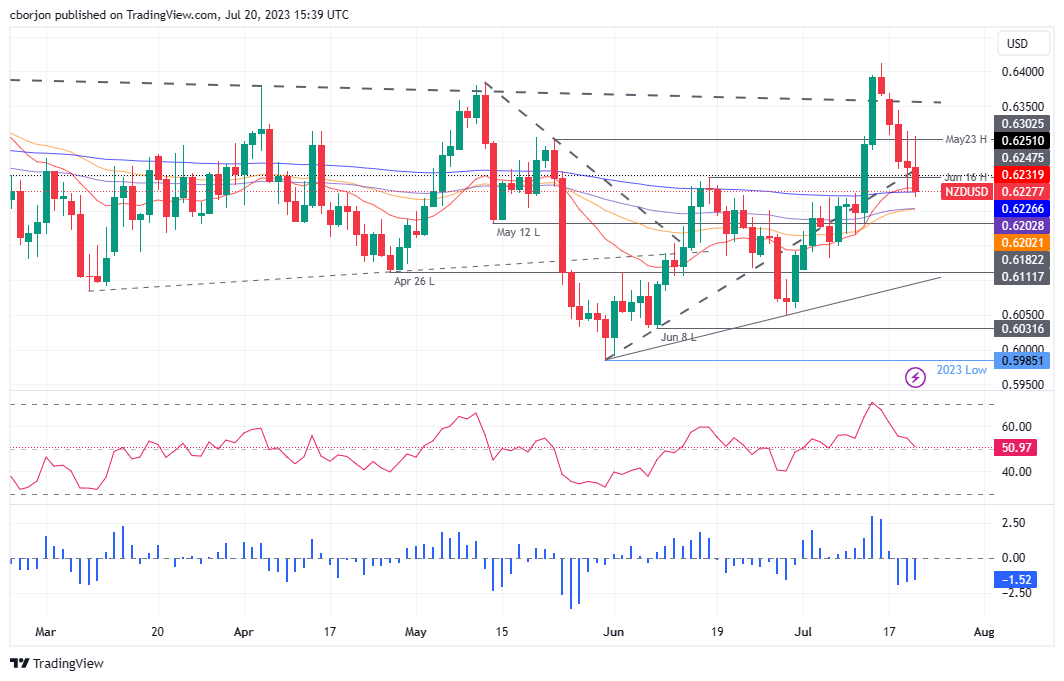
NZD/USD buyers’ failure to conquer the 0.6300 mark exposed the pair to selling pressure, with the major prolonging its losses toward the 200-day Exponential Moving Average (EMA) at 0.6226. Of note, the pair has fallen to the latter twice in the last couple of days, but a daily close has not been achieved to shift the trend to neutral. In addition, the 20-day EMA at 0.6232 cushioned the NZD/USD’s fall, which if breaks the 0.6232/26 area, a challenge to 0.6200 is on the cards. On the other hand, if NZD/USD advances toward 0.6300, that would keep the trend intact.
Author

Christian Borjon Valencia
FXStreet
Markets analyst, news editor, and trading instructor with over 14 years of experience across FX, commodities, US equity indices, and global macro markets.

















