NZD/USD slips as US data fuels Fed rate hike speculation
- US August retail sales rose by 2.6% YoY, missing estimates but signaling consumer spending resilience.
- Producer Price Index climbed 1.6% YoY in August, doubling July’s figure and exceeding market expectations.
- New Zealand’s Manufacturing PMI is expected to shrink for the sixth month, adding headwinds to the NZD/USD pair.

The Greenback (USD)t) stages a recovery against the New Zealand Dollar (NZD) on Thursday, as the NZD/USD pair drops 0.13% following the release of data from the United States (US). The pair is trading at 0.5910 after hitting a daily high of 0.5944.
NZD/USD faces downward pressure as US economic indicators point to a resilient economy, raising the odds for a Fed rate hike
The latest data revealed during the day showed the US economy remains resilient, as consumer spending keeps investors hopeful the Federal Reserve would achieve a soft landing despite keeping interest rates higher for longer.
The US Department of Commerce revealed that August retail Sales rose by 2.6% YoY, below July’s downward revised 2.6% figures, and missed estimates of 2.9%. Digging deeper into the data, core Retail Sales, which exclude volatile items, grew by 0.2% beneath forecasts of 0.6%.
At the same time, the US Bureau of Labor Statistics (BLS) revealed the Producer Price Index (PPI) for the same period as above-mentioned. The PPII climbed 1.6% YoY in August and exceeded estimates of 1.2%, doubling July’s 0.8% increase. Other data announced by the BLS showed that Initial Jobless Claims for the week ending September 9 rose to 220K, below the consensus of 225K, underscoring a hot labor market.
Per the NZD/USD’s reaction to the data, market participants believe there will be another rate hike by the Fed before the year’s end. The CME FedWatch Tool shows the Fed would not raise rates at the September meeting. But for November, there’s a 35% chance the US central bank could lift rates.
On the New Zealand (NZ) front, traders are bracing for the release of Manufacturing PMI data. Although most PMIs released worldwide suggest an ongoing economic slowdown, NZ is not immune. New Zealand’s PMI shrank for five consecutive months, with the trend expected to extend to August, with estimates of 46.0.
Besides that, NZ’s major trading partner, China, is expected to release retail sales and industrial production. If the data returns positive and exceeds prior readings, that could lend a lifeline to the NZD/USD pair.
NZD/USD Price Analysis: Technical outlook
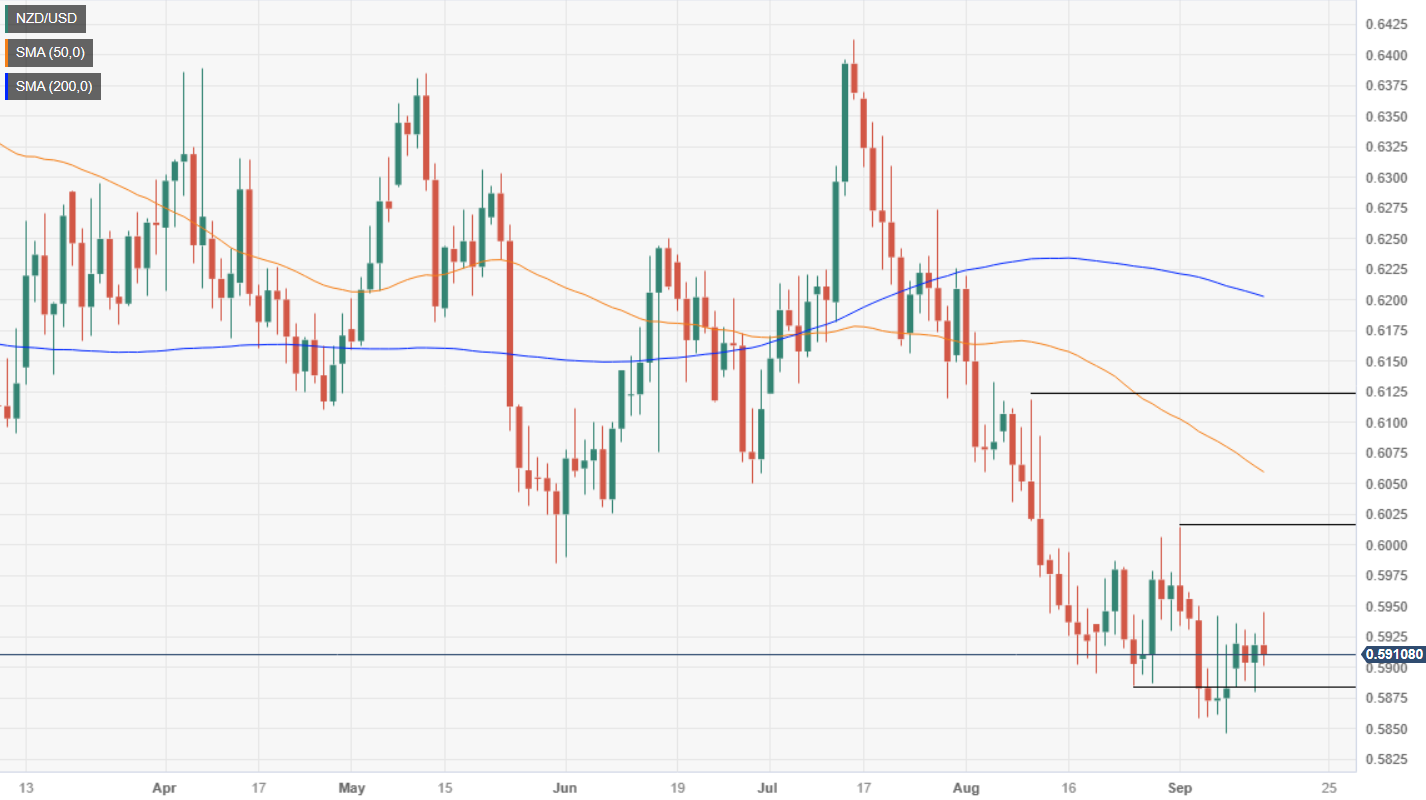
After today’s data, the pair printed a new two-week high, which NZD/USD sellers used to open fresh shorts positions as the major shifted bearish and dropped toward the 0.5910 area as price action began to form an inverted hammer. A decisive break below 0.5900 could open the door to test the year-to-date (YTD) low of 0.5859. On the other hand, the major would shift neutral if NZD bulls reclaim 0.6000.
Author

Christian Borjon Valencia
FXStreet
Markets analyst, news editor, and trading instructor with over 14 years of experience across FX, commodities, US equity indices, and global macro markets.

















