|

NZD/USD Price Analysis: Pair faces resistance at 20-day SMA, momentum persists

  • NZD/USD declined to 0.5895 on Thursday.
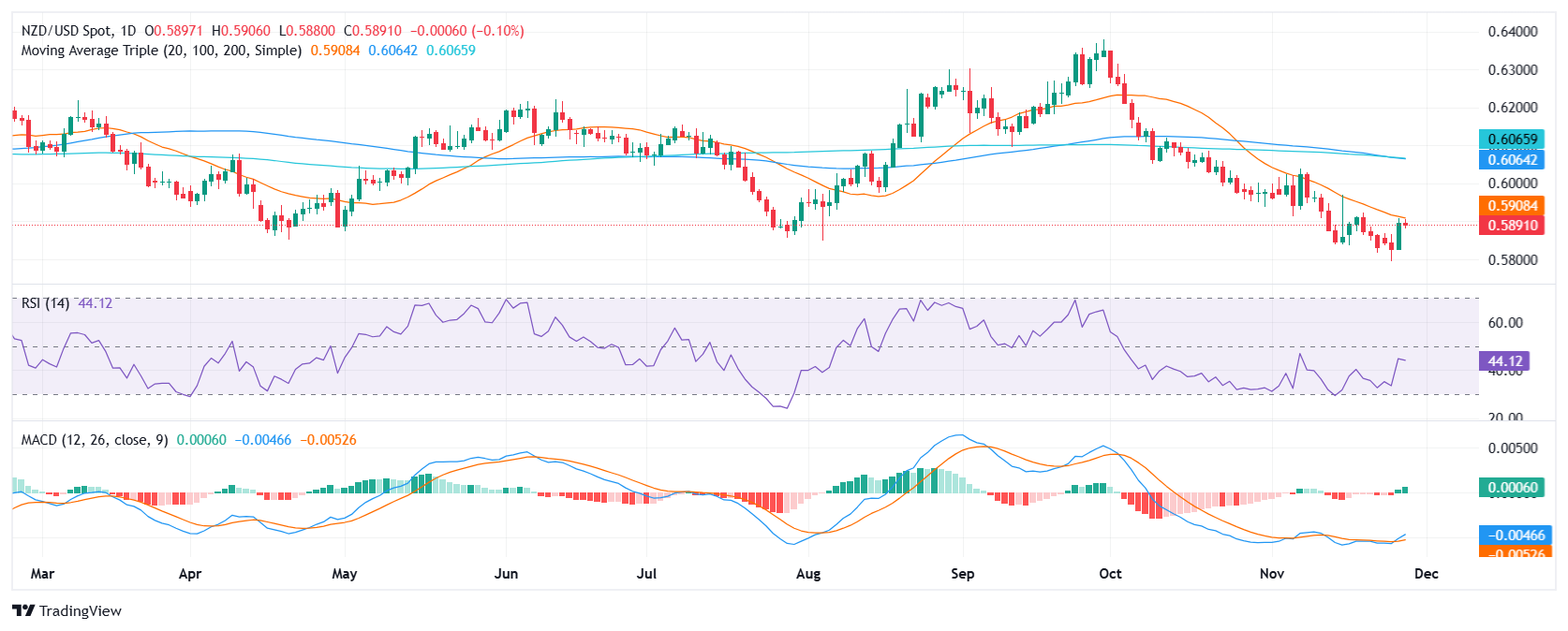
  • Pair rejected at 20-day SMA and indicators lost some steam, but may have momentum to conquer the SMA.
  • As long as the pair holds below the 20-day SMA, the outlook for the short-term will be negative.

The NZD/USD declined slightly in Thursday's session, reaching a low of 0.5895, before recovering some ground. Overall, the momentum seems to be mixed. The pair has been in a downtrend since late September, and the short-term outlook remains negative as long as it remains below the 20-day Simple Moving Average (SMA).

The technical indicators present conflicting signals. The Relative Strength Index (RSI) is currently at 47, indicating that it is in negative territory and suggests that selling pressure is present. On the other hand, the Moving Average Convergence Divergence (MACD) histogram is green and rising, indicating that buying pressure is rising. This divergence suggests that while there may be some selling pressure, there is also significant buying interest in the market.

Despite facing resistance at the 20-day SMA, NZD/USD maintains momentum from recent gains, with indicators suggesting both buying and selling pressure present. However, the downward trend continues as long as the pair remains below the mentioned SMA. When American traders return from Thanksgiving’s holiday, the pair may see further volatility which might set the direction of the pair.

NZD/USD daily chart
Author

Patricio Martín

Patricio is an economist from Argentina passionate about global finance and understanding the daily movements of the markets.


More from Patricio Martín
Share:

Editor's Picks

GBP/USD slides below 1.3250 after failing to break through 23.6% Fibo

The GBP/USD pair meets with a fresh supply during the Asian session on Wednesday and moves away from a nearly two-week high around the 1.3275 region, touched the previous day. Spot prices currently trade around the 1.3235 zone, down 0.20% for the day, as traders look to speeches from Bank of England Governor Andrew Bailey and Federal Reserve Chair Kevin Warsh for a fresh impetus.

EUR/USD keeps losses near 1.1400 after soft Eurozone inflation data

EUR/USD keeps the offered tone intact near 1.1400 in European trading on Wednesday, pressured by softer Euronze and German inflation readings and receding bets for aggressive tightening by the European Central Bank (ECB). Traders will take more cues from the US Manufacturing PMI due later in the day.

Gold stays in red below $4,000, awaits Warsh's speech

Gold remains under selling pressure below $4,000, in the red for the third straight day on Wednesday. The Iran uncertainty and Fed hike bets support the USD, weighing on the commodity. Traders now look to Fed Chair Warsh's speech and the US data for a fresh impetus.


ISM Manufacturing PMI expected to signal continued expansion in the US

Attention shifts to Wednesday’s release of the June ISM Manufacturing Purchasing Managers Index, one of the most closely followed indicators of activity in the US manufacturing sector and an important barometer of the broader economy. Markets expect the headline index to remain unchanged at 54.

Kevin Warsh isn't expected to say much in Sintra: That's exactly why markets will listen

Financial markets could find an important catalyst in the enchanting, fairytale-like landscape of  Sintra this week. The European Central Bank Forum will, as it does every year, gather the crème de la crème of central banks. The new boss at the Federal Reserve, who has clearly said that the Fed should stop explaining everything, will need to talk – and traders should listen.

Just like Fed, is BoJ’s independence under threat?

When talking about central bank independence, most of the focus has been on Donald Trump’s pressure on the Federal Reserve. But a similar story, a quieter one for now, seems to be happening on the other side of the Pacific: Japan’s government may be testing the Bank of Japan’s independence.