|

NZD/USD Price Analysis: Hovers near the immediate barrier at 0.5900 psychological level

  • NZD/USD struggles to halt the losing streak amid improved US Dollar.
  • MACD suggests tepid momentum, monitoring for potential shifts in market dynamics.
  • The pair could revisit the 1.0750 major level aligned to the weekly high at 1.0756.

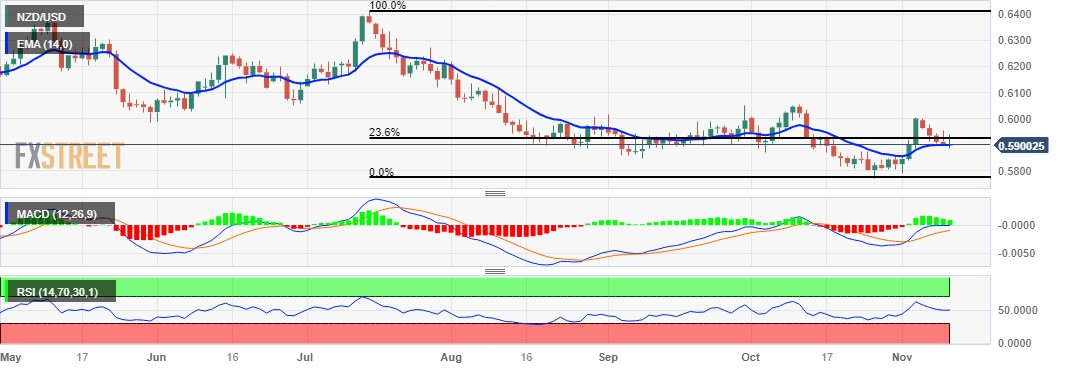
NZD/USD continues the losing streak for the fifth successive day, trading around the 14-day Exponential Moving Average (EMA) at 0.5898 during the European trading hours on Friday, lined up with the immediate resistance at 0.5900. Fed Chair Jerome Powell's endorsement of further interest rate hikes has exerted downward pressure on the Kiwi pair.

The 23.6% Fibonacci retracement level at 0.5923 is identified as a crucial resistance point in the event of the NZD/USD pair making further advances. If the pair manages to firmly break above this level, it could provide support for bullish momentum, allowing traders to explore the region around the previous week's high at the psychological level of 0.6000.

The 14-day Relative Strength Index (RSI) lies below the 50 level, indicating downward pressure. This suggests a bearish momentum and reflects a weaker market sentiment for the NZD/USD pair. As a result, the pair may be pushed toward major support at the 0.5800 psychological level, with the next potential level of support being the previous week's low at 0.5789.

However, the Moving Average Convergence Divergence (MACD) line is positioned below the centerline but above the signal line in the NZD/USD pair. This configuration suggests a subdued momentum, reflecting a state of uncertainty in the market. Traders may monitor this situation closely for potential shifts in market dynamics.

NZD/USD: Daily Chart
NZD/USD: other technical levels to watch

Overview
Today last price0.5898
Today Daily Change-0.0001
Today Daily Change %-0.02
Today daily open0.5899
 
Trends
Daily SMA200.5874
Daily SMA500.5913
Daily SMA1000.601
Daily SMA2000.6108
 
Levels
Previous Daily High0.5956
Previous Daily Low0.5896
Previous Weekly High0.6005
Previous Weekly Low0.5788
Previous Monthly High0.6056
Previous Monthly Low0.5772
Daily Fibonacci 38.2%0.5919
Daily Fibonacci 61.8%0.5933
Daily Pivot Point S10.5878
Daily Pivot Point S20.5857
Daily Pivot Point S30.5818
Daily Pivot Point R10.5938
Daily Pivot Point R20.5977
Daily Pivot Point R30.5998

Author

Akhtar Faruqui

Akhtar Faruqui is a Forex Analyst based in New Delhi, India. With a keen eye for market trends and a passion for dissecting complex financial dynamics, he is dedicated to delivering accurate and insightful Forex news and analysis.


More from Akhtar Faruqui
Share:

Editor's Picks

AUD/USD bulls regain control above 0.6950 amid USD retreat

AUD/USD regains traction and extends the previous day's bounce from the weekly low, aiming for 0.7000 in Asia on Friday. The overnight pullback in US bond yields keeps the US Dollar below an 18-month high, which in turn offers some support to the pair. Meanwhile, hawkish RBA expectations also keep the major underpinned.

USD/JPY holds gains near 158.00 after Japan's weak Household Spending data

USD/JPY clings to gains around 158.00 after data showed on Friday that Japan's Household Spending fell for the ninth straight month, undermining the Japanese Yen. Meanwhile, the US Dollar remains depressed as the overnight fall in US bond yields counters a hawkish Fed and geopolitical uncertainties, could cap any downside in the pair.

Gold remains range-bound below $4,200

Gold has given up some ground after an initial bullish attempt to reach weekly highs, returning to below the $4,200 mark per troy ounce on Friday. The US Dollar’s strong upside momentum, combined with rising US Treasury yields across the curve, seems to keep further gains in the yellow metal under scrutiny.

Has Bitcoin really escaped the macro forces it was built to fight?
Over 17 years ago, Satoshi Nakamoto designed Bitcoin (BTC) on the back of a global financial crisis as an alternative to the global monetary system outside the control of central banks, governments and traditional intermediaries. This raises a key question: has Bitcoin really become independent of the macroeconomic forces it was built to challenge?
The Euro is not the sick man of Europe. France's bond market is
EUR/USD remains under pressure, near the 17-month low of 1.1161 reached on Monday. The pair has lost more than 7% since its yearly peak, as concerns over France's public finances increasingly weigh on the single currency. But behind the weakness of the Euro (EUR), the problem does not necessarily lie with the European economy as a whole.
Has Bitcoin really escaped the macro forces it was built to fight?
Over 17 years ago, Satoshi Nakamoto designed Bitcoin (BTC) on the back of a global financial crisis as an alternative to the global monetary system outside the control of central banks, governments and traditional intermediaries. This raises a key question: has Bitcoin really become independent of the macroeconomic forces it was built to challenge?














