NZD/USD plummets below 0.6100 following US credit rating downgrade, risk-off impulse
- NZD/USD has taken a hit, declining by more than 1%, with a daily high previously at 0.6169.
- The US credit rating was downgraded from AAA to AA+, causing a surge in demand for the US Dollar and the Japanese Yen in the FX market.
- New Zealand’s unemployment rate rose to 3.6%, above expectations, and wage growth was weaker than anticipated, aligning with the RBNZ’s decision to end its tightening cycle.

NZD/USD plunged more than 1% on Wednesday, courtesy of a risk-off impulse as US credit rating was downgraded by Fitch, sparking a jump in US Treasury bond yields. That, alongside a solid July ADP National Employment report, boosted appetite for the US Dollar (USD). Hence, the NZD/USD slumps toward 0.6077 at the time of writing after reaching a daily high of 0.6169.
Risk-off sentiment boosts the US Dollar as Fitch downgrades US credit rating, and soft employment figures in New Zealand weigh on the Kiwi
Market sentiment was dampened after Tuesday’s Fitch Ratings downgraded US creditworthiness from AAA to AA+ “on a perceived deterioration in US governance, which it said gave less confidence in the government’s ability to address fiscal and debt issues,” according to the report. After the release, traders seeking refugee bought the US Dollar (USD) and the Japanese Yen (JPY) in the FX space.
Earlier, data revealed by ADP revealed that private hiring in July improved sharply, with the economy adding 324K jobs smashing 189K estimates, ahead of Friday’s US Nonfarm Payrolls report. According to a Reuters poll, the US economy created 200K jobs, as revealed by analysts. In other data, July’s manufacturing activity continued to improve in the US, as the ISM shows, arriving at 46.4, below 46.8 estimates but exceeding June’s 46.0.
On the New Zealand (NZ) front, labor market data for the second quarter (Q2) of 2023 was soft. The Unemployment rate rose by 3.6% above 3.5% estimates, and wages, including and excluding overtime, came in at 1.1% q/q vs. 1.2% expected and 0.9% in Q1. Regarding Average hourly earnings, they came at 1.9% QoQ below Q1 2.1%, supporting the Reserve Bank of New Zealand’s (RBNZ) decision to finish its tightening cycle. The swaps market suggests the RBNZ would keep rates unchanged for August and October, but November is still open. Nevertheless, if data remains weak, the RBNZ will hold rates at the current level.
NZD/USD Price Analysis: Technical outlook
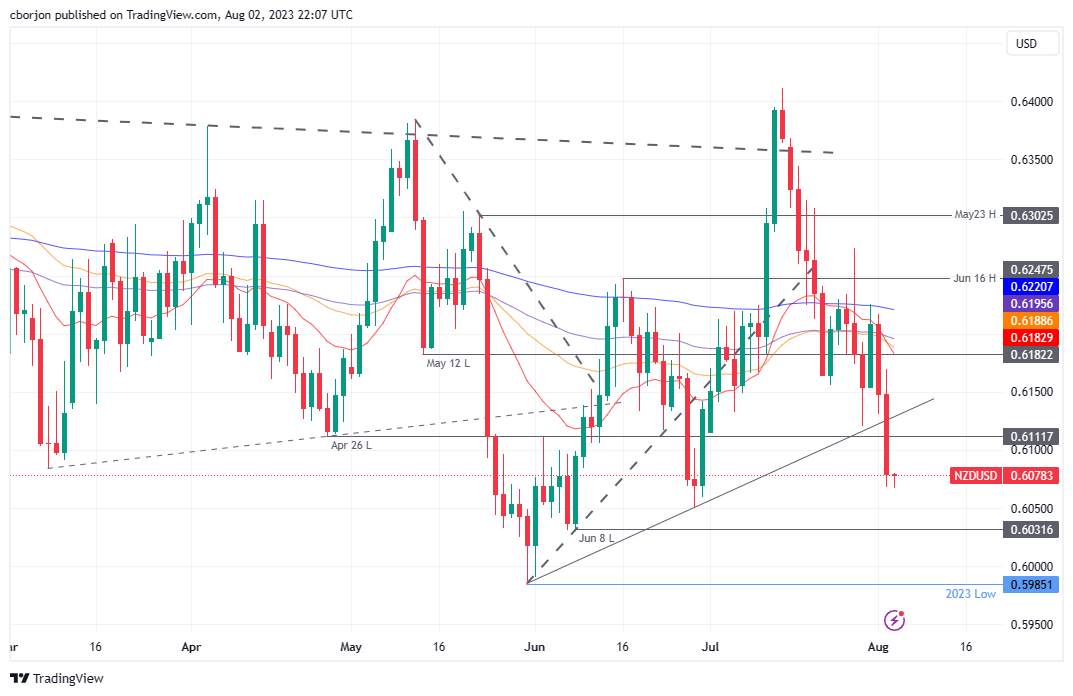
From a daily chart standpoint, the NZD/USD has turned bearish since the start of the week, dropping below the 200, 100, and 20-day Exponential Moving Averages (EMAs), spurring a 146 pip drop. Also, the NZD/USD breaking below the two-month-old upslope support trendline opened the door to test year-to-date (YTD) lows of 0.5985, but sellers must conquer demand zones on its way down. Firstly the June 29 daily low of 0.6050, followed by June’s 8 low of 0.6045, ahead of 0.6000. On the other hand, if NZD/USD stays above 0.6100, that could pave the way to test the psychological 0.6150, ahead of challenging a busy area with the daily EMAs hovering around 0.6200.
Author

Christian Borjon Valencia
FXStreet
Markets analyst, news editor, and trading instructor with over 14 years of experience across FX, commodities, US equity indices, and global macro markets.