|premium|

NIO Stock Forecast: Nio tumbles as President Xi’s third term of power spooks investors

  • NYSE: NIO fell by 15.7% during Monday’s trading session. 
  • It was a bloodbath for Chinese companies as the Hang Seng Index hit a 13-year low. 
  • Chinese EV stocks drop as Tesla lowers the price of its vehicles in China. 

Nio (NIO) saw one of its worst days of the year as Chinese stocks tumbled lower following President Xi Jinping's return for an unprecedented third term of power. On Monday, shares of Nio dropped by 15.7% and closed the trading session at a price of $9.45. Counter to the performance of Chinese ADR stocks, all three major US indices rose for the second straight session as investors brace themselves for big tech earnings this week. Overall, the Dow Jones added 1.3%, the S&P 500 gained 1.2%, and the Nasdaq rose higher by 0.9% during the session. 

Nio stock price

It was a verifiable bloodbath for Chinese stocks on Monday in both Asian and US trading sessions. The Hang Seng index plummeted earlier in the day and hit a 13-year low price level as a result. Stateside, all three major Chinese EV makers were obliterated with XPeng (XPEV) and Li Auto (LI) falling by 11.9% and 17.4%, respectively. Elsewhere, Alibaba (BABA) hit a six-year low, and JD.Com (JD) hit a new 52-week low. PinDuoDuo (PDD) sank by 24.6%. 

Another reason why Chinese EV stocks were hit so hard on Monday is that Tesla (TSLA) announced it is lowering the prices of both its Model Y and Model 3 vehicles in China. The Model Y will be discounted by about 9% and the Model 3 by about 5%. Investors are trying to determine whether demand for Teslas has slowed in China or if production costs are back on the decline. Either way, it is a curious move given that Tesla raised the prices as recently as June. Shares of TSLA were down by 1.5% on Monday. 
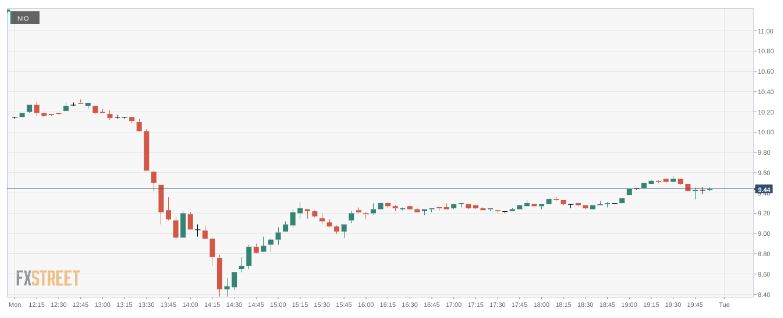
NIO 5-minute chart 10.24.22

Premium

You have reached your limit of 3 free articles for this month.

Start your subscription and get access to all our original articles.

Subscribe to PremiumSign In

Author

More from Stocks Reporter
Share:

Editor's Picks

AUD/USD struggles to recover as hawkish Fed bets escalate

The Australian Dollar is under pressure against the US Dollar as traders have raised bets supporting interest rate hikes by the Federal Reserve this year, with the AUD/USD pair posting a fresh almost eight-week low at around 0.7025. Hawkish Fed bets have accelerated following the release of the surprisingly strong United States Nonfarm Payroll (NFP) data for May.

USD/JPY holds higher ground toward 160.50 despite 'Yentervention' fears

USD/JPY holds higher ground toward 160.50 in Monday's Asian trading, despite intervention fears. Japan’s revised GDP print, which confirmed that the economy lost momentum in the first quarter, weighs on the Japanese Yen. Meanwhile, Friday's upbeat US NFP report and fresh Israel-Iran attacks favor the US Dollar bulls, underpinning the currency pair.

Gold remains heavy near $4,300 on Mideast woes, Fed rate hike bets

Gold remains vulnerable near $4,300 in European trading on Monday, following a modest Asian bounce to the $4,350-$4,355 area. Renewed hostilities in the Gulf push Crude Oil prices higher, fanning inflationary concerns and bolstering bets for more hawkish central banks. That weighs negatively on the Gold, as it mires in three-month lows.

Solana: ETF outflows and bearish sentiment reinforce downside risks

Solana (SOL) remains under pressure, trading below $66 on Monday after losing nearly 20% in the previous week. Institutional demand weakened with spot Exchange Traded Funds recording a net outflow of over $6.5 million last week, snapping a four-week streak of inflows.

Week ahead – Fed countdown begins amid US inflation data and geopolitical risks

Fed Chair Warsh’s first meeting approaches as key US inflation data could reshape expectations. Oil prices remain elevated as US-Iran talks continue; tariffs also return to the spotlight. ECB is expected to hike; will it be a one-off move or is July live?

The US economy defies the rules: 100 days into the Oil shock and the recession signal is still missing

More than three months after the start of the Iran war and the resulting disruption to global energy markets, the US economy continues to display remarkable resilience. The conflict has triggered a sharp rise in Oil prices, reignited inflationary pressures and fueled widespread concerns about a potential economic slowdown.