Nike stock near 52-week lows: Can its dividend and Caitlin Clark spark a rebound?

Nike (NKE) investors were hoping its fiscal first-quarter results would provide clearer evidence that the sportswear giant's turnaround is gaining traction. Instead, the report offered a mixed picture, with improving margins overshadowed by continued sales weakness and a cautious full-year outlook.
Those concerns have pushed NKE stock to roughly $33 a share and within striking distance of its 52-week low of $31.97. Shares have now fallen nearly 50% in 2026, highlighting the considerable execution risk surrounding Nike's turnaround in a weaker consumer retail environment.
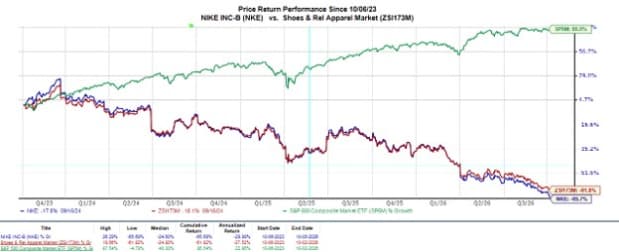
Nike's Q1 results highlight ongoing risks
Nike reported Q1 revenue of $11.21 billion, down 4% year over year and below the Zacks Consensus Estimate of $11.4 billion. Earnings came in at $0.48 per share, down from $0.49 a year ago but ahead of the 44-cent consensus EPS estimate, while gross margin expanded 60 basis points to 42.8%.
That said, several important areas remain under pressure. Nike Direct revenue fell 8% on a reported basis, including a 13% decline in digital sales, while Greater China revenue plunged 26% on a currency-neutral basis. Revenue from its Converse segment was down 28%.
More concerning is Nike's outlook. Management now expects fiscal 2027 revenue to decline at a high-single-digit rate and adjusted earnings of just $1.15-$1.35 per share, which would reflect a 27%-14% decline from EPS of $1.58 in FY26.
Nike is also restructuring its Sportswear, Jordan Brand, and Greater China businesses, with some corrective actions expected to stretch beyond FY27.
Nike's new “Pace” initiative could eventually help, with management targeting roughly $2.5 billion in cumulative savings through fiscal 2031. However, the program is also expected to generate about $1 billion in pretax restructuring charges, so the turnaround won't be immediate.
Is Nike's dividend safe?
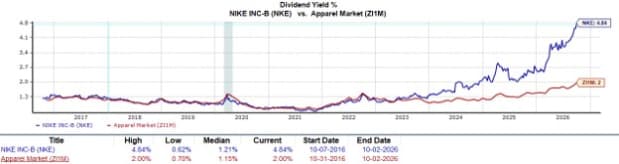
One increasingly attractive aspect of NKE stock is its dividend.
Nike currently pays a quarterly dividend of $0.41 per share, or $1.64 annually, giving the stock a yield of nearly 5% at current prices.
More impressively, Nike has raised its dividend for 24 consecutive years, leaving it on the cusp of the 25-year dividend-growth milestone associated with Dividend Aristocrat status.
The payout appears defensible for now, although investors shouldn't ignore the deterioration in coverage.
To that point, Nike generated only $135 million in operating cash flow during Q1 while spending $199 million on capital expenditures and approximately $610 million on dividends.
Meanwhile, the company's current annualized dividend obligation is running above what its FY27 earnings guidance would comfortably support.
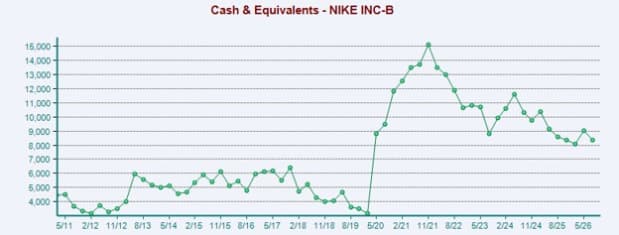
Fortunately, Nike still has substantial financial flexibility, ending its latest quarter with $8.36 billion in cash and equivalents. That liquidity, combined with Nike's long dividend-growth record and the importance management places on shareholder returns, makes an outright dividend cut appear unlikely in the near term.
Still, investors should view the roughly 5% yield as compensation for elevated business risk rather than evidence that NKE has suddenly become a low-risk income stock.
It’s also noteworthy that while Nike’s liquidity remains supportive of its dividend, its cash position has declined sharply in recent years amid heavy investment in digital infrastructure, e-commerce, and brand marketing.
Caitlin Clark could give Nike a much-needed boost
One bright spot is Nike's opportunity in women's sports, particularly its partnership with WNBA superstar Caitlin Clark.
Clark's highly anticipated Nike Caitlin 1 signature basketball shoe launched globally on Oct. 1 at $140, and the initial release sold out in nearly every size within roughly two hours. Nike's own website subsequently listed the Caitlin Blue colorway as sold out.
The strong launch illustrates Clark's enormous commercial appeal and allows Nike to capitalize on the rapid growth and broader cultural relevance of women's basketball and women's sports.
That becomes increasingly important as Nike works to restore some of the athlete-driven excitement historically associated with the brand. The company has faced intensified competition for top athletes, including the recent loss of global soccer superstar Kylian Mbappé to fast-growing rival On Holdings (ONON).
Clark won't single-handedly fix Nike's broader product and geographic challenges, but a successful signature franchise could strengthen Nike Basketball, expand apparel sales, and help the company connect with a younger generation of consumers.
Bottom line
There are legitimate reasons to believe Nike can eventually recover. The company's brand remains globally recognized, margins improved in Q1, its dividend yield has become unusually attractive, and Caitlin Clark could become one of Nike's most valuable next-generation athlete partnerships.
However, the risks remain difficult to overlook. Revenue is declining, Greater China remains deeply challenged, direct-to-consumer sales are weak, and Nike's turnaround initiatives could take several more quarters to meaningfully improve results.
For now, NKE lands a Zacks Rank #5 (Strong Sell), reflecting an unfavorable trend in earnings estimate revisions that is likely to continue following its weaker-than-expected FY27 guidance.
Want the latest recommendations from Zacks Investment Research? Download 7 Best Stocks for the Next 30 Days. Click to get this free report
Author

Zacks
Zacks Investment Research
Zacks Investment Research provides unbiased investment research and tools to help individuals and institutional investors make confident investing decisions.
















