New Zealand Kiwi waits on an RBNZ boxed in by its own rate cuts
- The RBNZ is widely expected to hold rates at 2.25% on Wednesday, but the forward track is where the real action sits.
- Inflation has pushed back to the top of the target band and is forecast to keep climbing, leaving the bank's old easing bias looking badly dated.
- Rate markets have quietly flipped to pricing the next move as a hike rather than a cut, setting up a hawkish-hold trap for the Kiwi.

There is something almost comic about a central bank that spent a year insisting rates needed to come down, only to find itself staring at inflation heading the wrong way. The Reserve Bank of New Zealand (RBNZ) slashed the Official Cash Rate (OCR) from a 5.5% peak all the way to 2.25% by late last year, the most aggressive easing cycle in the developed world. On Wednesday at 02:00 GMT, it is expected to leave that rate untouched for a third straight meeting and, in all likelihood, keep talking about looking through near-term price pressures. The trouble is that the tape, the data, and increasingly the bank's own forecasts no longer agree that those pressures are going anywhere.
The easing that won't stop biting
The uncomfortable truth for the RBNZ is that monetary policy works with a lag of roughly twelve to eighteen months, which means the deep cuts delivered through 2024 and 2025 are only now feeding through into activity and prices. Consumer Price Index (CPI) inflation hit 3.1% YoY in the final quarter of last year, breaching the 1% to 3% target band, and the bank's own projections have headline inflation pushing toward 4% in the middle of this year. That is not a rounding error; it is a central bank that eased into the teeth of an inflation problem and is now hoping the problem politely resolves itself. The Middle East has not helped. Surging Crude Oil prices tied to the US-Iran conflict have lit a fresh fire under imported inflation, and the governor has gone out of her way to keep hikes firmly on the table rather than rule them out.
The market stopped believing the cut story
For a sense of how far the narrative has turned, look at where the rate market now sits. Six months ago, the debate was about how much further the OCR would fall. Today, the swaps curve leans toward a hike before year-end, with bank economists steadily pulling their first-tightening calls forward into late 2026 and penciling in an endpoint back up around 3%. Wholesale rates beyond twelve months have already climbed on that repricing, and several lenders have nudged mortgage rates higher without waiting for the RBNZ to move. A hold on Wednesday is the base case, but a hold delivered alongside upgraded inflation forecasts and a reluctance to commit to any further easing is, in substance, a hawkish hold. That is the scenario the Kiwi is not fully braced for.
Why the forecasts matter more than the rate
This is a full Monetary Policy Statement (MPS), not an interim review, which means fresh projections and a press conference at 03:00 GMT. The OCR track buried in those forecasts will move the Kiwi far more than the unchanged headline number. If the bank lifts its inflation profile and flags the prospect of decisive tightening should second-round effects take hold, that is rocket fuel for the currency. If instead it leans on the transitory script and signals patience, expect the Kiwi to fade the disappointment. Adding to the noise, the government's Budget lands Thursday, so traders will be reading the rate decision and the fiscal stance together rather than in isolation.
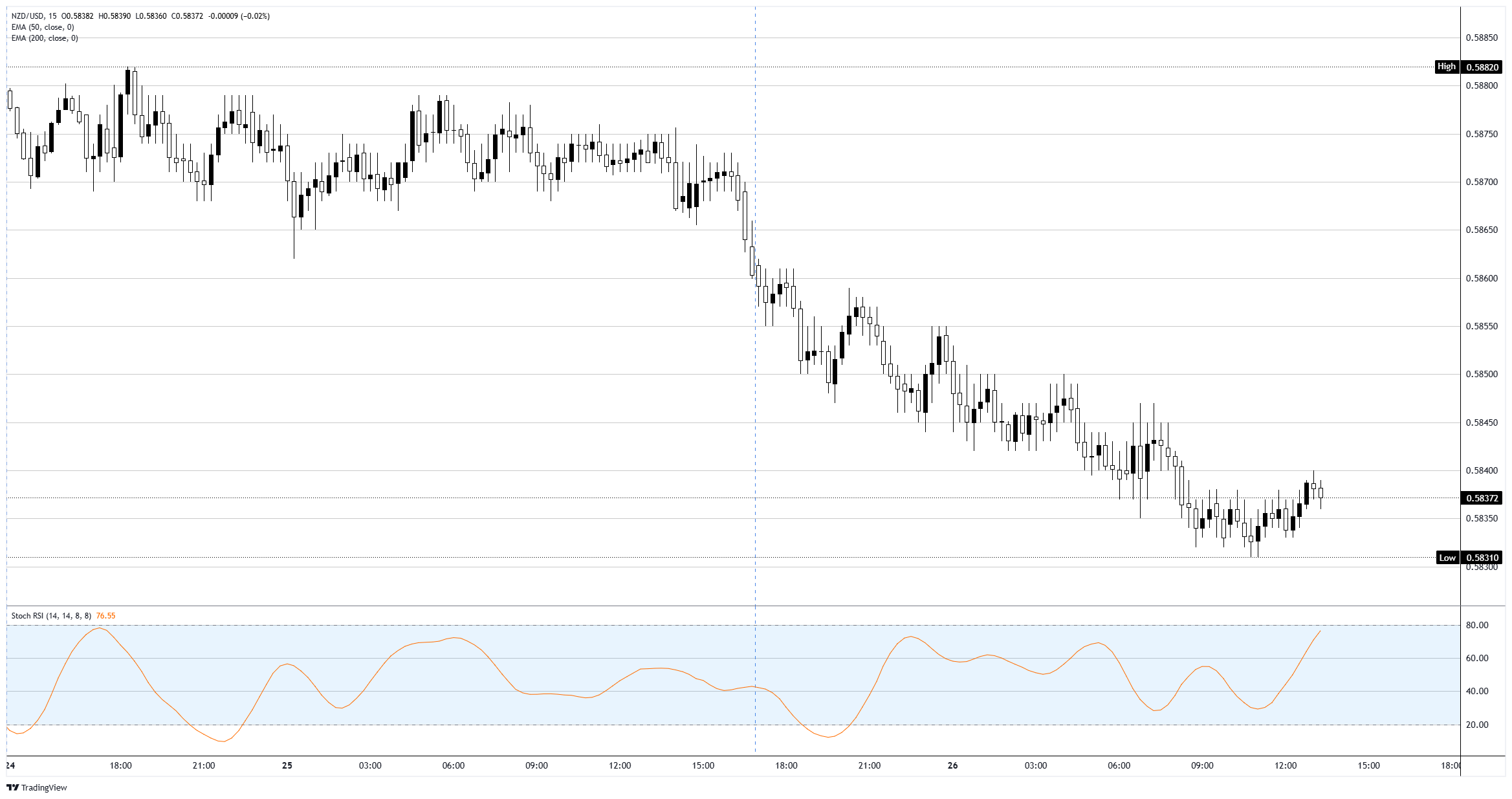
For now the Kiwi is trading near 0.5850 after grinding lower through the overnight session and stabilising just above 0.5830 on the intraday chart. On the daily, price has slipped below its clustered 50 and 200-day EMAs, which sit just overhead in the 0.5850 to 0.5900 band and have capped every rally this year. A genuinely hawkish statement opens a run at the 0.5900 handle, with 0.5950 the stretch target if the tightening rhetoric is explicit. A dovish or non-committal hold sends it back toward the 0.5800 handle, and a break there exposes 0.5750. The bias into the event is neutral with an upside skew, simply because the bank has more room to surprise hawkish than dovish from here. The wider question is how long the RBNZ can keep calling this inflation temporary before the curve forces its hand.
NZD/USD 15-minute chart
New Zealand Dollar FAQs
The New Zealand Dollar (NZD), also known as the Kiwi, is a well-known traded currency among investors. Its value is broadly determined by the health of the New Zealand economy and the country’s central bank policy. Still, there are some unique particularities that also can make NZD move. The performance of the Chinese economy tends to move the Kiwi because China is New Zealand’s biggest trading partner. Bad news for the Chinese economy likely means less New Zealand exports to the country, hitting the economy and thus its currency. Another factor moving NZD is dairy prices as the dairy industry is New Zealand’s main export. High dairy prices boost export income, contributing positively to the economy and thus to the NZD.
The Reserve Bank of New Zealand (RBNZ) aims to achieve and maintain an inflation rate between 1% and 3% over the medium term, with a focus to keep it near the 2% mid-point. To this end, the bank sets an appropriate level of interest rates. When inflation is too high, the RBNZ will increase interest rates to cool the economy, but the move will also make bond yields higher, increasing investors’ appeal to invest in the country and thus boosting NZD. On the contrary, lower interest rates tend to weaken NZD. The so-called rate differential, or how rates in New Zealand are or are expected to be compared to the ones set by the US Federal Reserve, can also play a key role in moving the NZD/USD pair.
Macroeconomic data releases in New Zealand are key to assess the state of the economy and can impact the New Zealand Dollar’s (NZD) valuation. A strong economy, based on high economic growth, low unemployment and high confidence is good for NZD. High economic growth attracts foreign investment and may encourage the Reserve Bank of New Zealand to increase interest rates, if this economic strength comes together with elevated inflation. Conversely, if economic data is weak, NZD is likely to depreciate.
The New Zealand Dollar (NZD) tends to strengthen during risk-on periods, or when investors perceive that broader market risks are low and are optimistic about growth. This tends to lead to a more favorable outlook for commodities and so-called ‘commodity currencies’ such as the Kiwi. Conversely, NZD tends to weaken at times of market turbulence or economic uncertainty as investors tend to sell higher-risk assets and flee to the more-stable safe havens.
Author

Joshua Gibson
FXStreet
Joshua joins the FXStreet team as an Economics and Finance double major from Vancouver Island University with twelve years' experience as an independent trader focusing on technical analysis.