New Zealand Dollar gains against US Dollar due to unfavorable US NFP backdrop
- New Zealand Dollar rises against the US Dollar as weak US ADP data sets a weak stage for the US NFP data.
- Fed’s Williams pushes back risks of high inflation expectations.
- The RBNZ is unlikely to raise interest rates again in October.

The New Zealand Dollar (NZD) is up 0.16% at around 0.5860 against the US Dollar (USD) during the European trading session on Thursday. The kiwi pair strengthens as the US Dollar underperforms, with weak United States (US) ADP Employment Change data staging an unfavorable backdrop for the Nonfarm Payrolls (NFP) data for August scheduled for Friday.
At press time, the US Dollar Index (DXY), which gauges the Greenback’s value against six major currencies, trades 0.3% lower to near 99.26.
On Wednesday, the US ADP reported that the private sector created 38K fresh jobs in August, fewer than 47K estimates and the prior release of 46K.
US jobs outlook seen stabilizing as TD Securities flags modest NFP rebound
According to TD Securities, the US labour market is expected to show signs of stabilization in August. The bank’s macro team looks for "August NFP to rebound to 95k after July posted a decline of 23k," framing the anticipated gain as a recovery from the prior month’s weakness rather than the start of a stronger hiring trend. At the same time, TD Securities expects the unemployment rate to show little movement, judging that "the UE rate likely went sideways at 4.1% with balanced risks," underscoring a broadly steady underlying jobs picture.
In addition to weak US private employment data, comments from New York Fed Bank President John Williams that “inflation expectations are contained”, and “recent data on price pressures has been encouraging", have increased doubts over upside inflation risks.
On the New Zealand Dollar front, market participants doubt the Reserve Bank of New Zealand (RBNZ) raising interest rates in the next policy meeting after hiking them to 2.75% on Wednesday.
Analysts at MUFG/BTMU highlight that RBNZ Governor Anna Breman struck a notably cautious tone on the policy outlook, stressing that “it’s likely that there will be further increase in the OCR, but the timing is highly uncertain because we will consider the effects of the two hikes that we’ve done now, and also the new information that’s happening and how that is affecting the medium-term inflation outlook”. In their view, this more measured guidance has already filtered into market pricing, with MUFG/BTMU noting that “the probability of another hike in October has fallen to around 36% down from 65% prior to the meeting.”
NZD/USD Technical Analysis
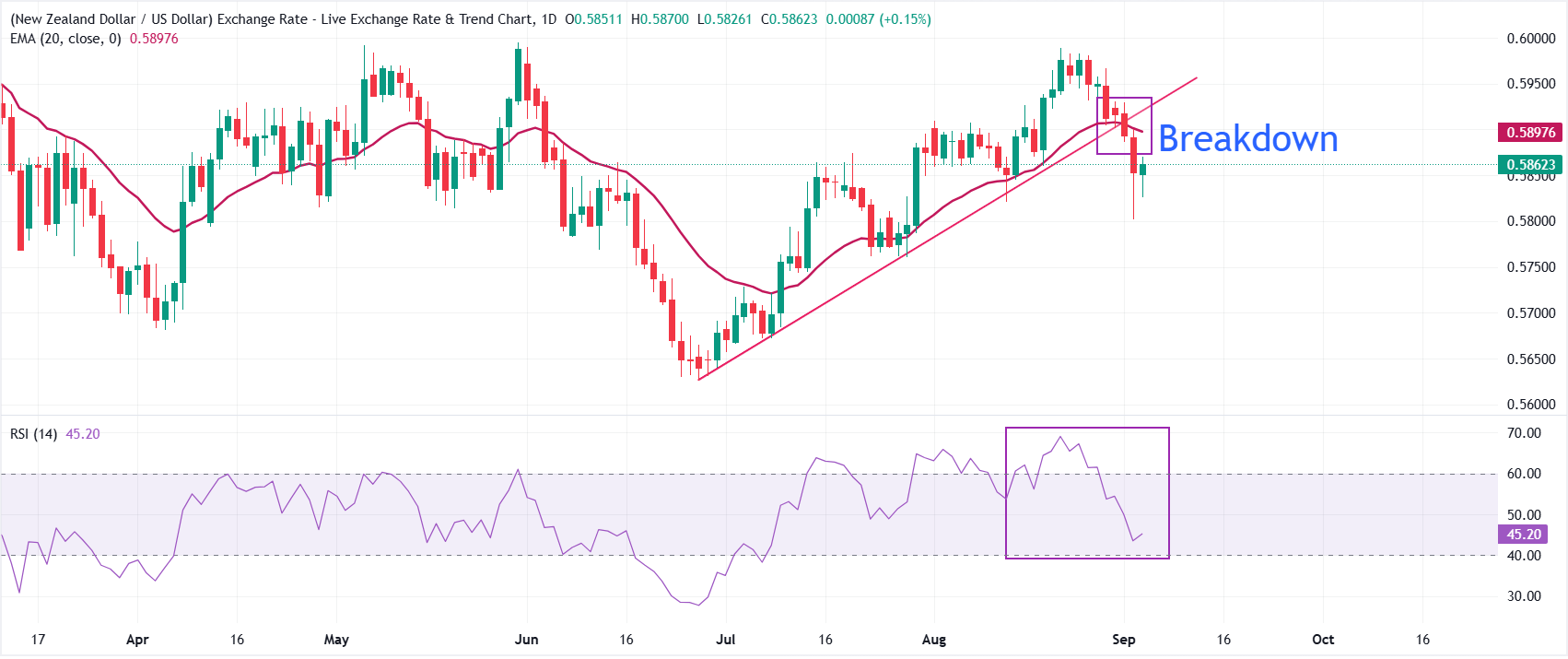
In the daily chart, NZD/USD trades at 0.5863, holding beneath the 20-period Exponential Moving Average (EMA) at 0.5898, which keeps the near-term bias bearish despite the broader recovery off the 0.56 area seen in recent weeks. The pair has also slipped below the former rising trend-line support, now a barrier at 0.5924, suggesting the latest pullback is eroding the bullish structure, while the Relative Strength Index (RSI) at 45.3 drifts toward neutral, hinting at fading upside momentum rather than outright oversold conditions.
On the topside, initial resistance is located at the 20-period EMA at 0.5898, where a daily close above would ease immediate selling pressure, before the broken ascending trend line at 0.5924 comes into play as a stronger cap. With no nearby technical supports defined below the market in this dataset, the focus remains on whether NZD/USD can reclaim 0.5898 and 0.5924; failure to do so would keep the pair exposed to further downside, even if momentum stays comparatively modest.
(The technical analysis of this story was written with the help of an AI tool. Know more.)
Economic Indicator
RBNZ Interest Rate Decision
The Reserve Bank of New Zealand (RBNZ) announces its interest rate decision after each of its seven scheduled annual policy meetings. If the RBNZ is hawkish and sees inflationary pressures rising, it raises the Official Cash Rate (OCR) to bring inflation down. This is positive for the New Zealand Dollar (NZD) since higher interest rates attract more capital inflows. Likewise, if it reaches the view that inflation is too low it lowers the OCR, which tends to weaken NZD.
Read more.Last release: Wed Sep 02, 2026 02:00
Frequency: Irregular
Actual: 2.75%
Consensus: 2.75%
Previous: 2.5%
Source: Reserve Bank of New Zealand
The Reserve Bank of New Zealand (RBNZ) holds monetary policy meetings seven times a year, announcing their decision on interest rates and the economic assessments that influenced their decision. The central bank offers clues on the economic outlook and future policy path, which are of high relevance for the NZD valuation. Positive economic developments and upbeat outlook could lead the RBNZ to tighten the policy by hiking interest rates, which tends to be NZD bullish. The policy announcements are usually followed by interim Governor Christian Hawkesby's press conference.
Author

Sagar Dua
FXStreet
Sagar Dua is associated with the financial markets from his college days. Along with pursuing post-graduation in Commerce in 2014, he started his markets training with chart analysis.