Nasdaq march futures eye key mid-structure pivot as daily and intraday align

Price behaviour around the central pivot is guiding near-term context as structure remains intact.
Nasdaq March Futures (NQH) — Daily & Intraday Structure Desk
New York Session | December 18
Market Context
Nasdaq March futures continue to operate within the same structural framework outlined in the original desk playbook, with both daily and intraday timeframes now converging around a clearly defined mid-structure decision zone.
Rather than signalling directional conviction, current price behaviour highlights a market focused on acceptance and rejection at structure, reinforcing the importance of predefined reference levels.
Daily Structure
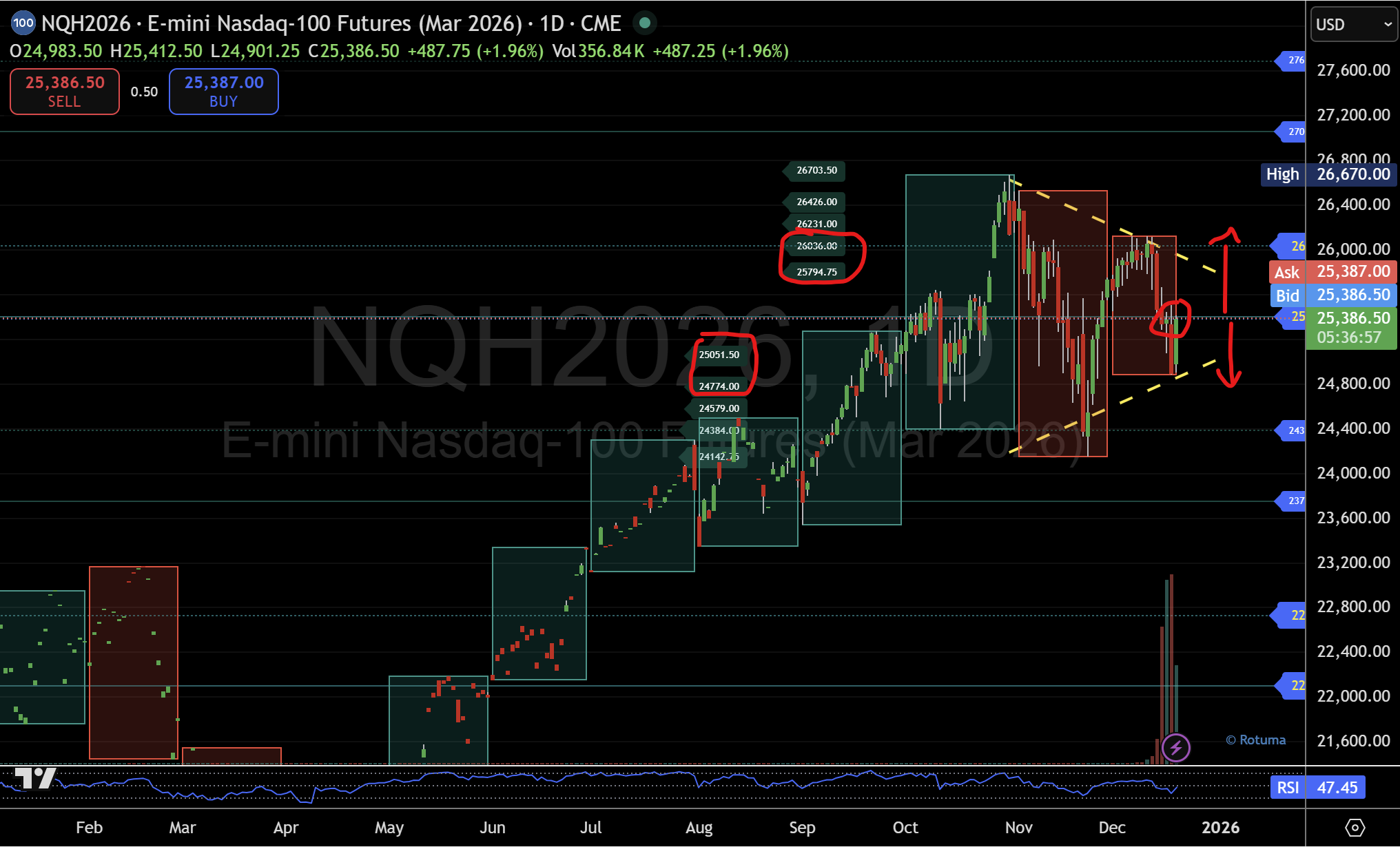
On the daily timeframe, price briefly slipped below the Micro-5 level at 25,051, before recovering and rotating back toward the 25,405 pivot — a level that failed to hold during the previous two sessions.
This recovery places price back at a familiar structural decision point.
- Acceptance above 25,405 would reopen scope for a rotation back toward the upper structure, with Micro-1 at 25,794 and Micro-2 at 26,036 acting as the next reference levels.
- Failure to hold would keep the broader structure unchanged and maintain the potential for a repeat rotation toward the lower structure.
Importantly, the daily structure itself remains unchanged. Price continues to participate within the existing framework rather than breaking it.
Intraday Structure (15-Minute)
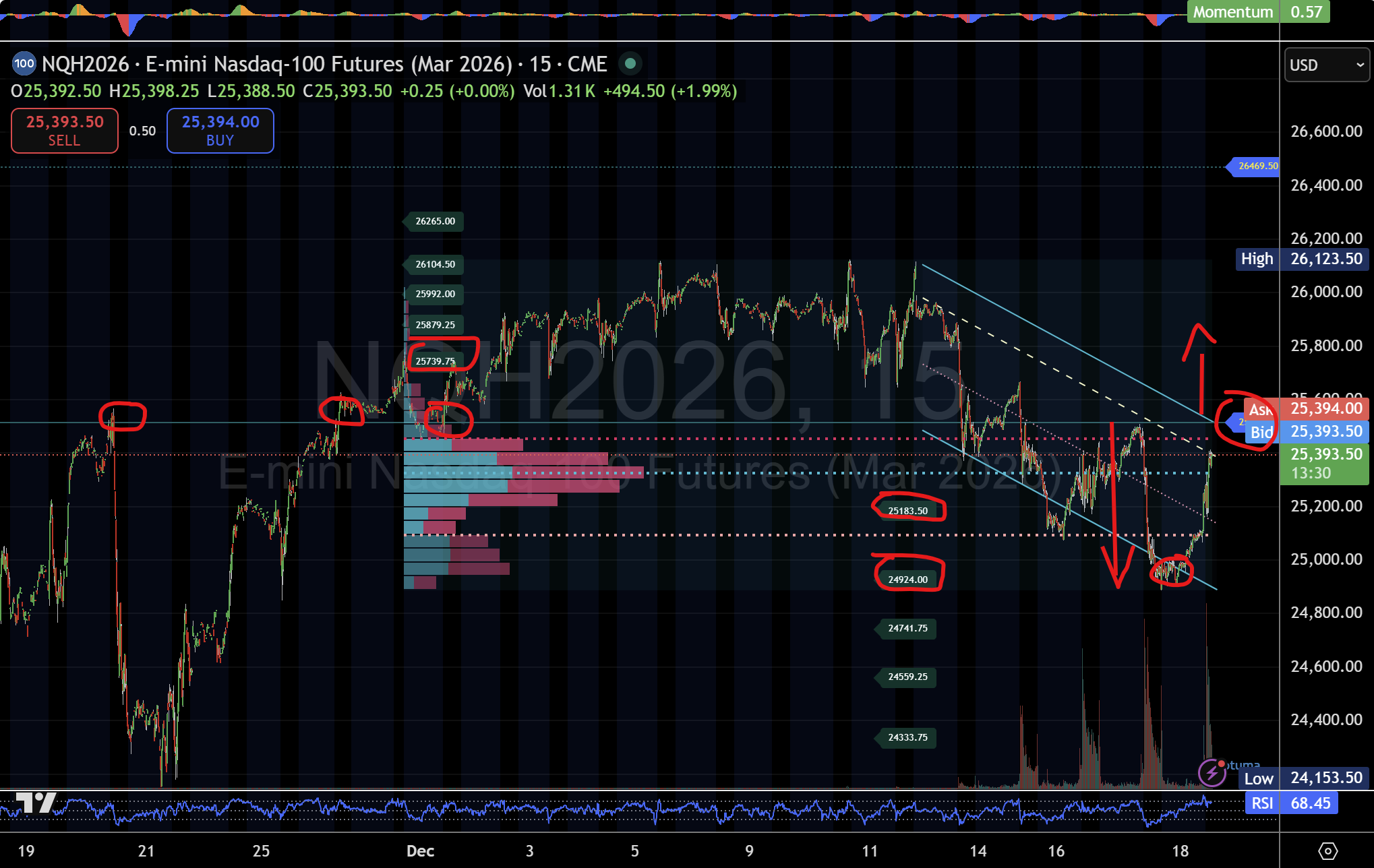
On the 15-minute timeframe, the index found support at Micro-4 (24,924) — the lower structure from the previous session — and successfully held this level through the Asia and London sessions.
Momentum has since carried into the New York session, producing a recovery that closely mirrors the recent daily behaviour. This reinforces the view that intraday price action is responding to the same structural logic as the higher timeframe.
The 25,514 intraday pivot, which represents the centre of the current structure, is now emerging as the first point of resistance for the session.
- Acceptance above 25,514 would signal a return toward the upper intraday structure.
- Rejection at this level would keep focus on a potential rotation back toward the lower structure.
Key Levels to Monitor
Daily
- 25,405: Structural pivot/balance point
- 25,794 – 26,036: Upper daily micro structure
- 25,051: Daily Micro-5 / lower structure threshold
Intraday
- 25,514: Intraday pivot / mid-structure decision point
- 24,924: Intraday Micro-4 / prior session support
Desk Takeaway
Both the daily and intraday structures are now aligned, placing increased emphasis on how price behaves around the middle of the structure rather than on directional bias.
The next rotation — higher or lower — will be determined by acceptance or rejection at these central pivots, not by momentum alone.
Structure defines the battlefield.
Price behaviour confirms it.
Levels exist before price reaches them — this desk documents response, not reaction.
This analysis is for informational purposes only and does not constitute investment advice. Trading involves risk, and past performance is not indicative of future results.
Author

Denis Joeli Fatiaki
Independent Analyst
Denis Joeli Fatiaki possesses over a decade of extensive experience as a multi-asset trader and Market Strategist.