|

MULN Stock Forecast: Mullen Automotive rebounds during relief rally on Wall Street

  • NASDAQ:MULN gained 2.83% during Tuesday’s trading session.
  • Mullen’s stock remains in a long–term downtrend despite recent catalysts.
  • The US Army is analyzing Canoo’s EV Vans for various military uses.

NASDAQ:MULN bounced back on Tuesday after a late-session collapse to close trading on Monday. Shares of MULN added 2.83% and closed the trading day at $1.09. Stocks rallied higher as all three major indices punished back above their 50-day moving averages for the first time since April. The recent performance of the markets indicate that investors could be thinking that the bottom is in for this bear market. Overall, the Dow Jones jumped higher by 754 basis points, the S&P 500 gained 2.76%, and the NASDAQ posted a gain of 3.11% during the sesion.


Stay up to speed with hot stocks' news!


Mullen’s stock still remains in a long-term downtrend as the EV startup remains below both its key 50-day and 200-day moving averages. Despite recent catalysts like the deal with DelPack Logistics to supply electric delivery vans, as well as the future launch of its FIVE Crossover EV, Mullen’s stock has failed to really develop any momentum. Even with the recent bullishness surrounding electric delivery vans from companies like Rivian (NASDAQ:RIVN) and Canoo (NASDAQ:GOEV), Mullen continues to be left spinning its tires on the charts.

Mullen stock price
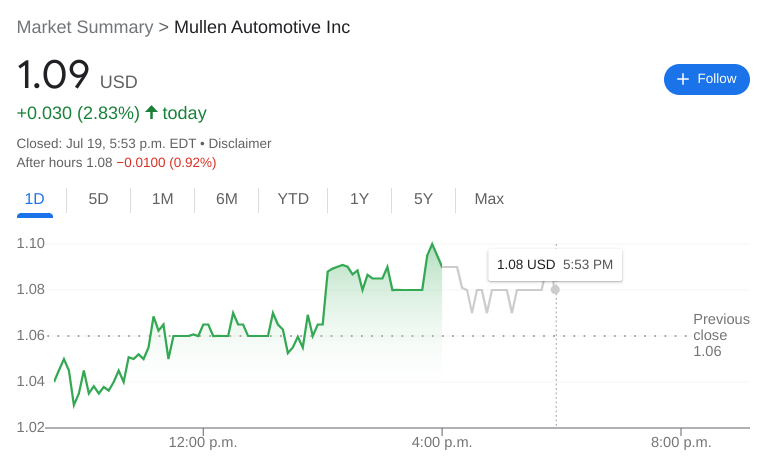
MULN Stock

Speaking of Canoo, more details were released on the company’s involvement with the US Army. Canoo is providing an electric van to be analyzed for military usage. This includes things like troop transport and being deployed on military operations. The EV startup already has a partnership with NASA and recently signed the deal with WalMart (NYSE:WMT) so a new partnership with the US Army would not be surprising.


Like this article? Help us with some feedback by answering this survey:

Author

More from Stocks Reporter
Share:

Editor's Picks

AUD/USD sticks to neutral bias above 0.7100 amid cautious markets

AUD/USD holds steady above 0.7100 in the Asian session on Monday as the US Dollar stalls its modest pullback from the highest level since late July amid persistent geopolitical uncertainties. The PBOC status quo on Loan Prime Rates also weighs on the Aussie. However, bets on another RBA rate hike continue to underpin the Australian Dollar ahead of the Trump-Xi Summit.

USD/JPY eases below 157.00 amid looming intervention risks

USD/JPY is easing back below 157.00 in Asia on Monday, undermined by modest Japanese Yen strength amid looming intervention risks after Friday's BoJ rate check. A Japanese holiday also keeps traders on edge amid escalating geopolitical tensions between Russia and Ukraine and in the Middle East. As a result, the US Dollar pauses its pullback, limiting the pair's downside.

Gold meets resistance around $4,400

Gold kicks in the new trading with on the back foot, keeping its trade near $4,350 per troy ounce. The precious metal’s correction comes on the back of the firmer US Dollar and espite declining US Treasury yields across the curve.

Bitcoin hits $85,000 for the first time in eight months
Bitcoin price reclaims $85,000 on Monday, advancing last week’s 5% recovery toward an eight-month high. The recovery in King Crypto aligns with renewed institutional demand, with Exchange Traded Funds (ETFs) recording $433 million in inflows on Friday.
The week ahead: Fuel prices in focus as we lead up to key eco releases

Financial markets are in a strange position as we move to the final weeks of Q3, uncertainty and volatility continue to grip markets, but the oil price is falling; and European and US stocks are poised to open higher later on Monday. Market stresses are concentrated in sovereign bonds, and European and US yields had another scare late on Friday, and moved higher.

BoJ Recap: Not as hawkish as expected

The Bank of Japan (BoJ) raised its short-term interest-rate target to 1.25% from 1.00% in a 7-2 vote, marking another step in the normalisation of monetary policy and widely matching what everyone has been expecting for weeks.















