Middle East conflict takes a backseat as stocks attempt to return to pre-war levels

There is an upbeat tone to financial markets this morning, as Europe takes its cue from the US, where stocks had a strong rally with most major US indices rising more than 1% at the start of the week. European stocks are also higher on Tuesday, although the gains so far for the UK have been less impressive than their US counterparts. The FTSE 100 is higher by 0.2%, however, the Dax is up nearly 1% and the Cac is higher by 0.4%. In the UK, the FTSE 250 is outperforming the FTSE 100 today, as the oil price slips back below $100 per barrel and weighs on the oil majors.
The oil price continues to remain central to financial markets and when it dips then risk sentiment tends to rise. Brent crude is now trading around $98.50, as reports suggest that Saudi Arabia, a US ally in the region, is pressing the US to drop their blockade on the Strait of Hormuz. There is still hope that peace talks can continue, with both the US and Iran signaling that talks will progress in the future. Even though tensions remain high and the Strait of Hormuz remains closed, the market is comfortable that this war has entered a new stage, one that will lead to the end of fighting and a pathway to reopening the waterway. This means that although still important, the war may start to take a backseat for markets, with other developments helping to drive price action.
Bumper trading results expected from BP could attract unwanted attention
As the war takes a back seat, the market can switch its focus from geopolitics to earnings data. BP’s share price has reversed earlier gains on Tuesday even though it reported a very upbeat trading outlook. The company reported an ‘exceptional’ Q1 for its oil traders as unprecedented volatility surged through commodity markets. BP reports results at the end of this month, but this update points to a strong picture for its trading division, after it had a disappointing Q4 performance. The company also reported that its oil and gas production was flat on the quarter, and it did not mention any production issues caused by the war. The muted reaction to BP’s stock price to this news is down to two factors, 1, the oil price is lower, which is weighing on the energy sector, and 2, this could attract the eyes of the government eager to fill their coffers, so BP should expect a hefty tax bill.
Not all commodity trading businesses have benefited from the war; some notable names were wrongfooted at the start of the conflict and incurred sharp losses. However, it appears that BP was positioned well, and like other energy firms has made a fortune through buying available tankers of oil and selling them for huge premiums, as the price of oil on the physical market continues to surge due to the supply crunch.
The news from BP, and Shell’s similar update last week, suggests that there have clearly been winners from this war. BP’s performance justifies the 33% increase in the share price so far this year, although the stock price slipped on Tuesday as crude oil fell back below the $100 per barrel mark. If the war is nearing its end, then oil majors could struggle through the rest of Q2.
S&P 500 rises back above pre-war levels
Another sign that the market is moving on from the conflict in the Middle East is the S&P 500 rising back up to pre-war levels. The Nasdaq is also back to early February levels, with strong gains for tech stocks and US banks, after Goldman Sachs reported a bumper first quarter of revenues. Software stocks are also in recovery mode, after being hit by fears about AI superseding their businesses earlier this year. Now we are seeing software stocks rebound in the US, with strong gains for the likes of Oracle, Service Now and Adobe. Oracle’s share price rose 12% on Monday and was the top performing stock on the S&P 500.
This is important for global equities and for market sentiment. In recent years, surging tech stocks have helped US indices reach record highs. Without them, US indices have struggled. If tech makes a comeback, then we could see US dominance return to financial markets, after European and Asian indices outperformed their US counterparts earlier this year. US indices are underperforming month to date, but if we see the tech stock recovery continue, then US stocks may continue to play catch up.
Elsewhere, the dollar is broadly lower today as the oil price slips and risk sentiment returns to markets. The dollar index is now at its lowest level since early March, as stocks and FX attempt to return to pre-war levels. Ahead today, US bank earnings will be in focus with JP Morgan’s Q1 numbers the highlight. European inflation rose as expected in Germany and Spain, and the focus is also switching to some key central bankers who are speaking throughout this week as the IMF Spring conference gets underway. ECB President Lagarde will speak later tonight, her comments will be watched closely, and they have the most potential to move markets, especially for the euro.
S&P 500 returns to pre-war levels
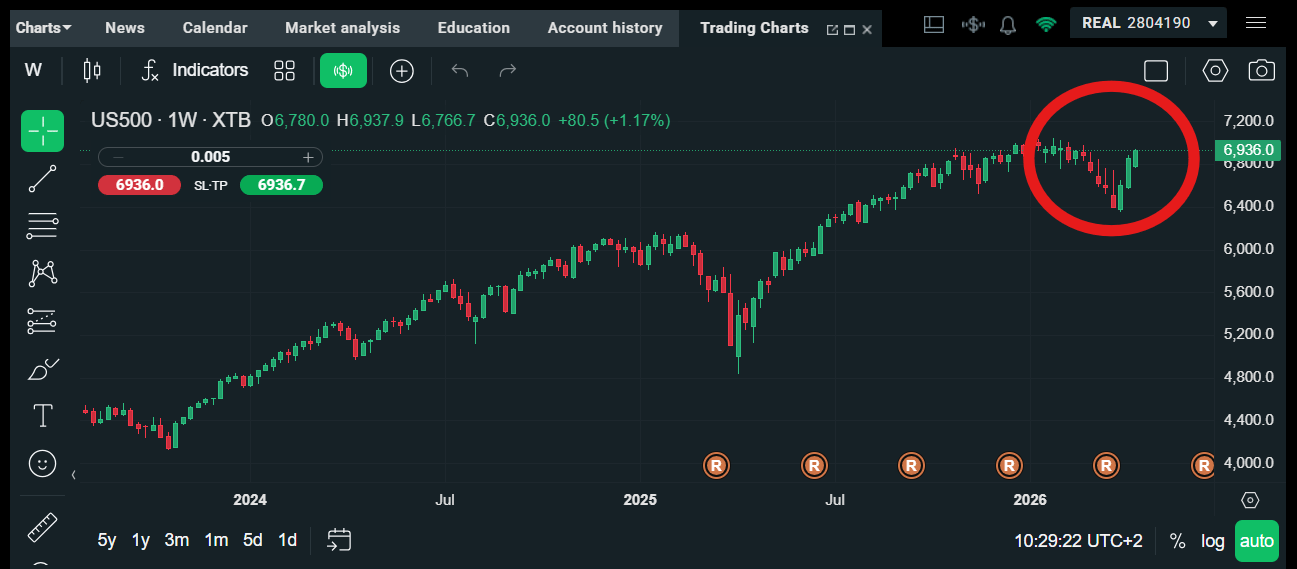
Source: XTB
Author

Kathleen Brooks
XTB UK
Kathleen has nearly 15 years’ experience working with some of the leading retail trading and investment companies in the City of London.