Micron claws its way back to positive territory after deep sell-off
- Micron stock recovers after plunging more than 9% on Monday.
- A DRAM price-fixing lawsuit alleges coordination between Micron, SK Hynix and Samsung Electronics.
- Samsung Electronics and SK Hynix announce construction of four chip fabs that will cost over $500 billion.
Micron Technology (MU) stock recovered back to positive territory by the close on Monday after selling off as much as 9.6% in the first hour of the morning session.
The culprit for the heavy sell-off was multi-pronged. First, SK Hynix and Samsung Electronics, Micron's South Korean competitors in the memory chip industry, both sold off after announcing enormous investments in new production factories. Then news emerged that Micron was facing a class-action lawsuit alleging that it had been involved in price fixing.
But the stock market swelled on Monday, leading to a steady accumulation of Micron's shares. The NASDAQ Composite surged over 2% as buyers bought into the Magnificent 7's recent weakness.
South Korean supply announcement follows DRAM price-fixing lawsuit
A class-action lawsuit filed on Thursday, June 25, in a California federal court alleges that Samsung Electronics, SK Hynix, and Micron Technology coordinated to restrict DRAM supply and push prices sharply higher during the AI boom.
Indeed, all three companies have seen their profits and margins swell over the past year as the ongoing data center buildout requires immense amounts of memory semiconductors. In particular, the lawsuit claims that the three companies all uniformly reduced production of these chips as they transitioned to producing higher-margin high-bandwidth memory (HBM) chips used in AI data centers.
By their own admission, all three companies very publicly shifted their focus to HBM chips, but it's not clear that they illegally coordinated on this impulse. Logically, companies will be drawn to higher-margin product lines.
The lawsuit contends that it was systematic price manipulation, pointing to DRAM prices that have skyrocketed by 500% to 700% over the past four years.
Separately, the government of South Korea announced that it was launching a half-trillion Dollar public-private investment to expand semiconductor production. SK Hynix and Samsung Electronics will each break ground on two semiconductor fabs in the southwest of the nation. While funding will come from the state, much of the $518 billion will be invested directly from the two companies' coffers alongside suppliers.
President Lee Jae Myung led the announcement. "We must secure the core elements of AI faster than any other country," the President said. "Semiconductors, physical AI, and AI data centers are the triple axis for our great leap forward."
While Micron is also building a new fab in Japan, the news out of South Korea means plenty of supply will arrive over the next few years that could put a lid on the ever increasing prices for memory chips.
But that supply won't arrive in time to arrest heavy near-term demand. According to investment bank Jefferies, memory prices could rise another 40%-50% next quarter and 30%-40% more in the following quarter.
Micron technical analysis
Micron stock sank to an intraday low of $1,023 in the morning session before closing up 0.9% at $1,142 at the close. In total, it amounted to more than a 10% swing in Monday's market cap.
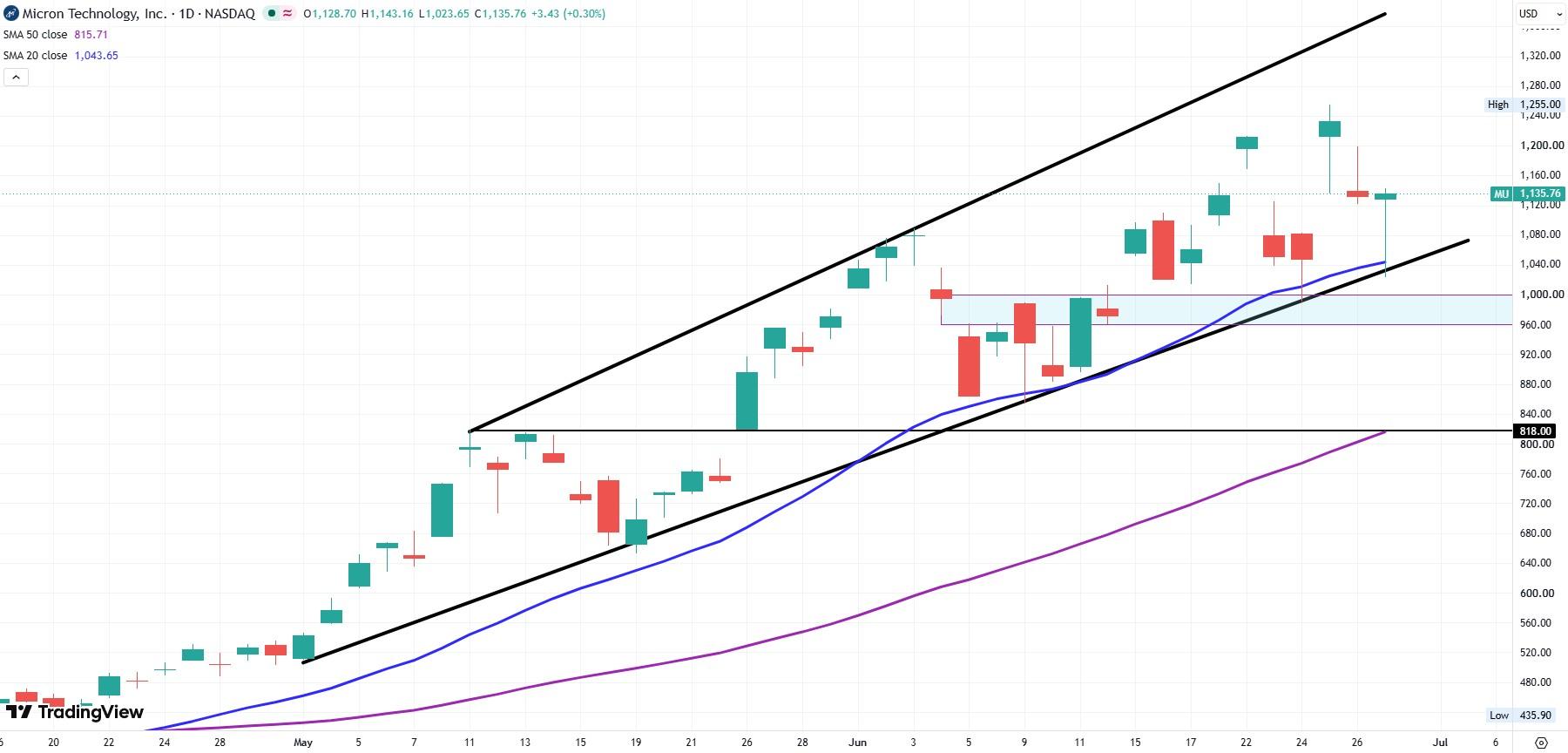
Once again, Micron found support near its lower trendline of the price channel that it has traded within since May 1. This is similar activity to May 19, June 9, and June 24.
This leads traders to believe that the rally is not yet over. The 20-day Simple Moving Average (SMA) is also closely tracking the lower trendline, providing it with more significance. For a major pullback to occur, Micron stock would need to close below the trendline, in which case it would immediately fall into the volume shelf between $960 and $1,000. A break there would allow Micron to dip toward long-term resistance-turned-support at $818, which coincides with the 200-day SMA.
But bulls will see the long lower wick from Monday's candle as a sign that the pressure is mostly upward. The top trendline has them expecting a run above $1,400 is coming next.
Author

Clay Webster
FXStreet
Clay Webster grew up in the US outside Buffalo, New York and Lancaster, Pennsylvania. He began investing after college following the 2008 financial crisis.

















