Mexican Peso slips as on Banxicos's stance and consumer pessimism

Most recent article: Mexican Peso mixed after Monday's sell-off from weak data and Banxico comments
- Mexican Peso pulls back after gaining over 1.50% last week, pressured by weaker Consumer Confidence.
- Banxico Governor Rodriguez justifies recent 25 bps rate cut amid 3-2 split decision, citing transitory inflation effects.
- Market focus shifts to key US inflation and retail sales data, USD gains momentum ahead of the releases.
The Mexican Peso retreats on Monday after posting solid gains of over 1.50% last week against the Greenback, with the latter posting decent gains ahead of a busy economic docket in the United States. Meanwhile, Consumer Confidence in Mexico dipped in July, which could be a prelude to the ongoing economic slowdown. The USD/MXN trades at 19-05 and gains over 1%.
Mexico’s National Statistics Agency announced that consumers grew less optimistic about the economic outlook and printed the second lowest reading since May’s 46.8 reading, revealed the Instituto Nacional de Estadistica Geografia e Informatica (INEGI).
In addition, Bank of Mexico (Banxico) Governor Victoria Rodriguez Ceja said in an interview with El Financiero that elements justified a 25-basis-point (bps) rate cut to the main reference rate amid a 3-2 split decision.
She acknowledged that despite headline inflation hitting 5.57%, she insisted it was unrelated to core prices, which decreased for the 18-straight month and reached 4.05% in July.
“We expect these effects of the shocks that we observe in non-core inflation to be transitory, so we are still expecting headline inflation to return to its target at the same time, at the end of 2025,” Rodriguez noted.
The USD/MXN depreciated following Banxico’s decision. Yet traders are laser-focused on the release of US inflation figures on Tuesday and Wednesday, followed by Retail Sales data on Thursday and Friday’s University of Michigan (UoM) Consumer Sentiment.
Daily digest market movers: Mexican Peso is heavy following Banxico’s cut
- Banxico’s board revealed that the Consumer Price Index (CPI) is expected to rise to 5.2% in Q3 and to edge lower to 4.4% in Q4, both readings for the remainder of 2024. They expect it will reach the 3% plus or minus 1% goal by Q4 2025.
- The board updated its inflation forecasts, indicating that headline inflation is expected to rise in the short term but remain unchanged in the longer term. Core inflation is projected to edge lower and dip below 4% in the fourth quarter of 2024.
- Mexico’s central bank acknowledged that inflationary risks remain tilted to the upside, while growth is biased to the downside.
- The CME FedWatch Tool shows the odds of a 50-basis-point interest rate cut by the Fed at the September meeting at 47.5%, down from 52.5% last Friday.
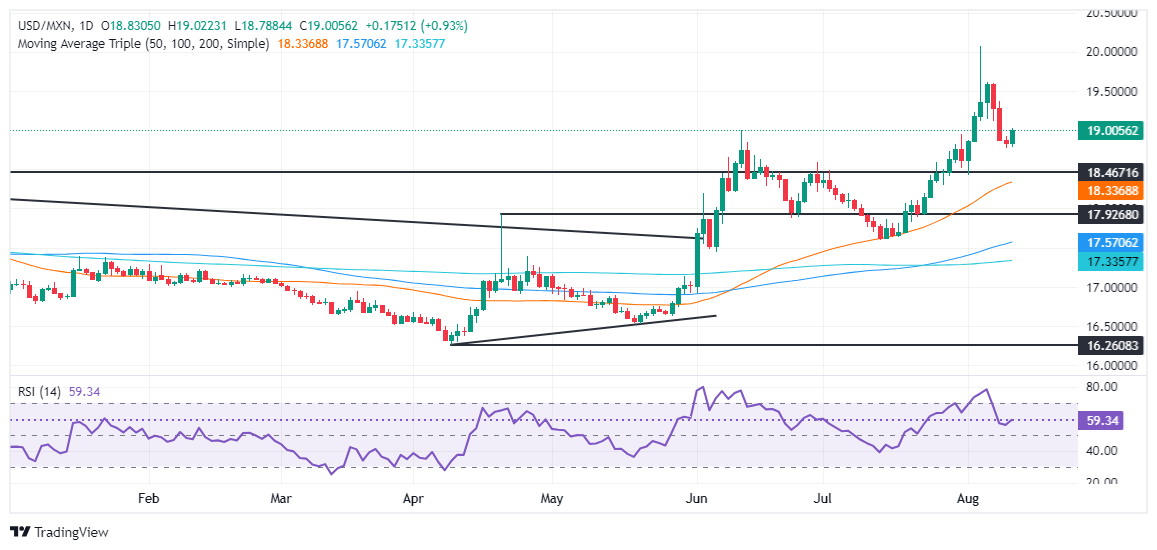
Technical analysis: Mexican Peso depreciates as USD/MXN rallies above 18.90
The USD/MXN uptrend resumed on Monday after hitting a six-day low of 18.76, yet traders had lifted the exchange rate past 18.90 with buyers eyeing a test of the psychological 19.00 figure.
The Relative Strength Index (RSI) is above the 50-neutral line, hinting that momentum favors buyers, which could push the exchange rate upward.
If USD/MXN clears 19.00, the next resistance would be 19.50, followed by the key 20.00 mark. A decisive break will expose the YTD high at 20.22, followed by the 20.50 mark.
Conversely, and in the most unlikely scenario in the short term, the USD/MXN’s first support would be the August 9 low 18.76. If surpassed, the next demand zone would be the June 28 peak at 18.59, followed by the psychological 18.50 mark.
Mexican Peso FAQs
The Mexican Peso (MXN) is the most traded currency among its Latin American peers. Its value is broadly determined by the performance of the Mexican economy, the country’s central bank’s policy, the amount of foreign investment in the country and even the levels of remittances sent by Mexicans who live abroad, particularly in the United States. Geopolitical trends can also move MXN: for example, the process of nearshoring – or the decision by some firms to relocate manufacturing capacity and supply chains closer to their home countries – is also seen as a catalyst for the Mexican currency as the country is considered a key manufacturing hub in the American continent. Another catalyst for MXN is Oil prices as Mexico is a key exporter of the commodity.
The main objective of Mexico’s central bank, also known as Banxico, is to maintain inflation at low and stable levels (at or close to its target of 3%, the midpoint in a tolerance band of between 2% and 4%). To this end, the bank sets an appropriate level of interest rates. When inflation is too high, Banxico will attempt to tame it by raising interest rates, making it more expensive for households and businesses to borrow money, thus cooling demand and the overall economy. Higher interest rates are generally positive for the Mexican Peso (MXN) as they lead to higher yields, making the country a more attractive place for investors. On the contrary, lower interest rates tend to weaken MXN.
Macroeconomic data releases are key to assess the state of the economy and can have an impact on the Mexican Peso (MXN) valuation. A strong Mexican economy, based on high economic growth, low unemployment and high confidence is good for MXN. Not only does it attract more foreign investment but it may encourage the Bank of Mexico (Banxico) to increase interest rates, particularly if this strength comes together with elevated inflation. However, if economic data is weak, MXN is likely to depreciate.
As an emerging-market currency, the Mexican Peso (MXN) tends to strive during risk-on periods, or when investors perceive that broader market risks are low and thus are eager to engage with investments that carry a higher risk. Conversely, MXN tends to weaken at times of market turbulence or economic uncertainty as investors tend to sell higher-risk assets and flee to the more-stable safe havens.
Author

Christian Borjon Valencia
FXStreet
Markets analyst, news editor, and trading instructor with over 14 years of experience across FX, commodities, US equity indices, and global macro markets.