Markets give a thumbs down to Burnham, as bond yields rise

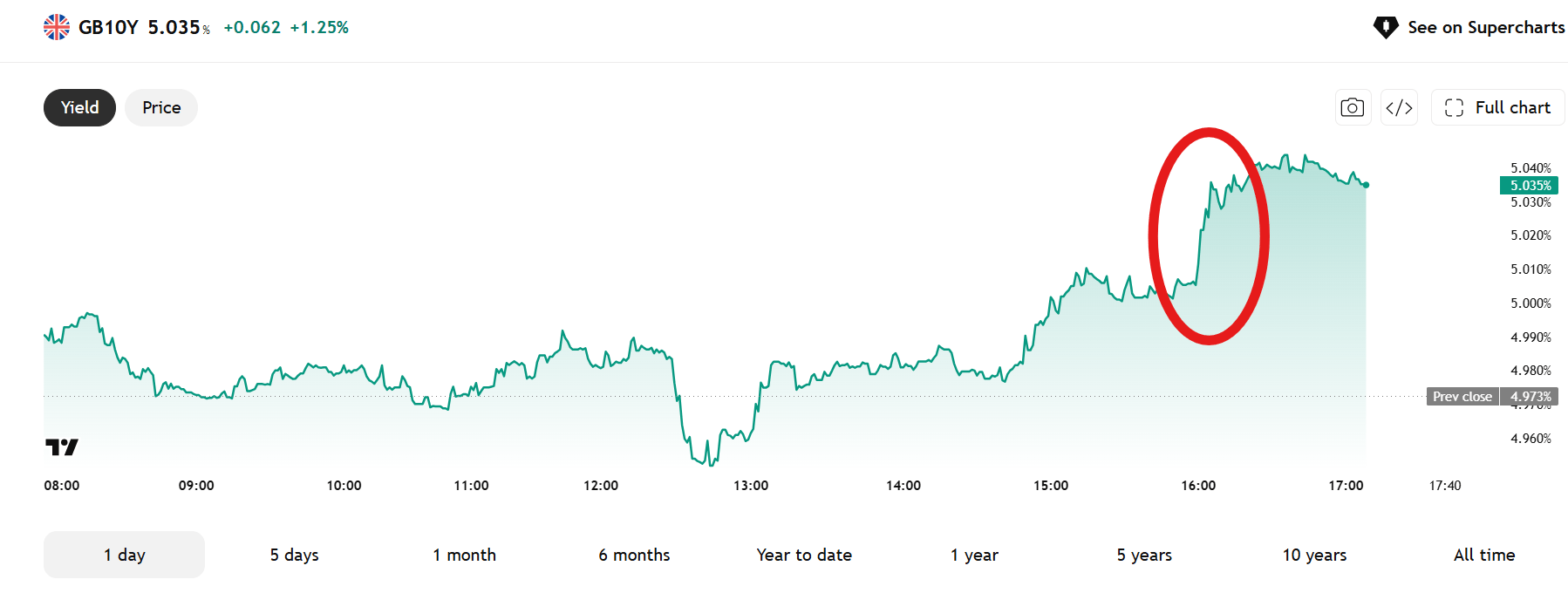
Rachel Reeves has been sacked as Chancellor, and financial markets don’t like it. Burnham became PM earlier on Monday, but as news trickles through about who has been ousted from Starmer’s old cabinet, UK yields are rising sharply. The 2-year yield is higher by 8 bps on Monday, and the 10-year yield is above 5%, after rising nearly 7bps as we move to the end of the day.
This could be reversed if we get a market-friendly pick for Chancellor, but we are still waiting to hear who that will be, although we may know by the end of today.
Yield increase gathers pace as Reeves resigns
Yields had risen moderately since Burnham’s speech outside of Downing Street, but they took another step higher after Reeves announced her resignation. Apparently, she refused the position of defense secretary. We still do not know who the new chancellor will be, this is a major appointment that Burnham would have been wise to announce either at the end of last week, or early this morning. The risk is that he is delaying the announcement in case the markets do not like it. This increases the chance that Ed Miliband will be announced as Chancellor, the market’s least favourite choice, and one who could cause yields to rise rapidly. We still think that Mahmood will make it as Chancellor, but the delay in the cabinet member announcements is deeply unsettling for financial markets.
Uk 10-year yields are back at their highest level since May, back before the Burnham coup, when markets took fright at the possibility of his premiership. Markets then calmed down when Burnham pledged to stick by Reeves’ fiscal rules and promised to stick to the Labour manifesto on tax. In a rare occurrence, UK bonds, stocks and the pound are all falling together on Monday.
Burnham goes on a spending spree on first day in office
Financial markets are reacting quickly to Burnham’s latest policy announcements. The new prime minister has been in his role for less than 24 hours, and he is said to be considering £24bn of spending increases. This includes £2bn to put Thames Water into administration to keep it running through to 2027, £18bn to treat social care in the same way as NHS services, i.e., free at the point of use, and £4bn to increase the tax-free allowance. Added to this, Burnham is expected to announce more cost-of-living measures on Tuesday, which are likely to cost billions more.
Is Burnham already making economic mistakes?
Although Burnham has said that all new spending plans will be fully funded, investors want to see it before believing it. It is still unclear exactly what Burnham’s economy policy will look like, which is leading to significant confusion, hence the selloff in the bond market on Monday. Some analysts argue that of all the tax cuts to consider, extending the tax-free allowance is the least effective and will not boost consumption. Added to this, 10% of people in the UK pay 60% of all tax, according to the Institute of Fiscal Studies. With Burnham refusing to rule out 5% increase to the top rate of tax, this looks unwise. You will either see high middle earners that pay the bulk of tax look to leave the UK, or people will start working less to avoid a 50% rate.
The UK is at a tipping point when it comes to tax and spend policies, too much spend and too much tax, but Burnham doesn’t seem to want to address the balance and is instead going on yet another spending binge.
UK political risk premium rises once again
The rise in the UK’s political risk premium is also evident in the pound. GBP is the weakest performing major currency today, reversing recent gains. GBP/USD has backed away from $1.35 and is currently lower by more than a quarter of one percent.
Chart 1: UK 10-year bond yield
Source: XTB
Author

Kathleen Brooks
XTB UK
Kathleen has nearly 15 years’ experience working with some of the leading retail trading and investment companies in the City of London.

















