Levi Strauss' Q2 earnings upcoming: What's ahead for the stock?

Levi Strauss & Co. (LEVI) is likely to register top and-bottom line growth when it reports second-quarter fiscal 2026 earnings on July 8, before market open. The Zacks Consensus Estimate for revenues is $1.52 billion, which indicates a rise of 4.8% from the year-ago quarter’s level.
The consensus estimate for quarterly earnings has been stable over the past 30 days at 24 cents per share and indicates a rise of 9.1% from the year-earlier quarter’s tally.
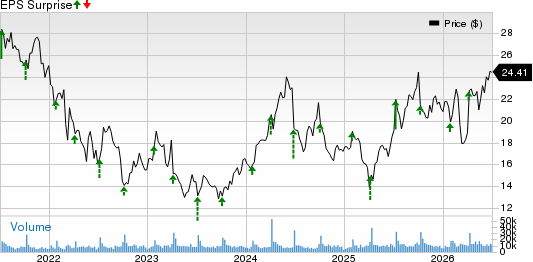
The company has an average trailing four-quarter earnings surprise of 21.4%. It delivered an earnings surprise of 13.5% in the last reported quarter.
Factors likely to influence LEVI’s Q2 results
Levi Strauss’ quarterly performance is likely to have benefited from omnichannel initiatives and brand strength, including jeanswear. The company has been strengthening its omni capabilities, including Buy Online, Pick-up in Store, line-queuing, same-day delivery, mobile checkout and return capabilities, including contactless returns. This ensures a seamless shopping experience for customers across online and offline channels.
The company is expanding its premium product offerings to attract higher-income consumers while maintaining value-oriented options for price-conscious shoppers. At the same time, Levi Strauss is streamlining its brand portfolio by placing greater emphasis on its flagship Levi's brand and other high-growth categories. The company continues to elevate its brands, invest in digital capabilities and diversify across geographies, product categories and distribution channels. These strategic initiatives, coupled with the strength of its direct-to-consumer business, are likely to have supported its quarterly performance. Such strengths, along with its solid direct-to-consumer business, are likely to have bolstered the quarterly performance.
On its last earnings call, management had expected reported revenues to grow in the range of 4-5% for the second quarter and organic growth of 3-4%. The company’s mitigation efforts are likely to have fully offset the tariff impacts. It had anticipated an adjusted EBIT margin in the range of 8-9%, with EPS of 22-24 cents.
The Zacks Consensus Estimate for quarterly revenues is currently pegged at $785 million for Americas, $424 million for Europe and $275 million for Asia, indicating respective increases of 4.9%, 5.2% and 6.6% year over year.
However, a challenging operating backdrop, including supply-chain disruptions, inflationary pressures and foreign currency translations, is likely to have been a concern. These headwinds, coupled with deleveraged selling, general and administrative costs, are expected to have somewhat weighed on the company’s profitability. Management had earlier projected the gross margin to be slightly down owing to unfavorable foreign exchange.
Levi Strauss & Co. price and EPS surprise
What the Zacks model predicts
Our proven model doesn’t conclusively predict an earnings beat for Levi Strauss this time around. The combination of a positive Earnings ESP and a Zacks Rank #1 (Strong Buy), 2 (Buy) or 3 (Hold) increases the odds of an earnings beat. But that’s not the case here. You can uncover the best stocks before they’re reported with our Earnings ESP Filter.
Levi Strauss has an Earnings ESP of -3.36% and a Zacks Rank of 2.
Valuation picture of LEVI stock
With a forward 12-month price-to-earnings ratio of 15.30x, which is below the five-year high of 22.86x but above the Retail - Apparel and Shoes industry’s average of 14.33x, the stock is trading slightly higher than its industry. Additionally, the stock has a Value Score of B.
The recent market movements show that Levi’s shares have gained 14.6% in the past six months against the industry's 10% decline.
Stocks with the favorable combination
Here are a few companies, which according to our model, have the right combination of elements to come up with an earnings beat this reporting cycle:
Tapestry, Inc. (TPR) has an Earnings ESP of +3.42% and a Zacks Rank of 1. TPR is likely to register a top and bottom-line increase when it reports fourth-quarter fiscal 2026 numbers. The Zacks Consensus Estimate for quarterly EPS of $1.23 suggests an increase of 18.3% from the year-ago fiscal quarter’s reported number.
The consensus estimate for quarterly revenues is pegged at $1.87 billion, suggesting growth of 8.3% from the prior-year fiscal quarter’s reported figure. TPR has a trailing four-quarter earnings surprise of 15.6%, on average.
Wingstop Inc. (WING) currently has an Earnings ESP of +0.23% and a Zacks Rank of 3. WING is likely to register a bottom-line increase when it reports fourth-quarter 2026 numbers. The Zacks Consensus Estimate for quarterly EPS of $1.02 suggests an increase of 2% from the year-ago fiscal quarter’s reported number.
WING’s top line is expected to have improved from the prior-year fiscal quarter’s reported number. The consensus estimate for quarterly revenues is pegged at $190.3 million, suggesting growth of 9.1% from the prior-year fiscal quarter’s reported figure. WING has a trailing four-quarter earnings surprise of 17%, on average.
Designer Brands Inc. (DBI) currently has an Earnings ESP of +0.09% and a Zacks Rank of 3. The company is expected to have registered a top-line increase when it reports second-quarter fiscal 2026 results. The consensus mark for revenues is pegged at $743 million, indicating a rise of 0.4% from the figure reported in the year-ago quarter.
The Zacks Consensus Estimate for quarterly EPS of 25 cents suggests a drop of 26.5% from the year-ago quarter. DBI has a trailing four-quarter earnings surprise of 112.8%, on average.
Want the latest recommendations from Zacks Investment Research? Download 7 Best Stocks for the Next 30 Days. Click to get this free report
Author

Zacks
Zacks Investment Research
Zacks Investment Research provides unbiased investment research and tools to help individuals and institutional investors make confident investing decisions.