|

Junior Gold Miners ETF (GDXJ) still has room for more downside

The VanEck Junior Gold Miners ETF (GDXJ) is designed to mirror the MVIS® Global Junior Gold Miners Index, giving investors targeted access to smaller‑capitalization gold producers across international markets. Because junior miners tend to exhibit greater volatility and higher growth potential, the fund is often viewed as a high‑beta vehicle for trading and investing in gold price trends.

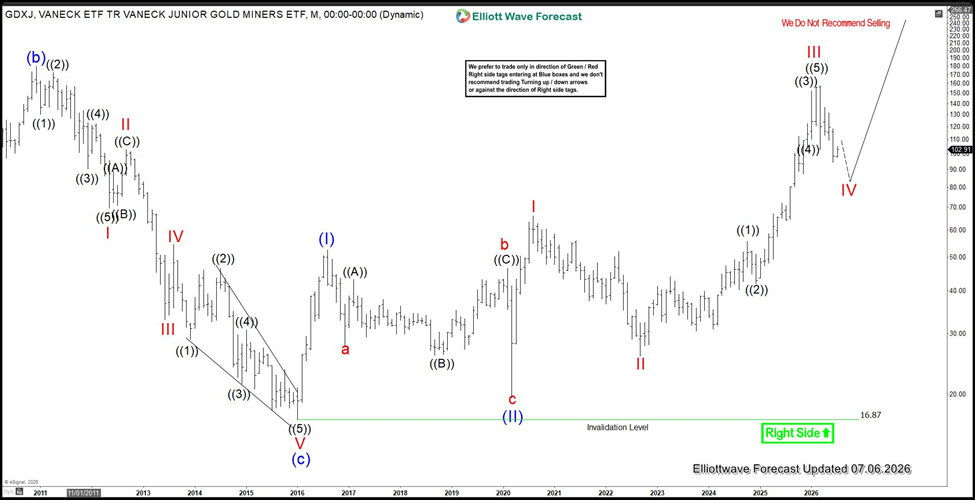
GDXJ monthly Elliott Wave view
Chart

On the monthly timeframe, GDXJ carved out a significant low in 2016 at $16.87. From that base, the ETF began climbing in a layered impulsive advance. The initial wave (I) topped at $52.50, after which a corrective phase in wave (II) pulled prices down to $19.52. Momentum then rebuilt, with wave I of (III) reaching $65.95 before wave II of (III) retraced to $25.64. A powerful extension followed, as wave III of (III) surged to $157.49. The market has since entered a wave IV of (III) correction, which remains unfinished. This suggests that further weakness is possible before the corrective phase concludes and the broader uptrend resumes.

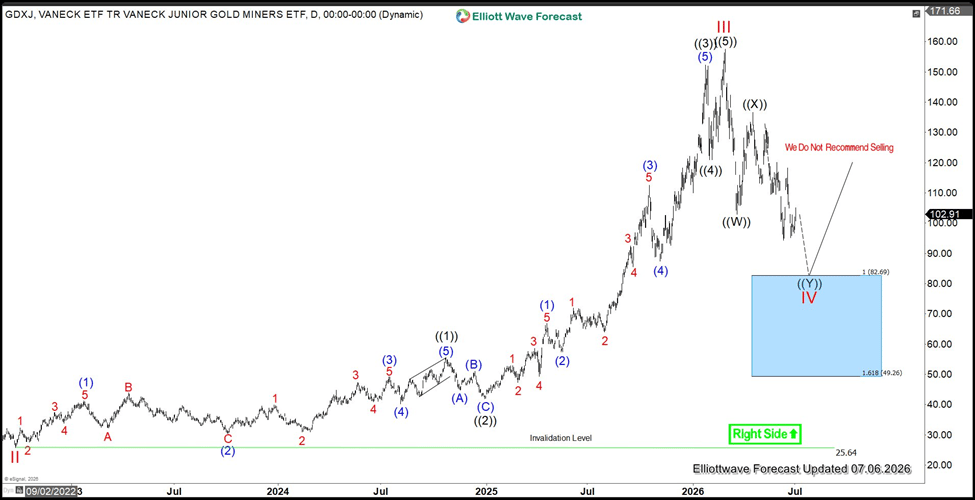
GDXJ daily Elliott Wave view
Chart

The daily Elliott Wave structure of GDXJ highlights the internal development of wave (III). The corrective wave II of (III) bottomed at $25.64, while the subsequent wave III of (III) surged to $157.49. That advance unfolded as a textbook five‑wave impulse, subdividing into waves ((1))–((2))–((3))–((4))–((5)). The market has since transitioned into a wave IV correction, which is evolving as a double three. Within this sequence, wave ((W)) completed at $106.59 and wave ((X)) at $136.55. Current price action suggests additional downside potential toward the 100%–161.8% Fibonacci extension of wave ((W)), spanning $49.26–$82.69. This zone is expected to provide support and set the stage for the next upward cycle.

Author

Elliott Wave Forecast Team

Elliott Wave Forecast Team

ElliottWave-Forecast.com

More from Elliott Wave Forecast Team
Share:

Editor's Picks

GBP/USD clings to gains near 1.3650 after mixed UK data

GBP/USD trades in positive territory at around 1.3650 in the European session on Friday as the upbeat PMI data supports Pound Sterling despite disappointing Retail Sales figures. Meanwhile, the US Dollar (USD) struggles to stay resilient against its peers following the Treasury Department's decision to boost long-term bond purchases earlier in the week, helping the pair hold its ground ahead of US PMI data.

EUR/USD holds near 1.1700 ahead of US PMI data

EUR/USD consolidates its weekly gains at around 1.1700 in the European session on Friday following the mixed PMI prints from Germany and the Eurozone. Investors await preliminary August PMI surveys for the US, while the persistent USD weakness allows the pair to keep its footing.

Gold hits fresh high since June above $4,550 as receding Fed hike bets undermine USD

Gold sticks to modest gains near its highest level since early June, touched earlier this Friday, and trades just above $4,550 heading into the European session. The commodity is looking to build on the breakout momentum above a technically significant 200-day Simple Moving Average amid a weaker US Dollar. Traders scaled back their bets on an immediate interest rate hike by the Fed after the latest US inflation data released last week signaled signs of cooling price pressures.

Bulls in control with Bitcoin heading toward $80,000, Ethereum $2,500, XRP $1.50
Bitcoin (BTC), Ethereum (ETH) and Ripple (XRP) are extending their rallies as bullish momentum strengthens and continue to cheer the US Treasury’s decision to double its debt buyback operations. BTC has climbed nearly 20%, ETH over 25% and XRP nearly 30% so far this week.
The Japanese Yen’s historic rescue is running out of steam
The Japanese Yen staged a spectacular 900-pip comeback after a historic US-Japan intervention. Less than three weeks later, that rescue is already showing signs of fading. The Yen is benefiting somewhat from a softer US Dollar, but its downward trend is likely to resume as the underlying pressure on the currency has not disappeared.
$20 billion offered, $2 billion taken: Why Treasury doubled its buyback cap

The US Treasury moved off its own calendar on Wednesday, and that is the part worth sitting with. At 12:32 GMT, the department said it would at least double the size of liquidity support buyback operations in the 10-year to 20-year and 20-year to 30-year sectors, lifting the maximum from $2 billion per operation to at least $4 billion, effective September 9 and running to November 4.