British Pound holds range as USD strength meets Fed doubts
- Fed hike bets cool after weak payrolls and revisions.
- ISM Services eases, but the employment component returns to expansion.
- Burnham chancellor uncertainty keeps Cable capped near 1.3400.
The Pound Sterling (GBP) steadies during the North American session on Monday as the week begins in a risk-off mood, evidenced by overall US Dollar (USD) strength in the FX markets, despite soft jobs data last week that trimmed hawkish Federal Reserve (Fed) bets for the rest of the year. At the time of writing, the GBP/USD pair trades at 1.3357, rising for the eighth consecutive day after rebounding from a daily low of 1.3328.
GBP/USD steadies as Dollar demand offsets softer Fed repricing
Last week's US Nonfarm Payrolls report missed estimates, while figures for April and May were downwardly revised, triggering a repricing toward a less hawkish Federal Reserve. Nevertheless, the Unemployment Rate is below the 4.5% level penciled by officials towards the end of the year.
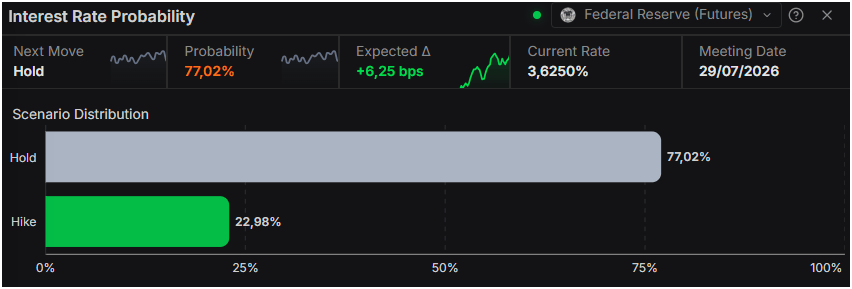
Money markets have priced in 22 basis points of tightening for the year’s end, according to Fed funds rates futures contracts. Meanwhile, for the upcoming July meeting, there’s a 77% chance the Fed will keep rates unchanged, versus a slim 23% chance of an increase, according to Prime Terminal.
Recently, the Institute for Supply Management (ISM) reported that the Services PMI came as expected at 54 in June, down from 54.5. Other survey measures showed that input costs eased somewhat, while the Services Employment Index improved from 47.9 to 51.2.
Across the pond, the UK economic calendar was light on Monday, yet Cable is still underpinned by a slight chance of a single rate hike by the Bank of England (BoE) towards the end of the year. A month ago, money markets were pricing in at least 44 basis points of tightening, but as of writing, the swaps market is pricing in 17 basis points, implying a 70% chance of a hike.
Last week, BoE Governor Andrew Bailey disregarded the chance to consider rate cuts, even though the energy shock subsided.
Geopolitics had taken a back seat as the second round of discussion between the US and Iran is expected to begin in Islamabad on Saturday. Some of the issues pending for discussion are Iran’s nuclear program, frozen assets, the Strait of Hormuz and Lebanon.
In the UK, there’s uncertainty about who Andy Burnham would pick as finance minister. Newswires reported that there’s a 55% chance that Ed Miliband, a former energy minister, would be tapped as Chancellor to succeed Rachel Reeves.
Hence, the GBP/USD pair would be leaning on political uncertainty in the UK. This could pave the way for some consolidation at around current levels, at around 1.3300-1.3400, until a chancellor is picked.
GBP/USD Price Forecast: Technical outlook
In the daily chart, GBP/USD trades at 1.3365, maintaining a mildly bearish bias as spot holds below the simple moving average cluster now converging around 1.3406. The pair is effectively capped by this SMA resistance and the broader downward trend-line barrier near 1.3513, even as the 14-day Relative Strength Index hovers in neutral-to-slightly positive territory around 55, suggesting only modest upside momentum that has yet to reclaim the overhanging structure.
On the topside, immediate resistance emerges at the simple moving average near 1.3406, with a stronger cap defined by the descending trend line around 1.3513. On the downside, the first notable structural floor aligns with the rising support trendline drawn from prior lows around 1.3159, where a break would likely expose a deeper retracement within the broader range despite the currently subdued momentum backdrop.
(The technical analysis of this story was written with the help of an AI tool. Know more.)
Pound Sterling FAQs
The Pound Sterling (GBP) is the oldest currency in the world (886 AD) and the official currency of the United Kingdom. It is the fourth most traded unit for foreign exchange (FX) in the world, accounting for 12% of all transactions, averaging $630 billion a day, according to 2022 data. Its key trading pairs are GBP/USD, also known as ‘Cable’, which accounts for 11% of FX, GBP/JPY, or the ‘Dragon’ as it is known by traders (3%), and EUR/GBP (2%). The Pound Sterling is issued by the Bank of England (BoE).
The single most important factor influencing the value of the Pound Sterling is monetary policy decided by the Bank of England. The BoE bases its decisions on whether it has achieved its primary goal of “price stability” – a steady inflation rate of around 2%. Its primary tool for achieving this is the adjustment of interest rates. When inflation is too high, the BoE will try to rein it in by raising interest rates, making it more expensive for people and businesses to access credit. This is generally positive for GBP, as higher interest rates make the UK a more attractive place for global investors to park their money. When inflation falls too low it is a sign economic growth is slowing. In this scenario, the BoE will consider lowering interest rates to cheapen credit so businesses will borrow more to invest in growth-generating projects.
Data releases gauge the health of the economy and can impact the value of the Pound Sterling. Indicators such as GDP, Manufacturing and Services PMIs, and employment can all influence the direction of the GBP. A strong economy is good for Sterling. Not only does it attract more foreign investment but it may encourage the BoE to put up interest rates, which will directly strengthen GBP. Otherwise, if economic data is weak, the Pound Sterling is likely to fall.
Another significant data release for the Pound Sterling is the Trade Balance. This indicator measures the difference between what a country earns from its exports and what it spends on imports over a given period. If a country produces highly sought-after exports, its currency will benefit purely from the extra demand created from foreign buyers seeking to purchase these goods. Therefore, a positive net Trade Balance strengthens a currency and vice versa for a negative balance.
Author

Christian Borjon Valencia
FXStreet
Markets analyst, news editor, and trading instructor with over 14 years of experience across FX, commodities, US equity indices, and global macro markets.

















