Japanese Yen retains its positive bias against broadly weaker USD; US CPI awaited
- The Japanese Yen attracts fresh buyers as stronger PPI reaffirms BoJ rate hike bets.
- Hopes for a US-Japan trade deal turn out to be another factor benefiting the JPY.
- A solid recovery in the global risk sentiment could cap gains for the safe-haven JPY.

The Japanese Yen (JPY) sticks to its strong intraday gains heading into the European session on Thursday, though it lacks follow-through as a sharp recovery in the global risk sentiment acts as a headwind for traditional safe-haven assets. Traders also seem reluctant and opt to wait for the release of the US consumer inflation figures. The crucial data might provide cues about the Federal Reserve's (Fed) rate-cut path, which will influence the US Dollar (USD) and provide a fresh impetus to the USD/JPY pair.
The near-term bias, however, seems firmly tilted in favor of the JPY bulls amid bets that the Bank of Japan (BoJ) will hike interest rates further, bolstered by a stronger Producer Price Index (PPI) released from Japan earlier today. Meanwhile, hawkish BoJ expectations mark a big divergence in comparison to the prospects for multiple interest rate cuts by the Federal Reserve (Fed), which keeps the USD bulls on the defensive. This suggests that the path of least resistance for the lower-yielding JPY remains to the upside.
Japanese Yen bulls have the upper hand as divergent BoJ-Fed expectations offset risk-on impulse
- The Bank of Japan's preliminary report released earlier this Thursday showed that Japan's Producer Price Index (PPI) increased by 0.4% in March and rose 4.2% compared to the same time period last year. The readings were higher than consensus estimates and could push up consumer prices, which, in turn, backs the case for further policy tightening by the BoJ and underpins the Japanese Yen.
- US President Donald Trump agreed to meet Japanese officials to initiate trade discussions after speaking to Japan's Prime Minister Shigeru Ishiba earlier this week. US Treasury Secretary Scott Bessent’s subsequent comments, saying that Japan may be a priority in tariff negotiations, fueled hopes for a possible US-Japan trade deal and turned out to be another factor that underpins the JPY.
- The US Dollar rebounded against safe-haven currencies, including the JPY, on Wednesday after Trump declared an immediate 90-day pause on the big tariff increases for most countries. The announcement eased worries about the global economic impact of US trade policies, triggering a sharp rally in equity markets. The S&P 500 soared 9.5% and registered its biggest daily gain since 2008.
- Meanwhile, the minutes of the March 18-19 FOMC meeting revealed that officials almost unanimously agreed that the US economy was at risk of experiencing higher inflation and slower growth on the back of Trump's trade tariffs. Policymakers, however, called for a cautious approach to interest rate cuts, forcing investors to trim their bets for more aggressive easing by the Fed.
- Traders now expect the Fed to wait until June to resume its rate-cutting cycle and are pricing in just 75 basis points of rate reductions by the year-end. The USD bulls, however, seem reluctant and opt to wait for the release of the US inflation figures – the Consumer Price Index (CPI) and the Producer Price Index (PPI) on Thursday and Friday, respectively – before positioning for further gains.
USD/JPY struggles to find acceptance above 148.00; seems vulnerable to slide further
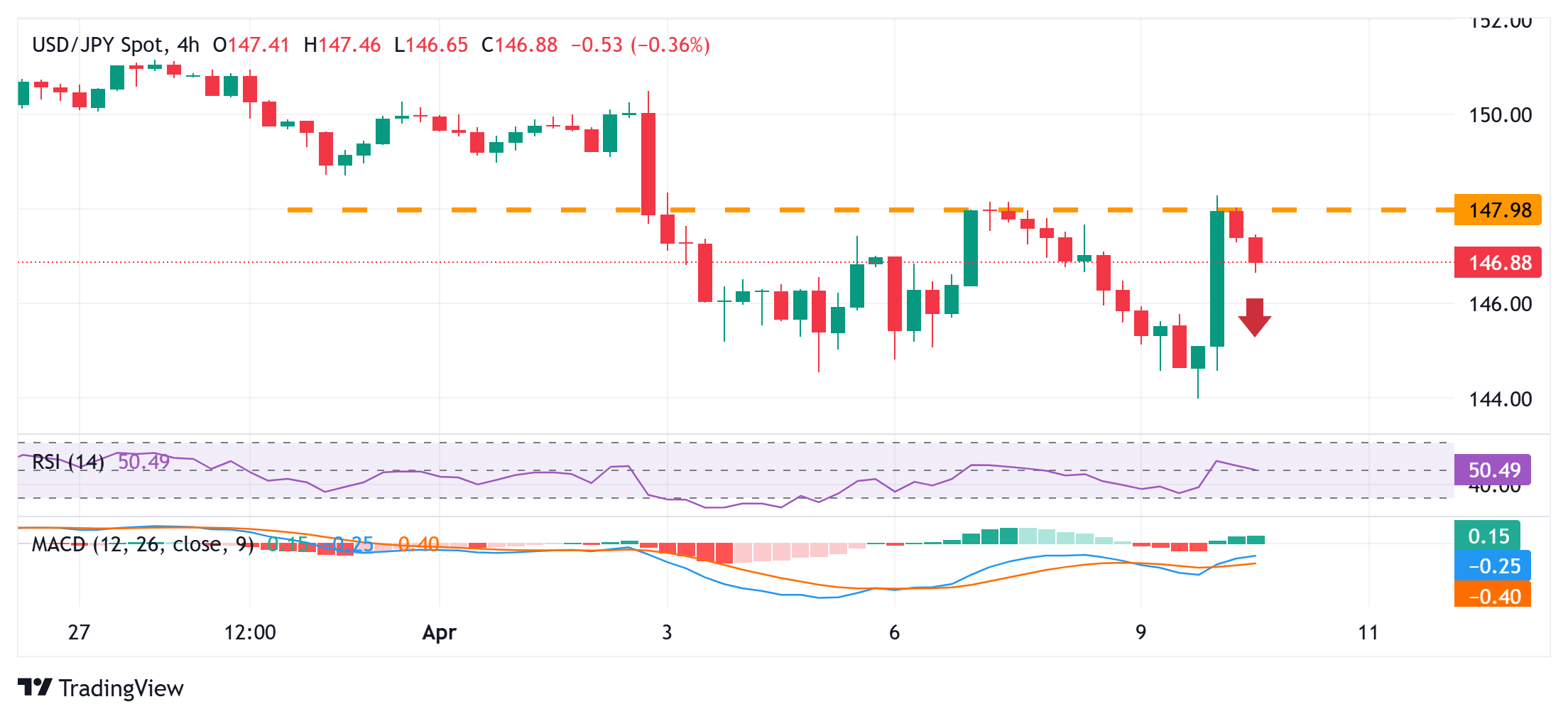
From a technical perspective, the USD/JPY pair has been struggling to find acceptance above the 148.00 round figure since the beginning of this week. Moreover, oscillators on the daily chart are holding in negative territory and are still away from being in the oversold zone. This, in turn, favors bearish traders and suggests that the path of least resistance for spot prices remains to the downside. Hence, a subsequent slide towards the 146.30 intermediate support, en route to the 146.00 mark, looks like a distinct possibility. Some follow-through selling would expose the next relevant support near the 145.50 region before the pair eventually drops to the 145.00 psychological mark.
On the flip side, the 147.75 zone, followed by the 148.00 mark, could act as an immediate hurdle ahead of the 148.25-148.30 region, or the weekly high touched on Wednesday. A sustained strength beyond the latter would set the stage for an extension of the previous day's goodish rebound from sub-144.00 levels, or the lowest since October 2024, and allow the USD/JPY pair to reclaim the 149.00 round figure. The momentum could extend further towards the 149.35-149.40 area en route to the 150.00 psychological mark.
US Dollar PRICE Today
The table below shows the percentage change of US Dollar (USD) against listed major currencies today. US Dollar was the strongest against the Canadian Dollar.
| USD | EUR | GBP | JPY | CAD | AUD | NZD | CHF | |
|---|---|---|---|---|---|---|---|---|
| USD | -0.25% | -0.14% | -0.63% | -0.06% | -0.49% | -0.78% | -0.22% | |
| EUR | 0.25% | -0.13% | -0.37% | 0.17% | -0.28% | -0.57% | -0.00% | |
| GBP | 0.14% | 0.13% | -0.26% | 0.30% | -0.16% | -0.46% | 0.02% | |
| JPY | 0.63% | 0.37% | 0.26% | 0.53% | 0.08% | -0.25% | 0.49% | |
| CAD | 0.06% | -0.17% | -0.30% | -0.53% | -0.45% | -0.74% | -0.28% | |
| AUD | 0.49% | 0.28% | 0.16% | -0.08% | 0.45% | -0.29% | 0.16% | |
| NZD | 0.78% | 0.57% | 0.46% | 0.25% | 0.74% | 0.29% | 0.48% | |
| CHF | 0.22% | 0.00% | -0.02% | -0.49% | 0.28% | -0.16% | -0.48% |
The heat map shows percentage changes of major currencies against each other. The base currency is picked from the left column, while the quote currency is picked from the top row. For example, if you pick the US Dollar from the left column and move along the horizontal line to the Japanese Yen, the percentage change displayed in the box will represent USD (base)/JPY (quote).
Author

Haresh Menghani
FXStreet
Haresh Menghani is a detail-oriented professional with 10+ years of extensive experience in analysing the global financial markets.

















