Japanese Yen bears now ready to give up yet despite intervention fears
- The Japanese Yen struggles to capitalize on Friday’s recovery from a multi-month low.
- BoJ Governor Ueda offered no cues about a December rate hike and weighed on the JPY.
- Intervention fears and subdued USD price action cap the upside for the USD/JPY pair.

The Japanese Yen (JPY) recovers a major part of its early lost ground against the Greenback, dragging the USD/JPY pair to mid-154.00s heading into the European session on Monday. Speculations that Japanese authorities might intervene in the FX market to prop up the domestic currency, along with the risk of a further escalation of geopolitical tensions, turn out to be key factors offering some support to the safe-haven JPY. Apart from this, a modest US Dollar (USD) downtick contributes to capping the upside for the currency pair.
Any meaningful appreciating move for the JPY, however, seems limited in the wake of the uncertainty about the Bank of Japan's (BoJ) rate hike timing. Furthermore, expectations that US President-elect Donald Trump's policies will be inflationary and limit the scope for further rate cuts by the Federal Reserve (Fed) remain supportive of elevated US Treasury bond yields. This supports prospects for the emergence of some USD dip-buying and should keep a lid on the lower-yielding JPY, which, in turn, favors the USD/JPY bulls.
Japanese Yen traders refrain from placing aggressive directional bets amid mixed fundamental cues
- Bank of Japan Kazuo Ueda said this Monday that the central bank will continue to raise policy rates, adjust the degree of monetary support if the economy, and prices move in line with the forecasts.
- Ueda added that Japan's economy is recovering moderately albeit there are some weak signs, and that the timing of the rate hike will depend on economic, price, and financial outlook.
- Japan's Finance Minister Katsunobu Kato warned on Friday that the government will scrutinize the FX market with very high vigilance and take appropriate action against excessive moves.
- US President Joe Biden authorized Ukraine to use US-supplied long-range missiles to strike deeper inside Russia, raising the risk of a further escalation of geopolitical tensions.
- The US Dollar remains on the defensive following the post-US election rally to the year-to-date peak touched last Thursday, though any meaningful depreciation seems elusive.
- Investors seem convinced that US President-elect Donald Trump's touted policies will be inflationary, which could limit the scope for further rate cuts by the Federal Reserve.
- Adding to this, the recent comments from influential FOMC members, including Fed Chair Jerome Powell, forced investors to scale back their bets for more aggressive rate cuts.
- Powell said last Thursday that with the economy growing steadily, a strong job market, and inflation still above the 2% target, there’s no need to hurry into cutting interest rates.
- Adding to this, Boston Fed President Susan Collins noted on Friday that there's no preset path for monetary policy and that the economy is in a very good place right now.
- Separately, Chicago Fed President Austan Goolsbee said that inflation numbers have to keep improving and that the recent CPI print has been a little higher than the target.
- The US Census Bureau reported on Friday that Retail Sales expanded by 0.4% in October, surpassing expectations for a 0.3% gain but down from September’s 0.8% increase.
- According to the CME Group's FedWatch Tool, traders are currently pricing in a 60% chance of another 25-basis-point rate cut by the Fed at the December monetary policy meeting.
- Investors now look to BoJ Governor Ueda's press conference for cues about a possible December rate hike, which should infuse some volatility and drive demand for the JPY.
USD/JPY bulls potential seems intact, 153.85 area might continue to act as an immediate strong support
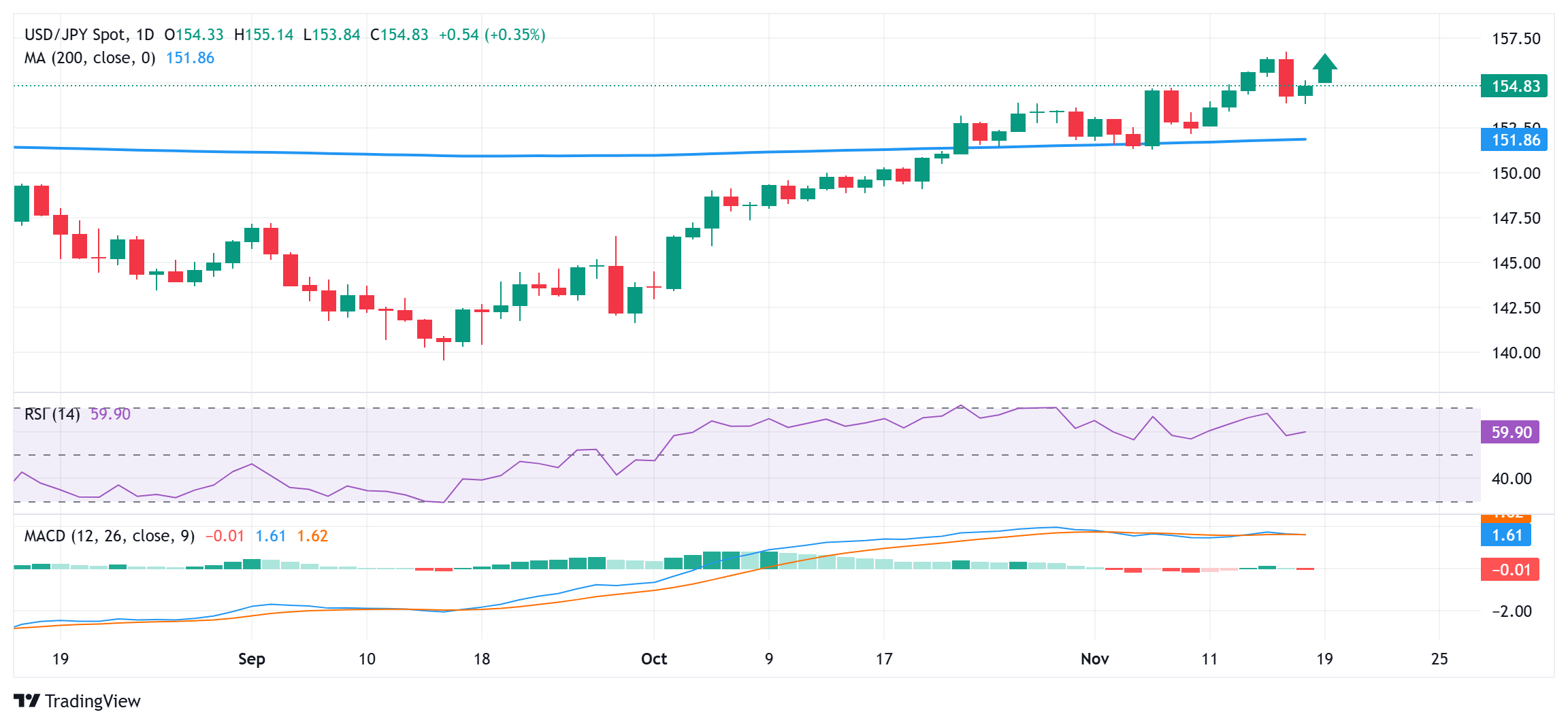
From a technical perspective, the USD/JPY pair once again showed some resilience below the 154.00 mark at the start of a new week. The subsequent move up, along with positive oscillators, favors bullish traders and supports prospects for a further intraday appreciating move. Acceptance above the 155.00 psychological mark will reaffirm the positive bias and pave the way for a move towards reclaiming the 156.00 round figure with some intermediate resistance near the 155.70 region.
On the flip side, the 153.85 zone now seems to have emerged as an immediate support, below which the USD/JPY pair could drop to the 153.25 region en route to the 153.00 mark and the next relevant support near the 152.70-152.65 area. A convincing break below the latter might expose the very important 200-day Simple Moving Average (SMA) resistance breakpoint, now turned support, currently pegged near the 151.85 region.
Fed FAQs
Monetary policy in the US is shaped by the Federal Reserve (Fed). The Fed has two mandates: to achieve price stability and foster full employment. Its primary tool to achieve these goals is by adjusting interest rates. When prices are rising too quickly and inflation is above the Fed’s 2% target, it raises interest rates, increasing borrowing costs throughout the economy. This results in a stronger US Dollar (USD) as it makes the US a more attractive place for international investors to park their money. When inflation falls below 2% or the Unemployment Rate is too high, the Fed may lower interest rates to encourage borrowing, which weighs on the Greenback.
The Federal Reserve (Fed) holds eight policy meetings a year, where the Federal Open Market Committee (FOMC) assesses economic conditions and makes monetary policy decisions. The FOMC is attended by twelve Fed officials – the seven members of the Board of Governors, the president of the Federal Reserve Bank of New York, and four of the remaining eleven regional Reserve Bank presidents, who serve one-year terms on a rotating basis.
In extreme situations, the Federal Reserve may resort to a policy named Quantitative Easing (QE). QE is the process by which the Fed substantially increases the flow of credit in a stuck financial system. It is a non-standard policy measure used during crises or when inflation is extremely low. It was the Fed’s weapon of choice during the Great Financial Crisis in 2008. It involves the Fed printing more Dollars and using them to buy high grade bonds from financial institutions. QE usually weakens the US Dollar.
Quantitative tightening (QT) is the reverse process of QE, whereby the Federal Reserve stops buying bonds from financial institutions and does not reinvest the principal from the bonds it holds maturing, to purchase new bonds. It is usually positive for the value of the US Dollar.
Author

Haresh Menghani
FXStreet
Haresh Menghani is a detail-oriented professional with 10+ years of extensive experience in analysing the global financial markets.