Japanese Yen remains firm against US Dollar amid hawkish BoJ bets, US PPI data eyed
- The Japanese Yen outperforms across the board on hopes of faster BoJ policy normalization.
- The BoJ is highly anticipated to hike interest rates next week.
- Investors await the US PPI data for August, releasing later in the day.

The Japanese Yen (JPY) holds onto an over-a-week-long upside run against the US Dollar (USD) on Thursday. As of writing, the USD/JPY pair trades marginally lower to near 153.45 and is close to its over six-month low at 152.89 posted on Wednesday.
The Japanese currency outperforms across the board as financial market experts see the Bank of Japan (BoJ) continuing its monetary tightening path even after hiking interest rates by 25 basis points (bps) to 1.25% at the policy meeting on September 18.
Yen support builds as markets brace for a hawkish BoJ hike
Analysts at DBS argue that “it is almost a done deal that the Bank of Japan will hike rates at the upcoming meeting on Sep 17-18,” with the “most likely outcome” seen as a “hawkish 25bps hike” accompanied by guidance that signals “a flexible pace of rate hikes at future meetings.” Echoing that view, Commerzbank notes that “an interest rate hike next week is now priced in at roughly 96%, and the market expects further hikes to follow quickly thereafter.” In their view, “as long as expectations continue to shift in such a hawkish direction, the yen should have little trouble appreciating further.”
Meanwhile, the US Dollar remains under pressure even as strong United States (US) Nonfarm Payrolls (NFP) data for August has lifted hawkish Federal Reserve (Fed) interest rate expectations.
According to the CME FedWatch tool, the odds of the Fed hiking interest rates at the policy meeting next week are 61.2%.
Contrary to the CME FedWatch tool, the latest Reuters poll has shown that 65 of 93 economists see the Fed holding interest rates steady next week. The poll also showed that a majority of economists see the Fed keeping policy rates at their current levels by the year-end.
Later in the day, investors will focus on the US Producer Price Index (PPI) data for August, which will be published at 12:30 GMT.
USD/JPY Technical Analysis
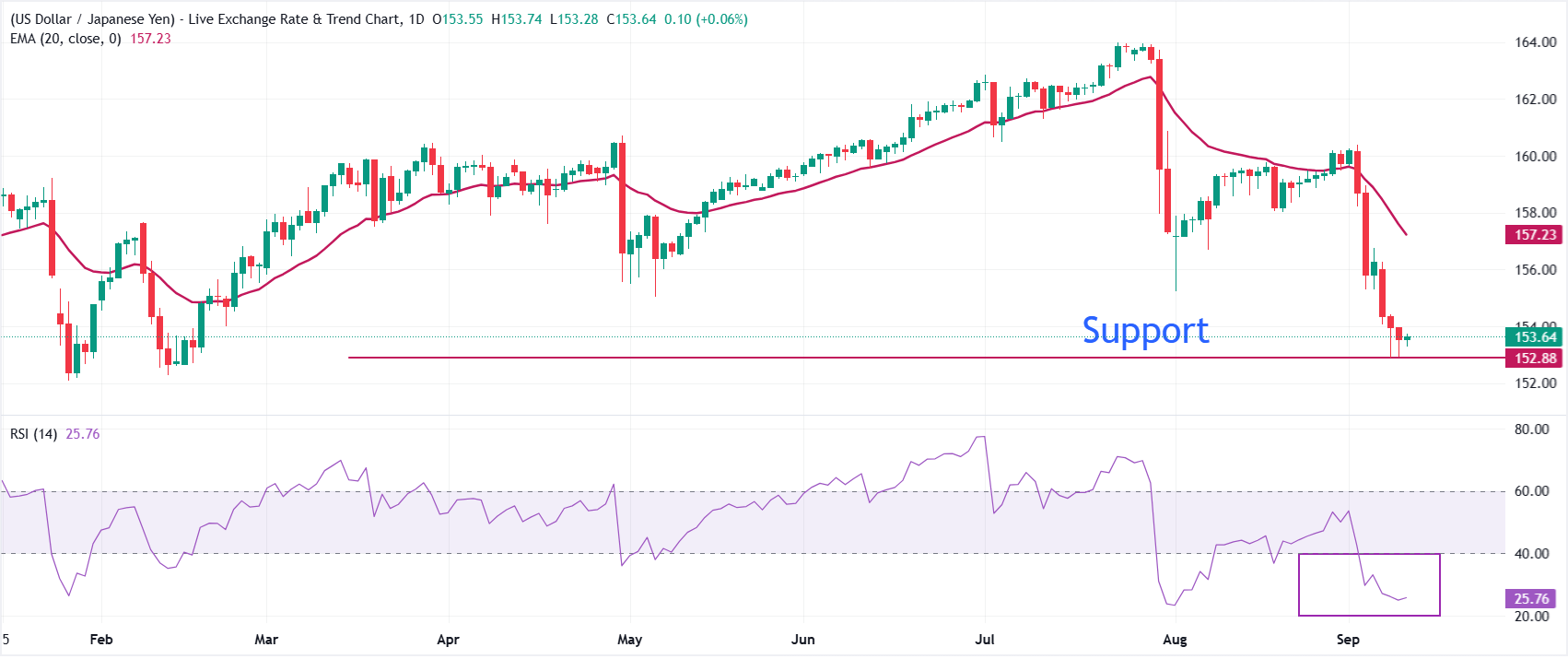
In the daily chart, USD/JPY trades at 153.64, keeping a bearish near-term tone as spot holds well below the 20-day Exponential Moving Average (EMA) at 157.23. The pair remains pinned near recent lows, while the Relative Strength Index (RSI) at 25.76 stays in oversold territory, which hints at persistent downside pressure even if a corrective bounce cannot be ruled out.
On the topside, initial resistance is aligned with the 20-day EMA around 157.23, and a daily close above this barrier would be needed to ease the current bearish pressure. On the downside, immediate focus sits on the current area around 153.64 as a pivot zone, and a sustained break lower would expose fresh lows and keep sellers in control.
(The technical analysis of this story was written with the help of an AI tool. Know more.)
Economic Indicator
BoJ Interest Rate Decision
The Bank of Japan (BoJ) announces its interest rate decision after each of the Bank’s eight scheduled annual meetings. Generally, if the BoJ is hawkish about the inflationary outlook of the economy and raises interest rates it is bullish for the Japanese Yen (JPY). Likewise, if the BoJ has a dovish view on the Japanese economy and keeps interest rates unchanged, or cuts them, it is usually bearish for JPY.
Read more.Next release: Fri Sep 18, 2026 03:00
Frequency: Irregular
Consensus: -
Previous: 1%
Source: Bank of Japan
Author

Sagar Dua
FXStreet
Sagar Dua is associated with the financial markets from his college days. Along with pursuing post-graduation in Commerce in 2014, he started his markets training with chart analysis.
















