Japanese Yen gains strongly on hopes of BoJ aggressive tightening cycle
- The Japanese Yen appreciates quickly against its peers after reports that the BoJ will fasten its monetary-tightening cycle.
- Japan would have an aggressively hawkish interest-rate cycle as the Yen’s weakness has spurred upside inflation risks.
- Investors await Japan’s National CPI data for June.

The Japanese Yen (JPY) attracts significant bids against its major currency peers during the European trading session on Wednesday. The USD/JPY pair falls vertically to near 162.65, but quickly recovers some losses and rebounds to around 162.90.
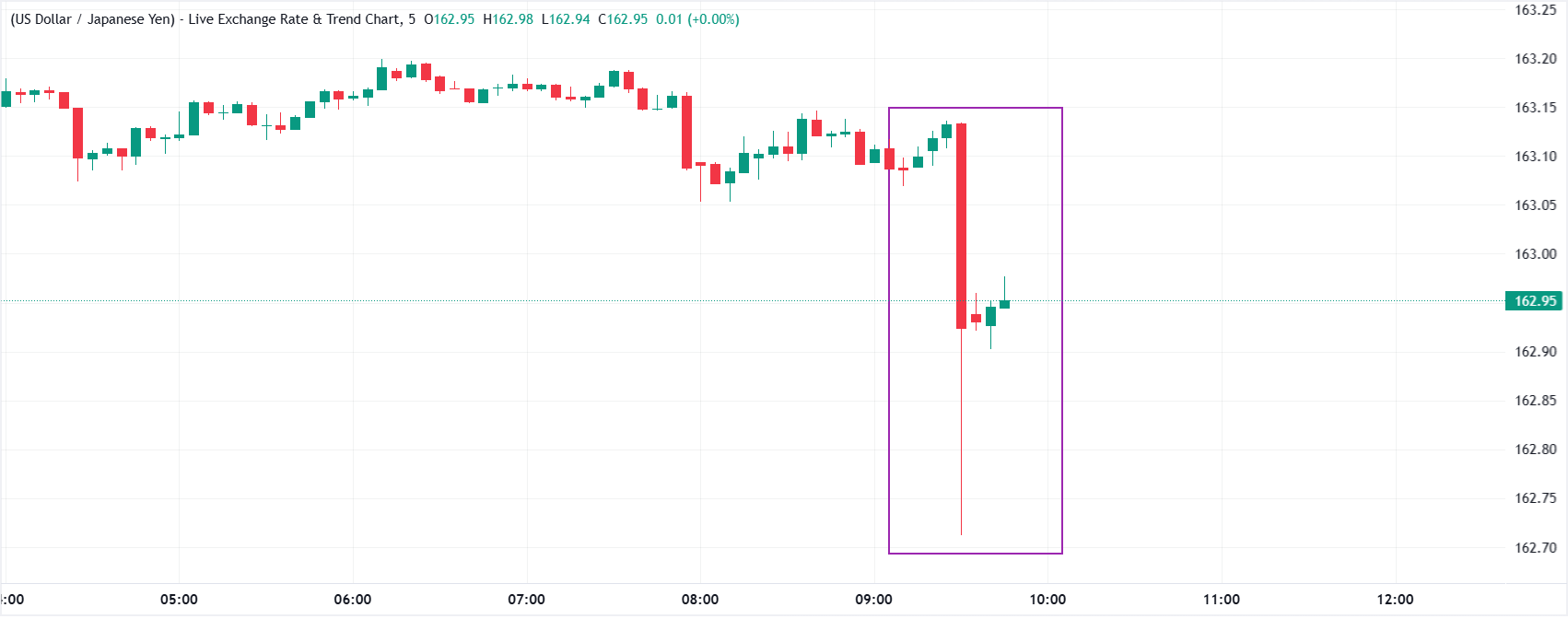
The Japanese currency witnesses strong buying interest after a Bloomberg report stated that Bank of Japan (BoJ) officials are open to raising interest rates at a faster pace than the consensus among economists, with the Japanese Yen’s continued weakness adding to upside inflation risks, according to people familiar with the matter.
A significant underperformance is seen in the Asia-Pacific currency against its major peers in the past few weeks. On Tuesday, USD/JPY posted a fresh multi-decade high near 163.23.
An aggressive monetary-tightening campaign by the BoJ would diminish its interest rate differential with other central banks.
For fresh cues on the BoJ’s interest rate outlook, investors await the monetary policy announcement next week, in which the bank is expected to leave interest rates unchanged at 1%.
In addition to BoJ’s quick monetary-tightening cycle hopes, fears of Japan’s intervention in Forex markets after a significant depreciation in the Japanese Yen are likely to have supported the currency too.
Earlier in the day, Japan’s Finance Minister (FM) Satsuki Katayama said that the authorities will take necessary steps on the foreign exchange if necessary. However, she declined to comment on specific Forex levels.
On the economic data front, investors await Japan’s National Consumer Price Index (CPI) data for June, which will be released on Friday. The National CPI ex. Fresh Food is expected to arrive at 1.6% Year-on-Year (YoY), higher than 1.4% in May.
Bank of Japan FAQs
The Bank of Japan (BoJ) is the Japanese central bank, which sets monetary policy in the country. Its mandate is to issue banknotes and carry out currency and monetary control to ensure price stability, which means an inflation target of around 2%.
The Bank of Japan embarked in an ultra-loose monetary policy in 2013 in order to stimulate the economy and fuel inflation amid a low-inflationary environment. The bank’s policy is based on Quantitative and Qualitative Easing (QQE), or printing notes to buy assets such as government or corporate bonds to provide liquidity. In 2016, the bank doubled down on its strategy and further loosened policy by first introducing negative interest rates and then directly controlling the yield of its 10-year government bonds. In March 2024, the BoJ lifted interest rates, effectively retreating from the ultra-loose monetary policy stance.
The Bank’s massive stimulus caused the Yen to depreciate against its main currency peers. This process exacerbated in 2022 and 2023 due to an increasing policy divergence between the Bank of Japan and other main central banks, which opted to increase interest rates sharply to fight decades-high levels of inflation. The BoJ’s policy led to a widening differential with other currencies, dragging down the value of the Yen. This trend partly reversed in 2024, when the BoJ decided to abandon its ultra-loose policy stance.
A weaker Yen and the spike in global energy prices led to an increase in Japanese inflation, which exceeded the BoJ’s 2% target. The prospect of rising salaries in the country – a key element fuelling inflation – also contributed to the move.
Author

Sagar Dua
FXStreet
Sagar Dua is associated with the financial markets from his college days. Along with pursuing post-graduation in Commerce in 2014, he started his markets training with chart analysis.