Is Tesla a bargain now as it trades at two-year lows?
-
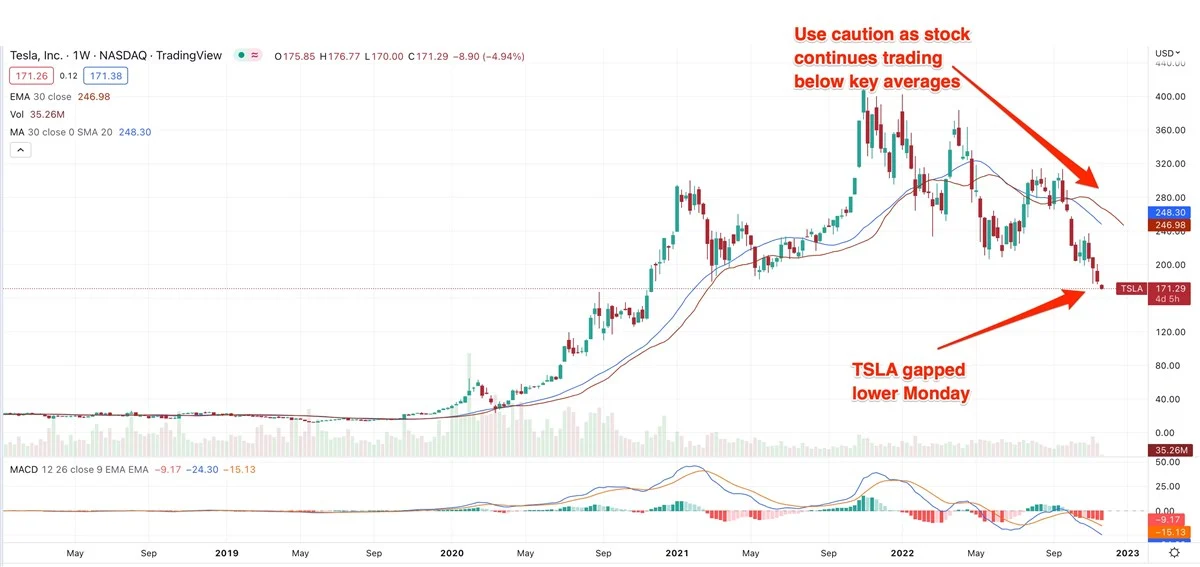
Tesla is now trading at October 2020 levels after opening sharply lower Monday. That move followed news of a recall due to a software problem affecting taillights.
-
Earlier this month, shares sank to a new low after CEO Elon Musk sold 19.5 million shares to partly finance his purchase of Twitter.
-
The stock has strong fundamentals and solid growth potential, yet the chart shows shares trading well below key moving averages.
-
Despite Tesla share continuing to sink, it, along with China’s BYD, is the clear leader and innovator within the EV space.

Tesla (NASDAQ: TSLA), which posted a spectacular acceleration from late 2019 through late 2021, is now trading at October 2020 levels after opening sharply lower Monday. That move came on the heels of Friday’s two-year low of $176.55.
This year, the stock has traded essentially in tandem with its index, the S&P 500. It made two short-lived rally attempts, one in April and another in August, as the broader market also tried to turn higher. Most recently, though, in October and November, Tesla has struggled as the index rallied.
Tesla’s November 9 decline to a session low of $177.12 followed CEO Elon Musk’s sale of 19.5 million company shares on November 8, after the close. The shares were valued at $3.95 billion. In a meeting with Twitter employees on November 10, Musk said he sold Tesla shares as part of the financing to purchase the social network in late October.
Musk himself, via his attention to Twitter, has clearly become a part of Tesla’s stock performance.
Will that allow rival electric vehicle makers, where presumably company leaders are more focused, to gain on Tesla’s market share?
Tesla still the clear leader
Make no mistake:Tesla remains wildly profitable. You can easily see that using MarketBeat earnings data for the stock, which shows a long history of beating Wall Street expectations. In its most recent quarter, the company earned $1.05 per share on revenue of $21.5 billion, up 69% and 56%, respectively.
For the full year, earnings see the company earning $4.10 per share, which would be an increase of 81%. Next year, that’s seen rising another 42% to $5.82 per share.
While there’s significant interest among traders in lower-priced, more speculative electric vehicle names such as Mullen Automotive (NASDAQ:MULN), Fisker (NYSE:FSR), and Nikola (NASDAQ:NKLA), none of those are profitable, and none qualify as institutional-quality investments.
Fellow U.S.-based EV maker Rivian Automotive (NASDAQ:RIVN) has never traded in the single digits, let alone been a penny stock, but it, like its low-priced industry peers, has never posted a profit.
Meanwhile, China-based startup NIO (NYSE:NIO) has been growing revenue but is also not profitable. The same can be said for Xpeng (NYSE:XPEV), which is trading in the single digits.
That leaves Tesla, along with China’s BYD (OTCMKTS:BYDDF) as the profitable leaders in their industry. Those companies, due to their financial strength, have been able to innovate while simultaneously growing market share.
For example, Tesla’s three-year earnings growth rate is 179%; its three-year revenue growth rate is 51%. BYD has grown earnings at a rate of 36%, while that sales rate is 37%. Both these companies are growing on the top- and bottom lines while some of the younger startups are struggling.
Both companies are expanding into new global markets. BYD made a big splash with a European launch in early October, and is also making inroads into India, New Zealand and Australia, and has plans to grow further in the Japanese market.
Meanwhile, Tesla has been slashing prices for its vehicles in China, as well as offering other promotions there to increase demand.
Shares down on recall news
Year-to-date, Tesla shares are down 48.85%, and are showing no signs of reversing higher anytime soon. The stock gapped down 2.08% at the open Monday, and was more than 5% lower about 90 minutes into the session.
News broke Saturday that Tesla was recalling more than 300,000 vehicles because of a software problem that could cause taillights turn off intermittently.
At the moment, there’s room for both the bear and bull cases when it comes to Tesla. The bearish side, of course, is evident on the chart. Downside momentum is strong, and far from being a value play at the moment, the stock continues slipping below moving averages.
On the bullish side, it’s wise to look at the company’s business model and longer-term potential. Not only does the company lead in EV sales, but it also has a battery business with largely untapped opportunity, including expansion into trucks, boats, motorcycles and even other applications.
While Tesla certainly doesn’t appear to be down-and-out for the count, it may be premature to start loading up on shares, even if you’re seeking a low valuation. As with any stock, it’s generally best to wait until you see some momentum or bullish moving average crossovers, which Tesla is nowhere near flashing at this time.
Author

Jacob Wolinsky
ValueWalk
Jacob Wolinsky is the founder of ValueWalk, a popular investment site. Prior to founding ValueWalk, Jacob worked as an equity analyst for value research firm and as a freelance writer. He lives in Passaic New Jersey with his wife and four children.