|

IONQ stock analysis: Resuming the uptrend after a brief correction

IONQ Inc., a trailblazer in quantum computing, specializes in developing and manufacturing quantum computers. Founded in 2015 by Christopher Monroe and Jung Sang Kim, the company is based in College Park, Maryland.

This technical analysis of IONQ’s weekly stock chart reveals key insights:

  • After a 3-wave pullback, the stock surged to new all-time highs.
  • This breakout confirms the potential for further growth, targeting the 65.84-73.16 range.
  • Based on this analysis, our recommendation is to hold onto your shares, as selling may not be the best strategy at this point.

IONQ Weekly Chart From 4.22.2025
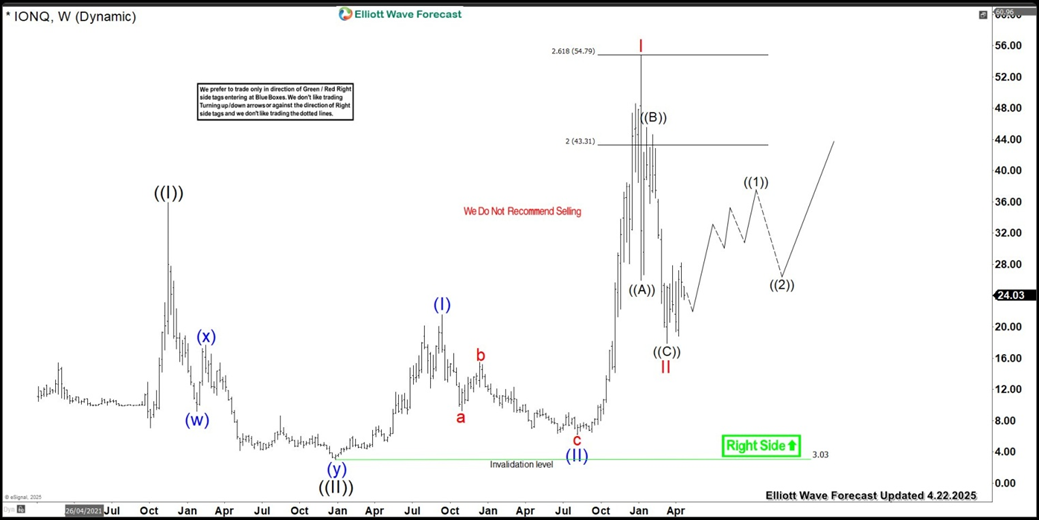
IONQ’s past update covered stock price action can be broken down as follows: The rally to $35.90 marked the end of wave ((I)), followed by a pullback that formed a double three structure. This pullback consisted of wave (w) ending at $9.16. A bounce in wave (x) to $17.66, and wave (y) concluding at $3.03.

Subsequently, the stock entered an impulse sequence, with wave (I) peaking at $21.60 and wave (II) correcting to $6.22. A strong rally ensued, culminating in wave I at $54.74, followed by a 3-wave pullback in wave II. This pullback unfolded as a zigzag correction: wave ((A)) ended at $25.92, wave ((B)) bounced to $45.56, and wave ((C)) concluded at $17.88.

IONQ Latest Elliott Wave Chart From 9.15.2025
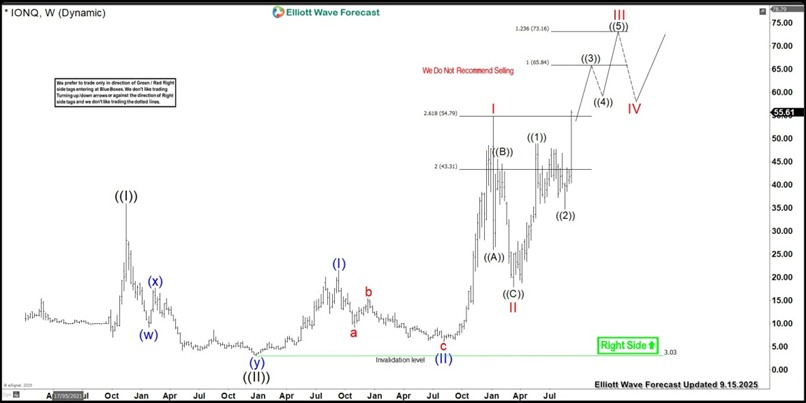
Since then, IONQ has surged to new all-time highs, indicating potential for further growth towards the $65.84-$73.16 range. Until this target is reached, dips are expected to remain supported within 3, 7, or 11 swings. Based on this analysis, selling is not recommended.

Author

Elliott Wave Forecast Team

Elliott Wave Forecast Team

ElliottWave-Forecast.com

More from Elliott Wave Forecast Team
Share:

Editor's Picks

GBP/USD edges lower below 1.3650, with eyes on US PCE data

GBP/USD trades with a negative bias below 1.3650 in the European session on Wednesday, eroding a part of the previous day's strong gains. The pair, however, remains within striking distance of a six-month top, set last Friday, as traders keenly await the release of the US Personal Consumption Expenditures (PCE) Price Index data for a fresh impetus.

EUR/USD holds lower ground near 1.1650 ahead of key US data

EUR/USD is holding lower ground toward 1.1650 in Wednesday's European session. The US Dollar is recovering modestly amid profit-taking and Middle East uncertainty. US inflation, tracked by the PCE, and another revision of Q2 GDP data should keep investors entertained on Wednesday.

Gold remains depressed below $4,650 on firmer USD; looks to US PCE for Fed rate outlook

Gold sticks to modest losses below $4,650 heading into the European session, though it lacks bearish conviction and remains confined within the previous day's broader range. The US Dollar regains positive traction amid some repositioning ahead of the US Personal Consumption Expenditures Price Index and is seen as weighing on the commodity. Adding to this, Federal Reserve Chair Kevin Warsh's remarks at the Jackson Hole Symposium on Friday might offer more cues about the interest rate path.

Dogecoin, Shiba Inu, Pepe: Profit-taking cools last week’s rally

Meme coins, including Dogecoin (DOGE), Shiba Inu (SHIB), and Pepe (PEPE), are losing their bullish momentum after last week’s double-digit gains. Facing downside pressure amid profit-taking, DOGE and PEPE risk further decline while SHIB holds at a support level.

US core PCE inflation set to keep pressure on the Federal Reserve to hike interest rates

The United States Bureau of Economic Analysis is expected to publish the Personal Consumption Expenditures (PCE) Price Index data for July on Wednesday, at 12:30 GMT. PCE inflation data for July is expected to reveal that price pressures remain high, well above the Fed’s 2% target.

Canada hits US goods with tariffs; The rate market sees a problem
On September 8, Canada begins charging its own importers 15%, 25% and 50% on roughly 700 lines of American goods. The measure is billed as dollar for dollar, and on the arithmetic of covered trade it is. What it is not is a tax on the United States.
















