Intel sheds 4% as announces $15 billion equity raise
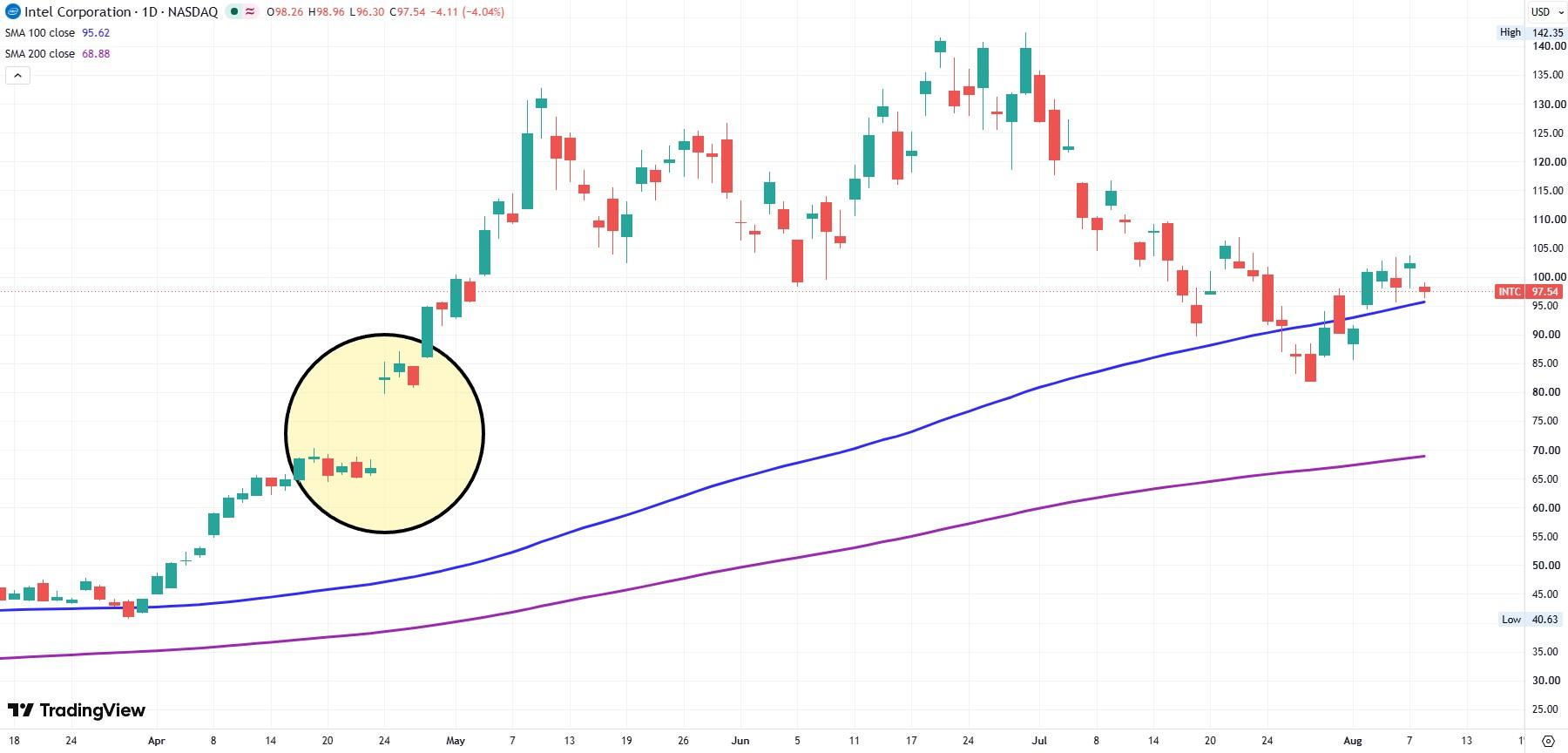
- Intel stock looks poised to close the gap at $70 created in April.
- Intel seeks to invest in AI compute, advanced semiconductor packaging, external wafers and physical AI.

Intel (INTC), the once dead-money legacy chipmaker that has transformed on the promise of AI demand into a full-stack competitor, sinks more than 4% on Monday after announcing an equity raise. Intel is looking to raise a minimum of $15 billion primarily for its AI buildout related to investment in AI compute, "physical AI, purpose-built silicon, advanced packaging and external wafers."
Intel called the capex plan a growth opportunity, and the public offering of common stock will allow underwriters Citigroup, Goldman Sachs and Morgan Stanley to purchase an additional $2.25 billion over the following 30-day period.
The wider stock market is mixed at present on Monday, with all three major indices remaining close to even. As the Strait of Hormuz remains shut, the price of Oil has risen over 3% to start the week.
Intel stock chart
INTC shares continue to offer a bearish profile after putting a new lower low on July 29. For now, Intel stock is using the crutch of the 100-day Simple Moving Average (SMA) as support, but there is plenty of evidence that it will break through in short order.
First, on a fundamental level, by selling stock Intel is expanding the universe of shares outstanding, which reduces future earnings per share (EPS). Then there's the fact that INTC already broke through the 100-day SMA in the past two weeks for the first time since March 30.
The Relative Strength Index (RSI), which isn't pictured on the daily chart below, sits near 47, demonstrating a slightly below-neutral momentum profile. More significantly, the gap up from April is yet to be closed, and it's basically an iron law of technical analysis that markets love to close gaps.
In order to close the gap from April, INTC needs to fall to $70 per share. Coincidentally, the 200-day SMA is trending right in the vicinity of $70, so a gap close would allow that moving average to support a pullback for Intel bulls to reinitiate the next leg of their longer-term uptrend.
Author

Clay Webster
FXStreet
Clay Webster grew up in the US outside Buffalo, New York and Lancaster, Pennsylvania. He began investing after college following the 2008 financial crisis.
















